Ranking #1 in Organic Isn’t Winning Sustainers Anymore

Last issue, we talked about how the conversion pixel is blind to your CRM—and cheerfully optimizes toward one-time gifts because the thank-you-page transaction is all it can see.
This issue: same disease, different organ.
Because there’s a second place where we in NFP digital keep measuring the wrong thing and then act surprised when the file won’t grow:
Search.
For 20 years, the game in Organic, or Paid, was simple. Rank #1. Win the click. Get the donor. Recently, Google changed the rules in the middle of the match. And almost nobody in our sector has noticed – yet.
But before I show you what broke, I have to define my terms.
What this article covers–and what it doesn’t
This article is about exactly 4 things:
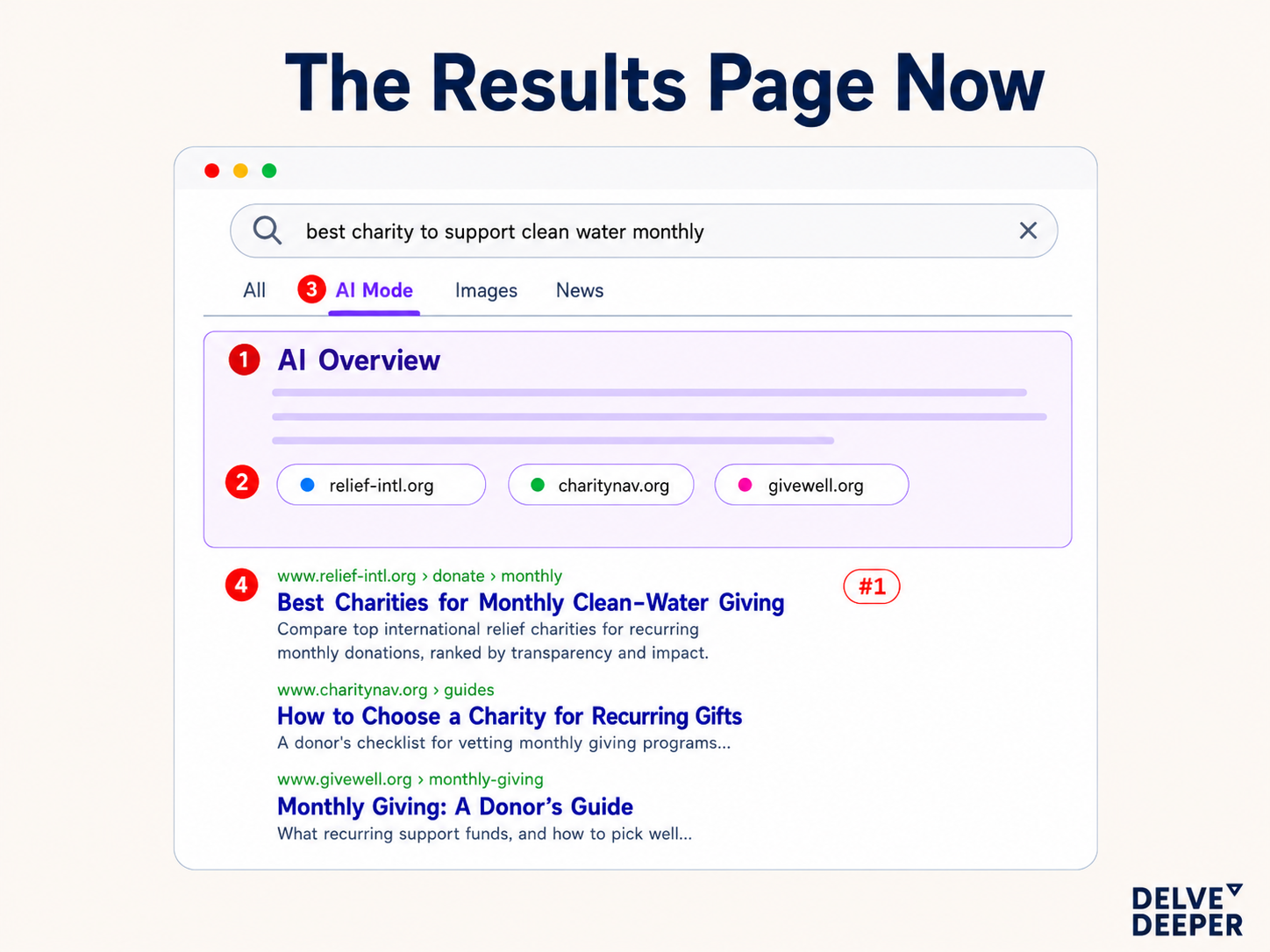
- AI Overview — the AI-written answer Google now drops on top of links. It summarizes the web and names a few sources. Powered by Gemini, but it’s part of Search.
- Citation — being named as one of those sources inside the AI answer. Here’s the mental shift that matters most: a citation is a yes / no, not a rank. You’re in the answer, or you’re invisible. There is no “AI #1.”
- AI Mode — the conversational tab inside Google. You ask, then ask follow-ups, and it builds an answer across several searches. Cites sources, same as Overviews.
- Classic organic result — the ten blue links. The unpaid listings Google has shown for 20 years.
What Is NOT covered by this article:
This article is about Google Search—not the standalone Gemini app or assistants such as ChatGPT, Claude, Copilot and Perplexity. Google’s Core Update does not move those systems, although the same underlying content work can improve your odds across all of them. Hold that thought.
Two more terms I want to clarify: GEO (or AEO) is the fashionable name for getting cited in AI answers. E-E-A-T is Google’s shorthand for Experience, Expertise, Authoritativeness and Trust—the qualities that make a source credible enough to quote.
Ok, now that we’re speaking the same language — here’s what just broke.
Sustainers aren’t won on the donate page. They’re won during the research.
Sustainers don’t set up a recurring monthly gift on impulse.
A one-time emergency gift? Sure – someone sees a flood, a famine, a heartbreaking ad, and they give $37 in ninety seconds. Beautiful. (Also seems like a one-night stand, right?)
A sustainer is different. A sustainer is a marriage. And before anyone marries you, they do their homework.
They ask questions: “Is this charity legit?” “How much $ actually reaches the cause?” “Which org should I give to every month if I care about clean water / refugees / kids?”
That research — the trust-building, due-diligence, am-I-going-to-commit-to-these-people phase — is where sustainers are actually born.
And here’s the thing that should grab you by the collar: that entire research moment has quietly moved inside the AI answer.
Google just cut the wire between ranking and being cited
In May 2026, Google rolled out a Core Update, right on the heels of rebuilding Search itself around AI. AI Overviews and AI Mode now sit on top of, or instead of, the ten blue links for a huge share of the exact informational, “help-me-decide” queries your future sustainers are typing.
Two things happened at once.
- Yup, the click is disappearing. When an AI answer shows up, the click-through rate on the #1 organic result drops. One recent Ahrefs study found that AI Overviews were associated with a 58% lower average click-through rate for the top-ranking page. The answer gets served. The visit to your landing page? Don’t count on it.
- Ranking and citation have come apart. This is the part nobody’s talking about. Not long ago, the pages cited inside AI answers were mostly the same pages already ranking in the top ten. That overlap has collapsed to somewhere around a third or less.
You now can BOTH:
- Rank #1 in Organic, for “best international rescue charity to donate to monthly”
AND
- Be nowhere in the AI answer that now sits above your link.
Stop chasing the ranking. Start earning the citation.
So what do you actually do?
There is no magic AI-citation hack. Google has said it out loud: the signals that earn an AI citation are the same signals that earned a good ranking — just with the bar raised. So no, you don’t need some shady GEO trick someone’s trying to sell you.
You and your nonprofit need to be demonstrably the most trustworthy, original, useful answer to the question that a future sustainer is asking … right now.
For a charity, that actually turns out to be a real advantage, because you’re sitting on the one thing an AI can’t generate by itself: the truth about your work.
Publish what only you have. Original mission data. Real beneficiary outcomes. Honest, specific impact numbers. The percentage that reaches programs, with the receipts. An AI can summarize a generic “About Our Impact” page in its sleep — and that page will not survive the summary. Your proprietary, first-hand evidence will.
Answer the trust question directly, and early. “Is [your org] a good charity to give to monthly?” should be answered, in plain language, near the top of a real page on your site — not buried, not vague, not marketing mush.
Put credentialed humans on it. Named authors. Real expertise. The same E-E-A-T signals that win rankings are what get you quoted in the answer.
Build the brand people already trust. Google’s new AI features now lean toward sources a person already follows and pays attention to — loyalty is becoming a discoverability signal. For us, that means your existing supporters and your reputation literally feed your visibility. Sound familiar? It’s the sustainer flywheel, showing up in the algorithm.
Measure the second scoreboard. Google just shipped AI performance reporting inside Search Console. Use it. Stop looking only at rank and clicks. Start tracking whether you’re cited on the queries that produce sustainers. You can’t grow what you refuse to look at.
And remember that “ONE THING” I told you to hold onto? All these things improve your odds of being cited in ChatGPT, Claude, Copilot and Perplexity. You do not optimize five times for five engines. You do the real work once.
(BTW, my team has been chewing on this shift for the last year, and it’s why we keep pushing clients away from publishing more blog posts and toward publishing the one thing no one else can. The agencies still selling keyword volume in 2026 are going to have a rough couple of years.)
The metric that compounds — just like your sustainer file
Close this loop and something genuinely exciting happens.
You STOP fighting for a ranking that no longer recruits anyone, and you START becoming the charity the AI recommends by name — at the considered, high-trust moment that creates sustainers (instead of one-night-stands– I mean, gifts!).
And this compounds.
The more trusted and cited you are, the more ready-to-commit donors find you while they’re deciding. More commit, more authority. More authority, more citations. Round and round—just like lifetime value across a healthy sustainer file.
That’s the real prize here. Not “winning SEO,” but showing up, trusted, in the room where the marriage decision gets made.
The donors who become sustainers are out there, doing their homework right now. The only question is whether the answer they’re reading mentions you.
Make sure it does. 🙂
Get the must-read newsletter for digital fundraisers.
Written by Delve Deeper team members in the thick of the work, the newsletter explores practical solutions for challenges like disconnected data, weak segmentation, lack of personalization, and inefficient media.