Point digital media funds at new-to-file and sustainers

The algorithms inside Google Ads, Meta, and DV360 are extraordinary at exactly one thing:
Finding more humans who look like the ones who already converted!
This is like telling Google Ads:
“Here is one single donor who gave $40 as an emergency gift—now go fetch me more people poised to make a single $40 emergency gift.”
This is great when there are emergencies. But we don’t want emergencies. They’re bad.
We want evergreen donors.
More specifically, we want new-to-file sustainers. These are people who weren’t in the CRM yesterday and who set up a regular monthly gift today.
New-to-file grows the file. Sustainer status is where the lifetime value lives. A new-to-file sustainer does both at once.
And yet, most of us in nonprofit digital fundraising have spent years optimizing for revenue or RoAS, and then … we are quietly wondering why the file isn’t getting healthier.
The answer isn’t that the online media buying machine is broken.
THE MEDIA BUYING MACHINE IS BRILLIANT.
We just pointed it at the wrong donor.
WHAT YOU ACTUALLY WANT VS. WHAT THE TRACKING PIXEL CAN SEE
Nobody running a digital program in 2026 wants more one-and-done donors.
Tell me if you disagree.
The conversion pixel fires on the thank-you page. Meta, Google Ads, or DV360 sees one transaction—the gift that happened the instant before someone hit DONATE.
That’s it.
The pixel does not see whether that person was already in your CRM. Or whether they’re still giving in month two, or month six. Or the difference between a Sustainer and someone who’ll never give again.
All of that—the stuff you actually care about—lives inside your CRM and surfaces weeks later.
THE PIXEL IS COMPLETELY BLIND TO IT.
It can’t optimize your media to acquire new-to-file sustainers.
THERE IS A FIX–AND IT’S OLD ENOUGH TO HAVE A MORTGAGE
Here’s the part that should make you a little annoyed: the solution to this problem has existed for a long time.
It’s called OFFLINE CONVERSIONS.
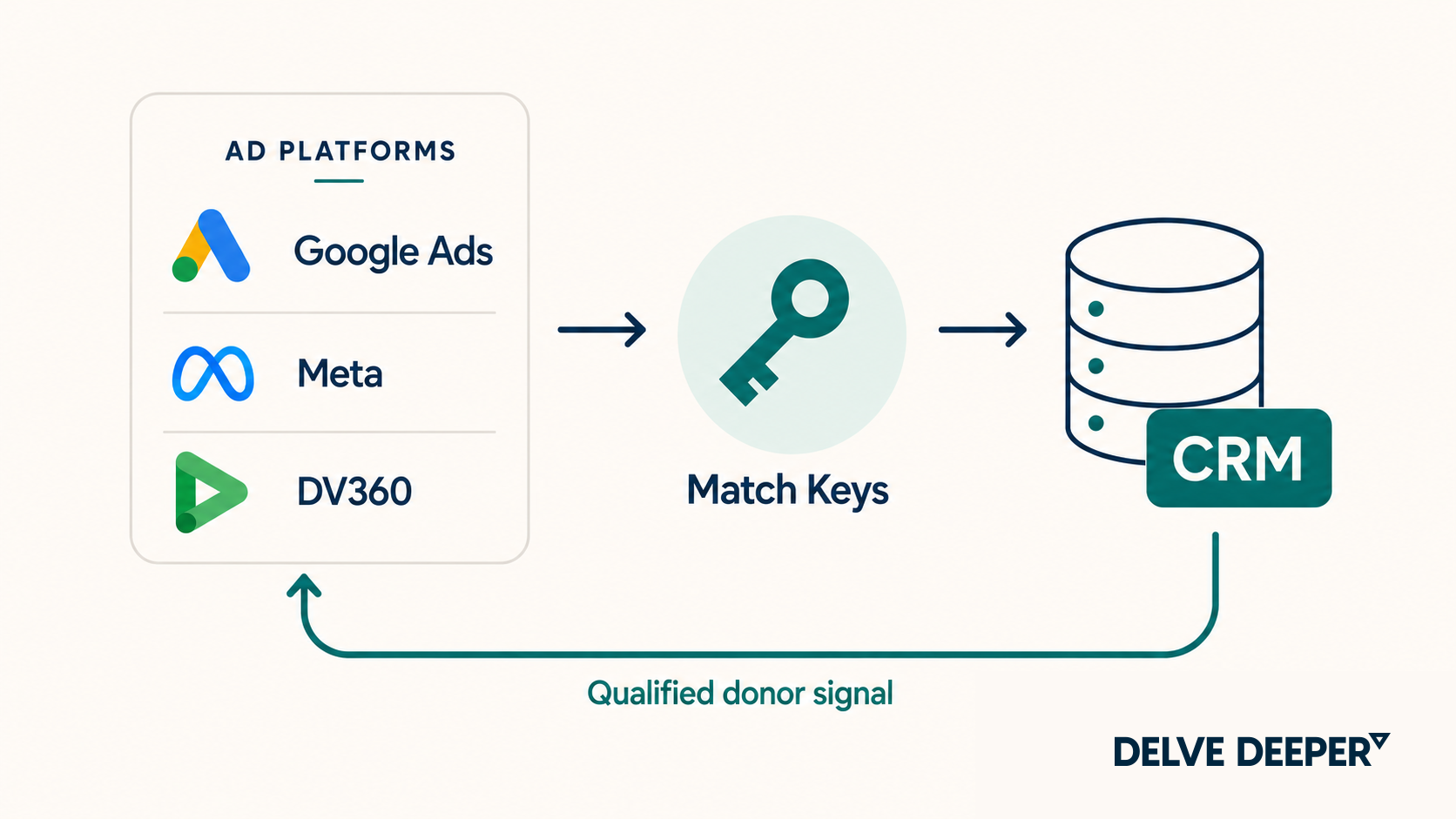
You stop letting the pixel define what a “conversion” is. Instead, you tell the platform the truth from inside your CRM: This donor, tied to this click, became a new-to-file sustainer who is still giving in month three.
Then the algorithm starts hunting for more people like that one.
You’re not changing the platform’s intelligence…
YOU’RE CHANGING ITS DEFINITION OF SUCCESS.
WHAT THIS ACTUALLY LOOKS LIKE IN 2026
(THE PART MOST “GUIDES” GET WRONG)
All three platforms have moved the furniture recently—and if you ask ChatGPT or Claude how to set this up, there’s a good chance it’ll cheerfully walk you through a system that stopped existing a year ago.
Google Ads: The legacy path relies on the Google Click ID, or GCLID. Google is now moving toward Enhanced Conversions for Leads and Data Manager, which can also use hashed first-party data such as email and phone.
Meta: Forget “Offline Events.” CRM, web, app and offline activity now flows through the Conversions API, or CAPI, using first-party match keys such as hashed email and phone.
DV360: Programmatic still runs through Floodlight, the DoubleClick Click ID, or DCLID, and Campaign Manager 360.
Different plumbing…
IDENTICAL PRINCIPLE.
Take what your CRM knows and what the platform can’t see, and hand it back as the signal the algorithm optimizes toward.
THE UNGLAMOROUS TRUTH ABOUT THE UNGLAMOROUS PLUMBING
Setting up the conversion action is the easy task.
The real work—the reason most charities never do this—is upstream.
To feed a clean signal back, your media data and CRM data need reliable match keys and a place where they can be joined.
And yes, in practice that often means landing both in a cloud warehouse—BigQuery, Snowflake, something—joining click IDs and hashed emails to donor records, watching the CRM for the moment someone becomes a Sustainer, and piping that event back out to the platforms.
Yes, it’s data engineering, not media buying.
BUT PLEASE. DO BUDGET FOR THIS.
Roughly:
- Decide what “good” means.
- Capture the keys on the way in.
- Land everything in one place.
- Watch the CRM, not the pixel.
- Send the truth back.
- Re-point the bidding.
Be specific. The algorithm is just a machine.
(Btw, even though I’m the CEO and the Founder, I get this because I used to be a data scientist coding SAS. Other awesome geeks at our agency are data engineers and data scientists, too!)
THE PAYOFF
(AND THE CONVERSATION IT UNLOCKS IN YOUR ORGANIZATION)
Once the loop is closed, you STOP reporting only ROAS and Revenue from one-time gifts and START reporting something far more useful:
COST PER ACQUISITION OF A NEW-TO-FILE SUSTAINER
A real CPA, for the exact donor you want, that the algorithm is now actively chasing.
Yup. This is what gets me excited!
For years, digital has been judged on RoAS while face-to-face and direct mail get judged on cost-to-recruit-a-Sustainer. Different yardsticks.
Close this loop and you finally get a like-for-like number that lets digital sit next to F2F and DM on the same line of the same spreadsheet.
I told you this is exciting!
The donors you want are out there. The machine is more than capable of finding them.
You just have to stop telling it that the thank-you page is what matters 🙂
Get the must-read newsletter for digital fundraisers.
Written by Delve Deeper team members in the thick of the work, the newsletter explores practical solutions for challenges like disconnected data, weak segmentation, lack of personalization, and inefficient media.