
If you run multiple YouTube line items within the same insertion order, there is a good chance some of your budget has been spent reaching the same person twice. Not because of a targeting mistake. Because of how DV360 has always worked: each line item optimizing independently, with no awareness of what the others are doing, no coordination about who has already been reached.
The result is predictable and expensive. Overlapping exposures across line items, reduced unique reach, and a frequency problem that hard caps can only partially solve, and only by creating a different problem in return.
Google has now launched IO-level Reach and Frequency Optimization for YouTube. It is live. And for anyone running brand campaigns across multiple YouTube formats, it closes a gap that has existed since multi-format buying became standard practice.
What the feature does
There are two modes and they solve related but distinct problems.
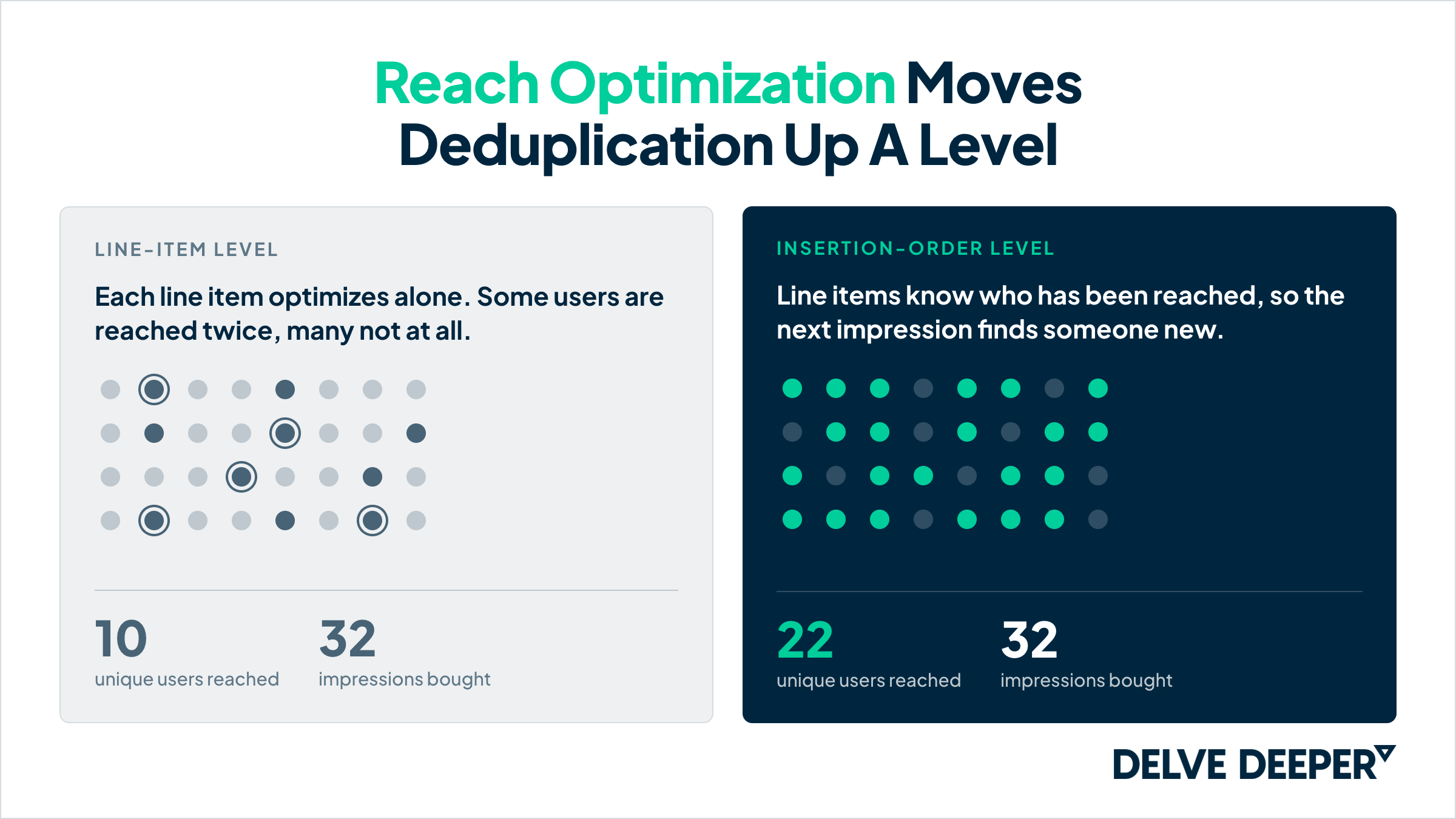
Reach optimization shifts deduplicated reach management from the individual line item level to the insertion order level. When a user has already been reached by one line item, the other line items within the same IO will try to find a different user instead. Google’s own example: if user A is reached by a video view line item, the efficient reach line item serves user B rather than user A again. Incremental reach goes up. Wasted impressions on people who have already been touched go down.
Frequency optimization allows multiple line items across different ad formats, including bumpers, skippable in-stream, in-feed, and Shorts, and across different line item types including efficient reach and non-skippable reach, to optimize together toward a single IO-level target frequency. Each line item keeps its own budget. But frequency is managed holistically rather than through isolated caps. The weekly goal must be set between 2 and 7.
Why this matters more than it sounds
The siloed optimization problem is not theoretical. A bumper campaign and an efficient reach campaign running simultaneously within the same IO have historically had no way to coordinate. Someone in your target audience could see both, consuming budget from two line items, while someone else in the same audience sees neither. You are paying for frequency you did not plan and missing reach you paid for.
Hard frequency caps at the line item level have been the standard workaround. They are better than nothing. They are also a blunt instrument with a known failure mode: when the cap is hit, the line item stops serving regardless of remaining budget, which leads to underspend and gaps in delivery.
Optimizing toward a frequency goal at the IO level is different in kind, not just degree. Instead of placing a ceiling and hoping the budget clears, the system pursues the frequency target actively across the whole insertion order, adjusting in real time based on who has been reached and who has not. The budgets stay separate. The optimization does not.
For brand campaigns where reach and frequency are the primary objectives and the metrics that get reported back to clients, this is a more accurate expression of what the campaign is actually trying to do.
What to check before activating
Before turning this on, review which YouTube line items within your insertion orders are currently managing reach or frequency independently. The reach optimization mode works best when you have a mix of line item types within the same IO targeting overlapping audiences. The frequency optimization mode requires a clear view of what IO-level weekly frequency you are actually trying to hit before you set the goal.
Neither mode requires restructuring how budgets are allocated across line items. What changes is how impressions are distributed within those budgets. That is a meaningful change and worth verifying before assuming the current split still makes sense once IO-level optimization is doing the coordination work.
Get the must-read newsletter for digital fundraisers.
Written by Delve Deeper team members in the thick of the work, the newsletter explores practical solutions for challenges like disconnected data, weak segmentation, lack of personalization, and inefficient media.