
| If you’re a digital fundraiser trying to figure out where to spend your next media dollar, the move seems clear: find your best donors and spend more against them.
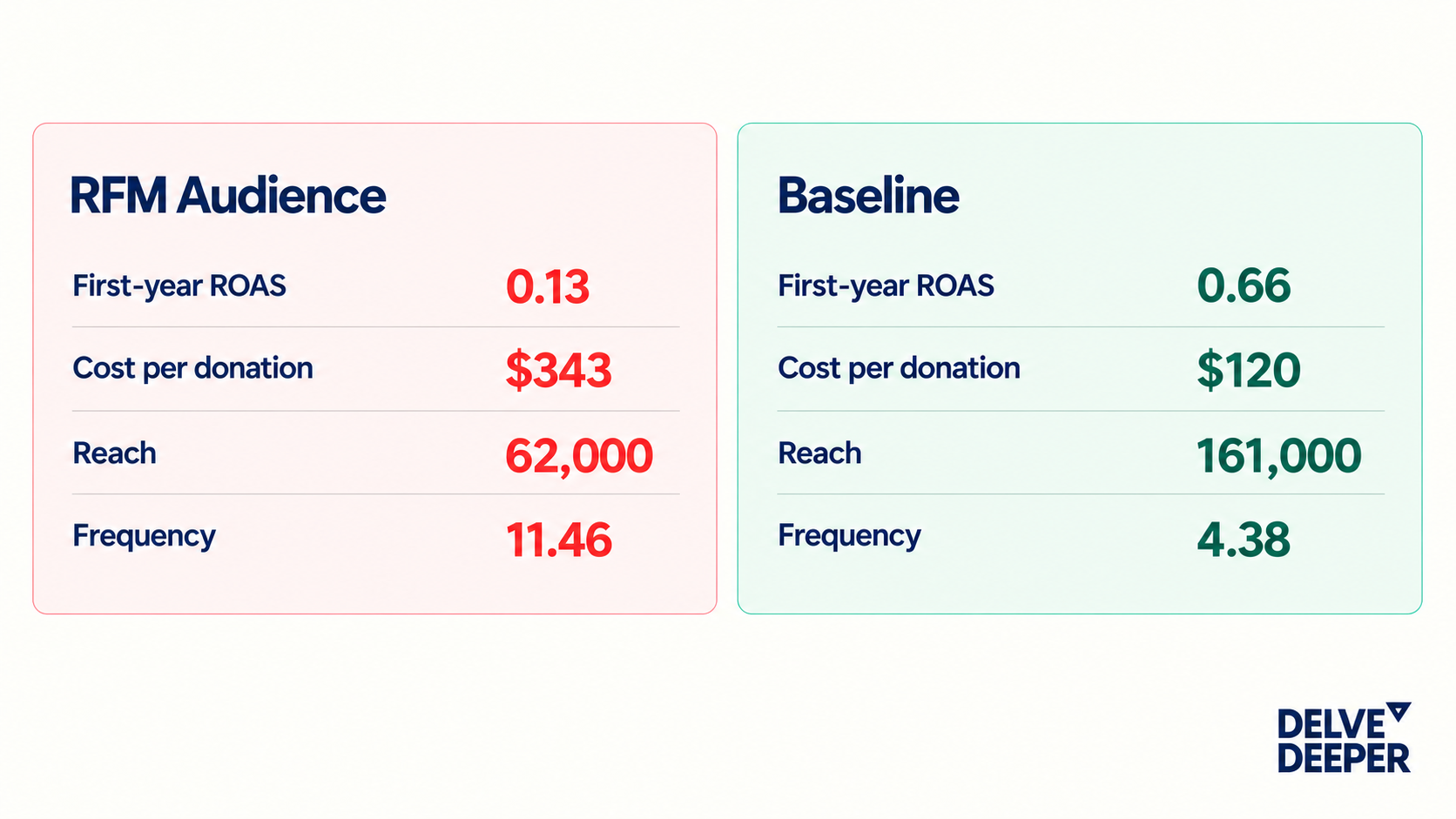
After all, they’ve probably given recently, often, and more. Exactly what you want. It seems obvious. But we like testing things that seem obvious. So we took strong donor segments based on recency, frequency, and monetary value — RFM — and concentrated more paid media investment against them. The hypothesis was that they should be a stronger paid media audience. The numbers said otherwise. The RFM audience generated a 0.13 first-year ROAS, compared with 0.66 for the baseline. Cost per donation was about $343, versus roughly $120. The RFM campaign reached about 62,000 people at a frequency of 11.46. The baseline reached more than 161,000 people at a frequency of 4.38. Did RFM fail? Nope. RFM does the job it does, not the one we wanted it to do. It didn’t answer the question we asked it: where should the next media dollar go? Fundraisers have used RFM for years to understand which donors look most valuable based on what they have already done: who gave recently, who gave often, and who gave more. But everything around RFM has changed. Paid media platforms are more automated. Acquisition is more expensive. Audience signals are easier to upload, match, suppress, model, and activate. So a donor segment that used to help us understand the file can quickly become a media budget decision. That’s where the risk comes in. Knowing who has been valuable is not the same as knowing who deserves the next paid impression.
PRECISION CAN TURN INTO REPETITION.The number that bothered me most from the results above was not the ROAS. It was frequency: 11.46. The original RFM audience contained roughly 359,000 people, but after about a month, the campaign had reached only around 62,000. We had made the audience more precise. But precision didn’t create more opportunity. It had created more repetition. Inside the ad platform, that can look perfectly reasonable. The algorithm found the people we told it were valuable and kept reaching them. From the donor’s side, the experience can look… not great. Someone who has donated five or six times is not just a high-value record. They are someone who has already said yes five or six times. At some point, another paid impression stops being better targeting and starts becoming more pressure on someone who is already supporting you. Maybe it’s right. Maybe it’s wrong. But it should be a choice. THE NEXT DOLLAR IS THE REAL QUESTION.The real decision about where to spend the next dollar comes from the combination of: Audience + Intent + Message + Channel + Goal A recently lapsed donor represents one job. A loyal donor who has already given six times represents another. A prospect who has never heard of the organization represents another one entirely. One dollar cannot do all of those jobs at once. Audience First makes the tradeoff visible. Instead of asking, “Which audience looks most valuable?” we can ask something more useful: What relationship do we have with this person right now? What are we asking them to do? What message fits that moment? Which channel makes sense? And is this still the best place for the next dollar? Marketers have a tendency to build an audience and then feel obligated to activate it. But not every audience we can build deserves media dollars. Sometimes the right investment is zero. Audience First gives us room to think about what we need to create next. That matters in acquisition. If every dollar moves toward people who already look valuable, we can build a very efficient-looking loop around the existing donor base. The numbers may feel comfortable, but we may not actually be growing. Retargeting is largely working with demand we already have. Prospecting helps create the audience we will need later. If we judge both only on immediate ROAS or cost per donation, retargeting will often win. That does not mean it deserves every incremental dollar. None of this means we should stop using RFM. We just can’t ask it to do everything. RFM helps us understand what someone has done. Audience First helps us decide what the media should do next. |
Get the must-read newsletter for digital fundraisers.
Written by Delve Deeper team members in the thick of the work, the newsletter explores practical solutions for challenges like disconnected data, weak segmentation, lack of personalization, and inefficient media.