
Digital is the fastest, cheapest way to bring in a new-to-file sustainer. And at the same time, most organizations are convinced digital “doesn’t drive sustainers.” I have two hypotheses as to why:
- Nobody knows what a digital sustainer costs, because your P&L speaks two languages: cost is seen by channel, while revenue is seen by audience. We invest money in Paid Search or Paid Social – but it’s Sustainers or Mid-Level Donors that donate.
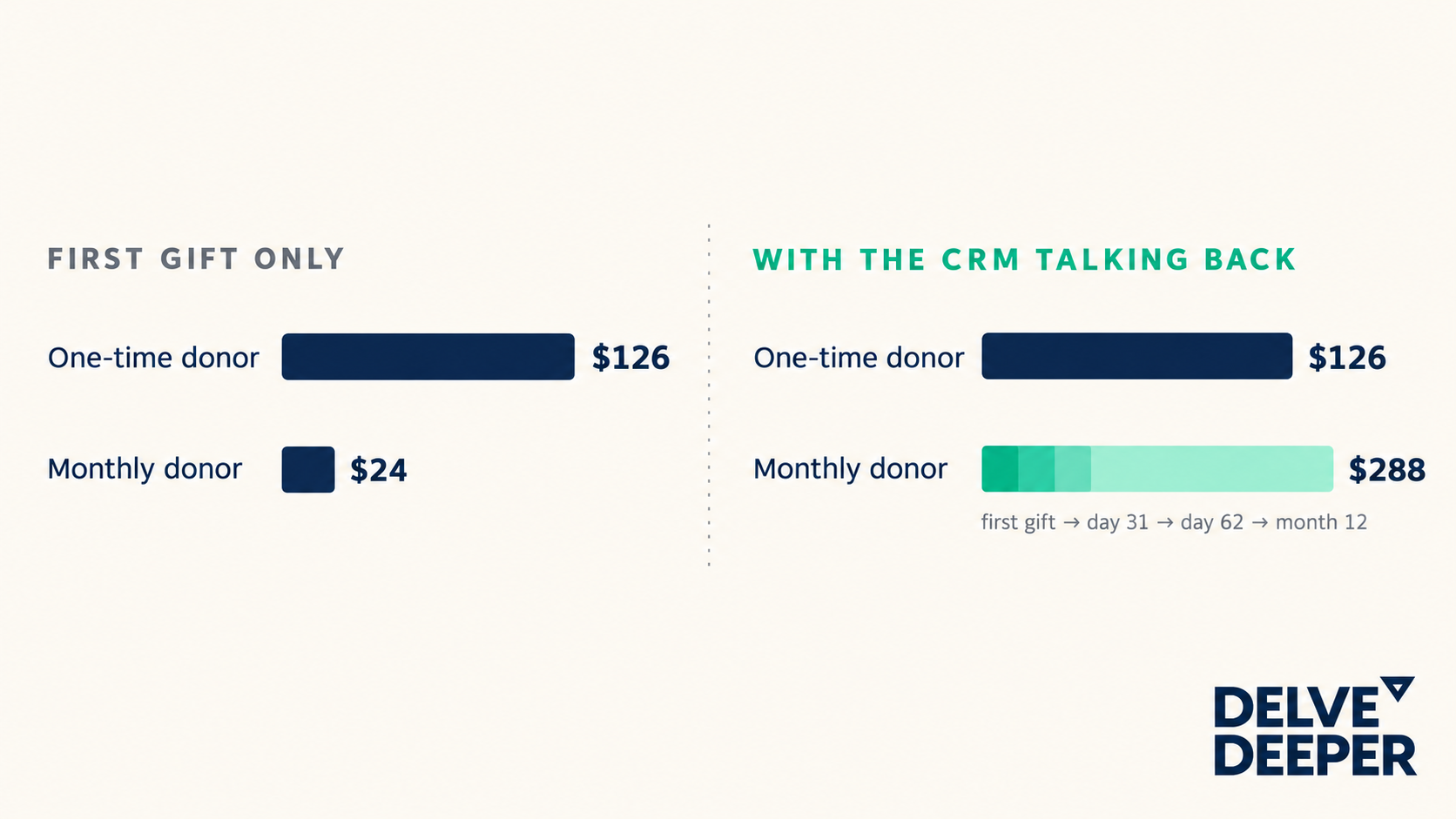
- Nobody manages the channels to the cost per sustainer. Performance Max and Advantage+ are told to chase immediate revenue, and a $126 one-time gift beats a $24 first monthly gift every time. So…the algorithm learns to avoid sustainers!
And three proven tactics I used to fix this gap:
- Give every dollar one job – don’t be happy for a $1,000 existing donor gift that a prospecting campaign has driven.
- Integrate the CRM talking to the media platforms,
- Ask your agency to run the account like an actively-managed stock portfolio.
Most agencies won’t tell you this because these steps add accountability…and who likes more accountability? 🙂
On stage at Bridge this summer, a VP of Individual Giving at one of the largest organizations that co-presented with me told the room she doesn’t need magic from an agency. She needs certainty.
“If you cannot tell me the cost of my next sustainer, you are not managing my money. You are spending it.”
I totally agree. Let’s break it down.
1. Nobody knows what a digital sustainer costs.
Say you put $1 million into a paid search and get 10,000 donors back. The usual 20% of them, 2,000 people, sign up to give monthly.
What did a sustainer cost you?
- Is it $1M divided by 2,000? That’s $500, and it’s wrong. It punishes digital for the 8,000 one-time donors it also brought in, as if they were worth nothing. They weren’t.
- Is it $1M divided by 10,000? That’s $100, and that’s wrong too. We all know a sustainer costs more to acquire than a one-time donor.
So what’s the real number?
Most organizations don’t know. And neither does an agency that’s managing your media. Furthermore, neither do I. This question can’t be answered after the fact.
Canvassing is simple since all conversions are sustainers. Take the total investment, divide by total conversions – voila. Digital is harder because the cost and revenue don’t match:
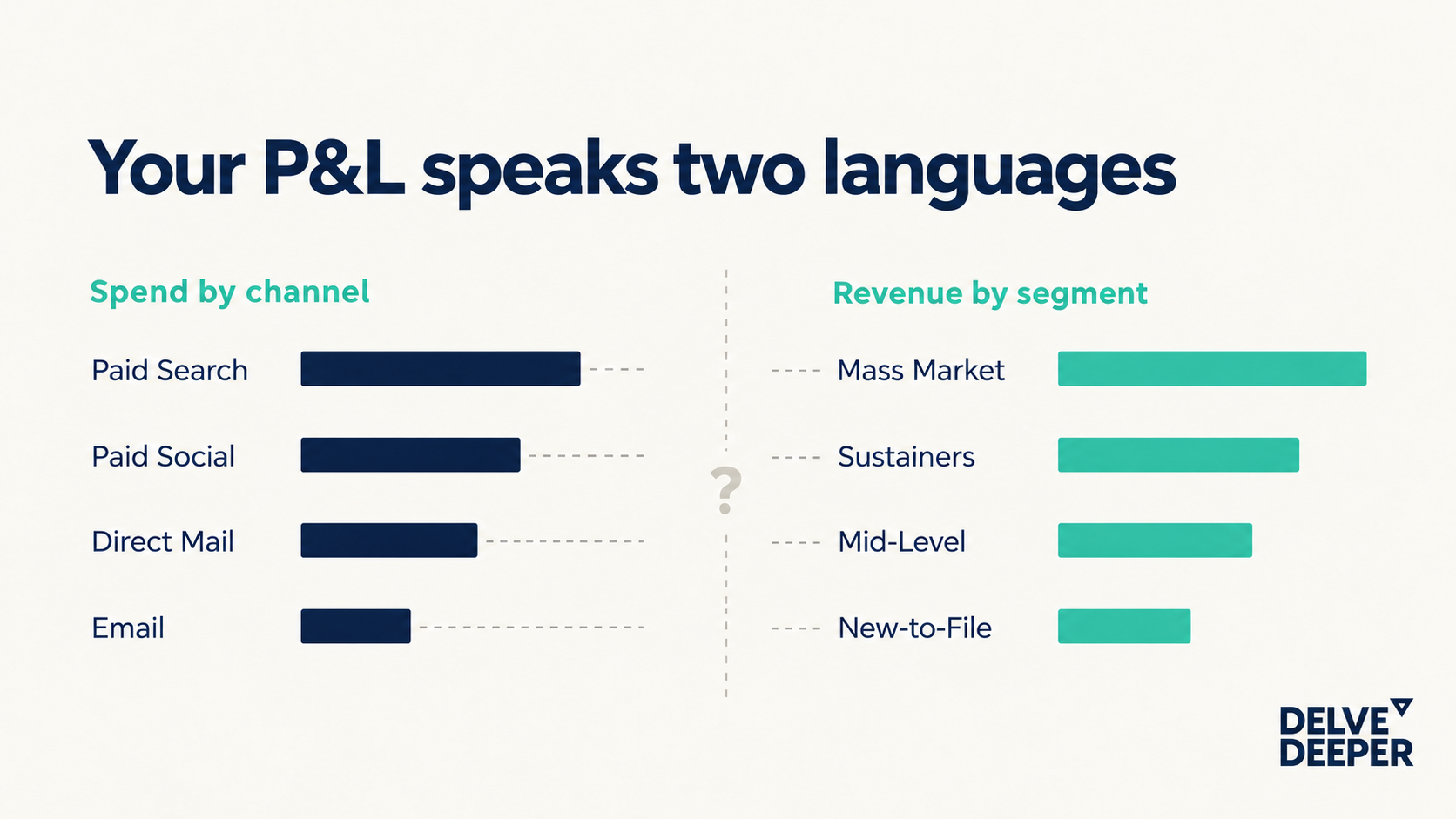
Your P&L speaks two languages:
- Cost lives in channels: paid search, paid social, direct mail, email.
- Revenue lives in audiences: mass market, sustainers, mid-level, new-to-file.
A common way to resolve it is to report revenue by channel, but it never really works, because channels don’t pay. Donors pay. So instead of splitting revenue by channel, we need to split cost by audience.
Every dollar has ONE job. This pot of money is for acquiring sustainers. That pot is for one-time donors. A third is for moving mass donors up to mid-level.
That’s the whole mechanic and yet, it’s exponentially easier to say than to get it done. We agencies don’t like accountability – the minute one says, “these dollars are for acquiring sustainers,” one will be graded on it. It’s so much better to claim credit for all the revenue that happens.
2. Nobody manages channels to the cost per sustainer.
Performance Max and Advantage+ – tools that currently represent 70%+ of most accounts we audit – were built so marketers could spend less time marketing. They’re small-business tools that are great for a local business owner, but not enough – and never designed – for an enterprise fundraising team with multiple audiences, ambitious growth goals, and a complex CRM.
Most PMax and Adv+ campaigns I’ve seen drive good – but not good enough”- cost per sustainer, and that’s by design! Here is what’s going on:
- The average one-time online gift is about $126.
- The average first monthly gift is about $24.
- A monthly donor would have to give more than five times to match a single one-time gift.
- And the algorithm only ever “sees” the first gift!
The machine sees a $126 donation and a $24 donation, and it does exactly what you told it to – goes and finds more $126 donors.
In a way, most campaigns I’ve seen are trained to avoid sustainers.
The fix is offline conversions. It’s a terrible name because there’s nothing offline about it. It’s the CRM integration back to Google and Meta. But the feature was built a decade ago so retailers could send in-store purchases back into their online ad accounts, and the name stuck.
Here’s how they use it:
- Send one conversion, that $24, back to the Google Ads and Meta at the first donation,
- Another $24 when the first renewal lands,
- Another $24 at the second, and so on.
As a result, the algorithm learns to optimize for LTV – those donors that stay for years to come.
Meta went further and built a feature called Qualified Trials (ask your agency if they are using it): don’t count the signup at all until the person has stayed a set number of days without canceling. I recommend 62, to align Digital with Canvassing.
And then, there’s the part that gets me in trouble with the platform reps–Google doesn’t like when I recommend something against their best practices. With the right signal in place, we keep seeing plain old manual search beat Performance Max on cost per sustainer. Any day, every day – and not by a little.
Manual isn’t magic. Every day, stop the worst 5% of what’s running, scale the best 5%, start a fresh set of tests, and hold every single dollar to ONE target: cost per new-to-file sustainer.
We call that loop S³ (Stop, Scale, Start). It works for the same reason active management works anywhere – just as any successful VC beats the S&P 500, every ad agency should be beating PMax. Otherwise, what’s the value?
So why won’t your agency tell you any of this?
Agencies are set up to sell channels. They’re paid on media volume. They’re graded on last-click platform ROAS. They manage the Cost – and as we established, the Cost is in the Channel.
Most of us have never been given CRM access either. We can’t see the sustainer at day 62 even if we wanted to.
So the pitch your organization gets instead is “more”. More channels, more co-op data, more media. A CTV test. A DRTV spot. A leased SMS list.
Ask your agency for a cost per new-to-file sustainer, or at least a cost per new-to-file donor, by channel. If they can’t answer, ask: are they managing or spending your money?
What it looks like when we challenge it
One international animal welfare organization we work with went for this setup: one job per dollar, the CRM connected back to the platforms, a human running the account as a portfolio. In three months, they were getting 38% more new-to-file sustainers from the same budget. Cost per new sustainer went down from $960 to $346.
Ask your agency this week:
- What will my next sustainer cost?
- Will it cost more than canvassing?
- When do I break even?
Get the must-read newsletter for digital fundraisers.
Written by Delve Deeper team members in the thick of the work, the newsletter explores practical solutions for challenges like disconnected data, weak segmentation, lack of personalization, and inefficient media.