
Every year, nonprofit fundraising teams face a familiar challenge: budgets tighten, leadership looks for places to cut, and direct response is often one of the first areas under scrutiny.
The fundraising team understands what those cuts could mean for future revenue and donor growth. The harder part is making that impact clear to finance teams and leadership, especially when the immediate savings are easier to measure than the long-term cost.
As a digital media agency working with nonprofits, we’ve seen how these conversations play out. Here’s what we’ve learned.
Why nonprofit fundraising faces a unique challenge
Unlike many other business investments, fundraising spend is often evaluated through the lens of overhead rather than long-term growth.
Acquisition costs are visible in annual reports and financial statements, while the value of a newly acquired donor may take years to fully materialize. Leadership teams are often working within annual budgets, but donor relationships don’t follow the same timeline.
There’s also the question of unrestricted revenue. Direct response fundraising plays an important role in generating the flexible funding organizations need to support their missions, including programs and operational expenses that restricted grants may not cover.
When acquisition budgets are reduced, the consequences aren’t always immediately obvious. The impact may not become clear until future years, when fewer donors are available to renew, upgrade, or become sustainers.
The cut that looks like a saving
One of the biggest challenges with direct response is that new donors don’t always generate a positive return with their first gift.
The real value often comes over time, through repeat donations, monthly giving, and deeper engagement with the organization.
This creates a difficult dynamic during budget discussions. Cutting acquisition spend can produce immediate savings without an equally immediate drop in revenue.
But while short-term performance may appear stable, the organization is bringing fewer new donors into its pipeline. Over time, that smaller donor base can affect retention revenue, sustainer growth, and overall fundraising performance.
Rebuilding that pipeline isn’t as simple as turning campaigns back on. Organizations may need to reinvest in audience development, testing, and optimization before returning to previous acquisition levels.
The question isn’t just how much money a budget cut saves today. It’s how much future donor revenue the organization may be giving up in exchange.
Talk about revenue, not just metrics
Metrics like cost per acquisition (CPA) and return on ad spend (ROAS) are important for evaluating campaign performance. But they don’t always tell leadership what they really want to know: How is this investment contributing to the organization’s financial health?
That’s why fundraising teams need to connect marketing performance to outcomes that matter to finance and executive leadership.
For example, using illustrative numbers:
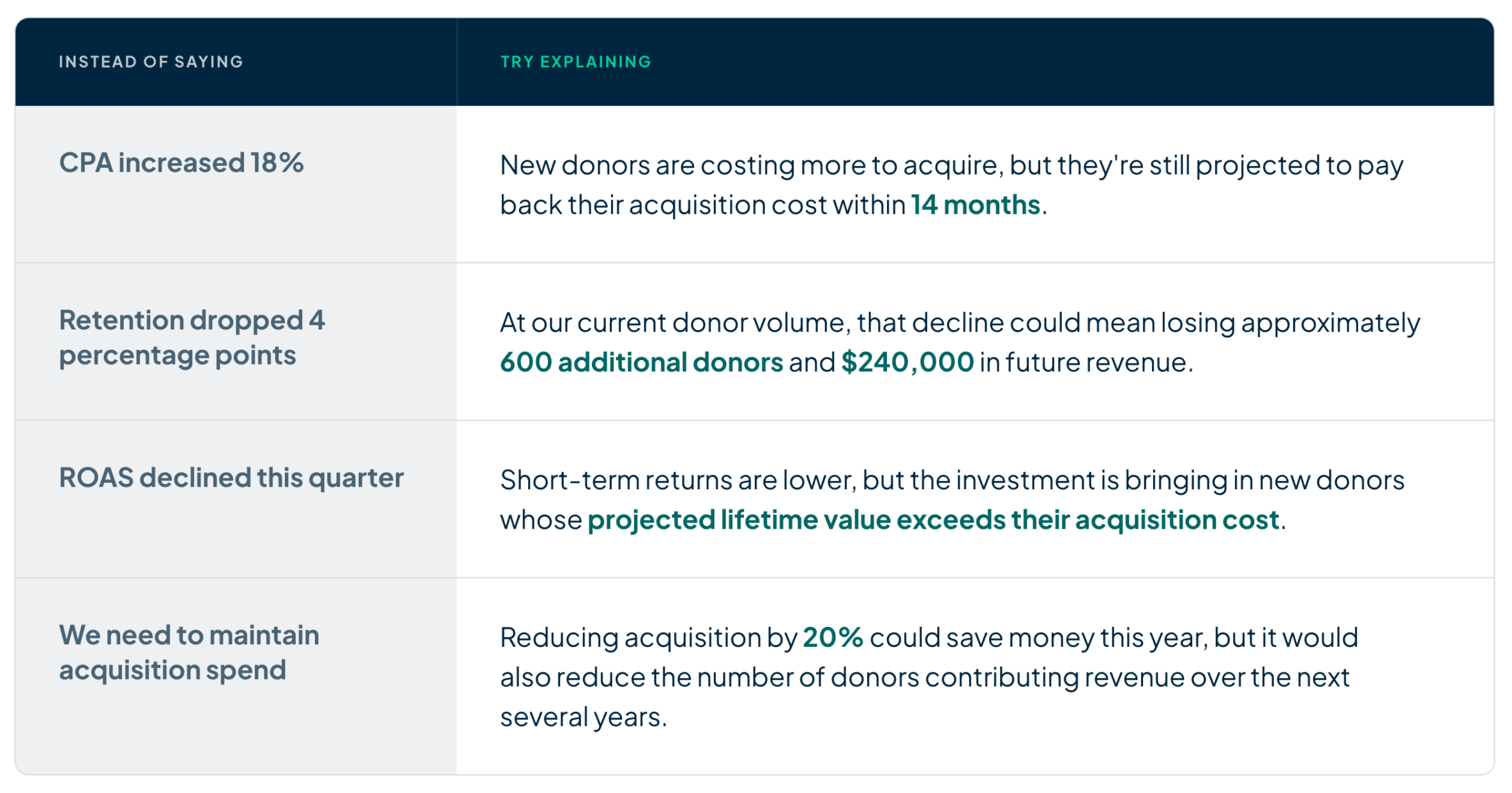
The goal isn’t to eliminate marketing metrics. It’s to translate them into financial outcomes that leadership can evaluate alongside other organizational investments.
Set expectations before budgets are on the table
Many difficult budget conversations start with a disconnect in expectations.
If leadership expects donor acquisition to break even within the first year, a campaign designed to generate value over several years may look unsuccessful before it’s had a chance to deliver.
Fundraising teams should establish realistic expectations around acquisition costs, donor retention, lifetime value, and payback periods before those investments are evaluated.
Rather than simply describing acquisition as a long-term investment, show what that means financially.
For example, if the organization expects to recover its acquisition costs within 18 months, explain how that projection was calculated and what needs to happen for it to hold true.
That gives finance teams a clearer framework for evaluating performance and helps avoid judging long-term investments entirely on short-term results.
Show what happens if you cut
One of the most effective ways to make the case for direct response is to show leadership what happens under different investment scenarios.
A simple three- to five-year forecast can compare maintaining current acquisition spend against reducing it.
The model should account for:
- New donor acquisition: How many fewer donors will enter the file if investment decreases?
- Donor retention: How many of those donors would have continued giving in future years?
- Lifetime value: What is the projected revenue contribution of those lost donors?
- Sustainer growth: How might reduced acquisition affect the pipeline of future monthly donors?
- Recovery costs: What additional investment might be needed to rebuild acquisition volume later?
The most important part is using the organization’s own historical data rather than relying on generic industry benchmarks.
What we think
Direct response isn’t always underperforming. Sometimes, its value simply isn’t being communicated in a way that resonates with the people making budget decisions.
For nonprofit fundraising teams, the opportunity is to move beyond defending campaign metrics and start demonstrating how acquisition investment contributes to long-term revenue, donor growth, and organizational sustainability.
If your organization is navigating these conversations, we’d love to help!
Get the must-read newsletter for digital fundraisers.
Written by Delve Deeper team members in the thick of the work, the newsletter explores practical solutions for challenges like disconnected data, weak segmentation, lack of personalization, and inefficient media.