
Every nonprofit has them: the one-time donor who’s opened your last twelve emails. The volunteer who’s engaged for three years but never gotten a personal ask. The donor who didn’t lapse loudly, they just quietly stopped clicking.
Your team knows these people exist. You just never had enough hours to do anything about it. That’s the real story of AI in fundraising, and most nonprofits are focused on the wrong benefit.
Everyone’s Talking About Speed. That’s Not the Opportunity.
Ask ten fundraising leaders what AI means for their organization and most will say some version of the same thing: faster appeals, faster campaigns, faster reporting. All true and useful, and all missing the bigger point.
The real opportunity is attention, and specifically, who gets it.
Fundraising has always run on scarce attention. Major donors get individualized outreach because they’re worth the time. Everyone else gets communications built to work reasonably well for thousands of people at once. That’s a rational response to limited capacity. But that constraint is disappearing, and most organizations haven’t caught up to what that means.
The Donors Already in Your Database Are the Opportunity
Most AI fundraising conversations focus on acquisition: better targeting, faster creative, predictive audiences. But the biggest opportunity is sitting in your CRM right now.
Supporters who gave once, who opened your emails, who attended an event years ago and never heard from you again in a way that reflected it. Your database has been quietly collecting signals about who these people are and what they care about. Almost none of it gets acted on, because acting on it at scale has never been possible for a team your size.
A one-time donor who keeps opening emails and consistently engages with a specific issue is telling you something. AI is what finally makes it possible to listen.
Attrition Doesn’t Announce Itself
Donors rarely email to say your last six communications missed the mark. They just open fewer emails. Then they stop clicking. By the time they’re officially “lapsed,” the relationship has been fading for months, unnoticed, while your team spends real budget acquiring new donors instead.
AI creates a way to catch that shift early and respond with something more relevant than the next scheduled email blast.
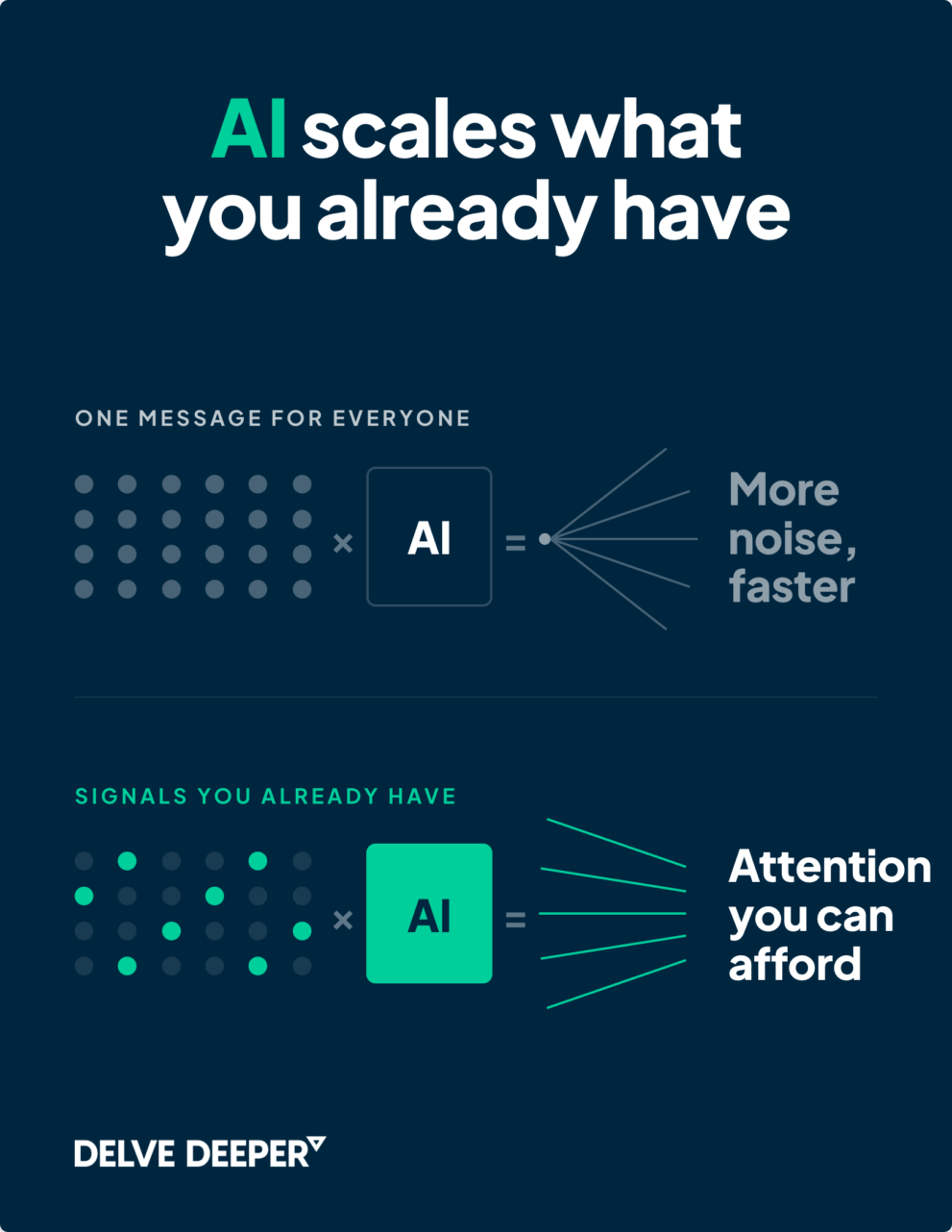
AI Doesn’t Fix a Bad Strategy. It Scales Whatever You Already Have.
Here’s the catch: making personalization easier doesn’t make it good. If your segmentation is weak, AI helps you send more irrelevant messages, faster. If you don’t know what you want a supporter to do next, ten versions of the same email change nothing.
The right question isn’t “what can we automate?” It’s “where would more attention actually build a better relationship?” Once you know that, AI makes the attention affordable.
What Nonprofits Should Do Right Now
Start with the donors sitting between your major gift prospects and your anonymous audience: first-time donors who haven’t converted to sustainers, repeat donors who never got personal outreach, lapsed donors whose drop-off went unnoticed, and highly engaged supporters who’ve never gotten a tailored ask.
Look at where your program treats meaningfully different people the same way. That’s where AI helps, not by writing faster, but by helping your team recognize differences that were always there and act on them at a scale you could never manage alone.
This Is What We Do
At Delve Deeper, we help nonprofits find these opportunities inside the relationships they already have, and build the digital fundraising strategy to act on them. Not more content, faster. More relevant fundraising, at scale.
Reach out to learn how Delve Deeper can help your organization put AI to work on the donors you already have.
Get the must-read newsletter for digital fundraisers.
Written by Delve Deeper team members in the thick of the work, the newsletter explores practical solutions for challenges like disconnected data, weak segmentation, lack of personalization, and inefficient media.