
First-party donor data is the information your organization collects directly from supporters, and it is one of the most useful inputs for improving digital advertising, finding new donors, and measuring what is working. With Giving Tuesday on December 1 and year-end giving underway, this guide answers 14 common questions about how nonprofit marketers can put that data to work, including what to check in the next 30 days.
Key Takeaways
- First-party donor data comes from your own relationships with supporters, and its value depends on how you use it, not how much you collect.
- Customer Match and offline conversions are two practical ways to connect donor data to Google Ads, Meta, and Display & Video 360 (DV360).
- Measure acquisition with cost per donation and return on ad spend (RoAS), then check retention and lifetime value to see whether those donors stay.
- Sustainers can be worth around 7.5 times more over their lifetime than one-time donors, so the strongest programs track cost per sustainer, not just cost per donation.
- Consent, platform policies, and data quality should be settled before any donor data is activated.
Glossary
Cost per donation: Advertising spend divided by the number of donations attributed to it. Sometimes abbreviated CPD.
Cost per sustainer: Advertising spend divided by the number of new monthly donors acquired.
Connected TV (CTV): Streaming television delivered over the internet, such as apps on smart TVs.
Customer Match: A Google Ads feature that lets you upload customer information, such as email addresses, to reach or exclude those people in your campaigns.
Data activation: Using donor data to inform audience targeting, messaging, and measurement instead of keeping it only for reporting.
Donor lifetime value (LTV): The estimated total amount a donor will give over the course of their relationship with your organization.
Donor retention rate: The percentage of donors who continue to give over a defined period.
First-party data: Information an organization collects directly from its own supporters through its own channels.
Modeled audience expansion: Using a platform’s modeling to find new people who resemble a group you already know, such as your current donors.
New to file (NTF): A donor who has never given to your organization before.
Non-Brand Search: Search ads shown for general cause or topic searches that do not include your organization’s name.
Offline conversions: Results that happen outside the ad platform, such as a donor becoming a monthly sustainer in your CRM, that are sent back to the platform so it can optimize toward them.
PMAX (Performance Max): A Google Ads campaign type that uses automation to run across Google’s channels from a single campaign.
Programmatic advertising: Automated buying and placement of digital ads across display, video, audio, and connected TV inventory.
Return on ad spend (RoAS): Attributed donation revenue divided by advertising spend.
Sustainer: A donor who gives on a recurring basis, usually monthly.
Third-party data: Information collected by an outside provider that has no direct relationship with your supporters.
1. What is first-party donor data?
First-party donor data is information a nonprofit collects directly from its own supporters through its own channels.
This includes donation history, giving frequency, email engagement, event participation, communication preferences, and website activity collected with appropriate consent.
Unlike third-party data purchased from outside providers, first-party data comes from your organization’s own relationships. That makes it more accurate, more relevant, and more defensible from a privacy standpoint. For nonprofit marketers, it is the foundation for understanding donor behavior, building audiences, and measuring fundraising performance over time.
2. What is first-party data activation in nonprofit fundraising?
First-party data activation is the process of using donor information to make marketing decisions, such as who to target, what to say, and how to measure results.
Instead of keeping donor data only for reporting and recordkeeping, activation connects it to the choices you make across digital channels. For example, an organization might identify donors who have given multiple times, build an audience strategy around them, and test whether tailored messaging increases recurring giving sign-ups.
Effective activation requires reliable data, appropriate consent, and a clear performance goal.
3. How can nonprofits use first-party donor data in Google Ads?
Nonprofits can use first-party donor data in Google Ads in three main ways: reaching known supporters with Customer Match, excluding existing donors from acquisition campaigns, and sending offline conversions so bidding optimizes toward the outcomes that matter most.
A nonprofit focused on finding new donors, for example, can separate existing supporters from genuinely new audiences when evaluating results. First-party data can also connect ad performance to what donors do later, such as becoming a sustainer, which gives a more complete picture of campaign value.
Eligibility depends on your account, campaign type, and Google’s current policies, so review the requirements in question 14 before you begin.
4. What is Customer Match and can nonprofits use it?
Customer Match is a Google Ads feature that lets advertisers upload a list of customer information, such as email addresses, to reach or exclude those people across Google’s channels.
For nonprofits, it has two common uses. The first is excluding current donors from acquisition campaigns so spend goes toward new supporters. The second is reaching existing supporters with a specific message, such as inviting one-time donors to become monthly donors.
Customer Match is subject to Google’s eligibility requirements, customer data policies, and consent rules, which can change, so confirm the current requirements in your Google Ads account before uploading any list.
5. How do offline conversions help nonprofits acquire more sustainers?
Offline conversions help nonprofits acquire more sustainers by sending outcomes from your CRM, such as a new monthly donor, back to the ad platform so it can optimize toward those outcomes instead of any gift.
Most digital programs optimize toward revenue or any donation, which means the platform learns to find people who give once. When you connect your CRM to the platform, you can teach it to find people who become sustainers, and you can manage the program to cost per new to file sustainer instead of cost per donation.
This is not a new capability. Google Ads has supported offline conversion tracking since 2013, Meta has supported offline events since 2016, and DV360 has supported conversion uploads since 2016. The step that most programs skip is the setup. Depending on the platform, results are matched back to the original ad click or to hashed customer information, and both approaches require appropriate consent.
6. How can nonprofits use donor data to reach new audiences?
Nonprofits can use donor data to reach new audiences by studying what their best supporters have in common and testing those findings in new channels.
Analyzing the giving patterns and engagement history of your most valuable donor groups can reveal which messages, causes, and acquisition channels attract them. Those findings become audience hypotheses to test through Non-Brand Search, paid social, and programmatic advertising. Where platform capabilities and policies allow, eligible first-party data can also support modeled audience expansion.
The goal is not simply to find more people who look like existing donors. It is to use what you have learned from current supporters to discover new sources of donor growth.
7. What is the difference between donor acquisition and donor retention?
Donor acquisition is bringing new supporters into an organization, and donor retention is keeping the relationship going with people who have already given.
Both matter for sustainable growth, but they are usually measured differently. Acquisition is typically evaluated by new donor volume, cost per donation, and initial revenue. Retention is evaluated by whether supporters give again, keep engaging, or become recurring donors.
They should be measured together. A campaign that brings in inexpensive first-time gifts can be worth less over time than one that acquires donors who keep giving. Connecting acquisition and retention data shows which marketing investments are building lasting relationships.
8. How should nonprofits measure digital donor acquisition performance?
Nonprofits should measure digital donor acquisition with a combination of immediate campaign metrics and longer-term donor outcomes.
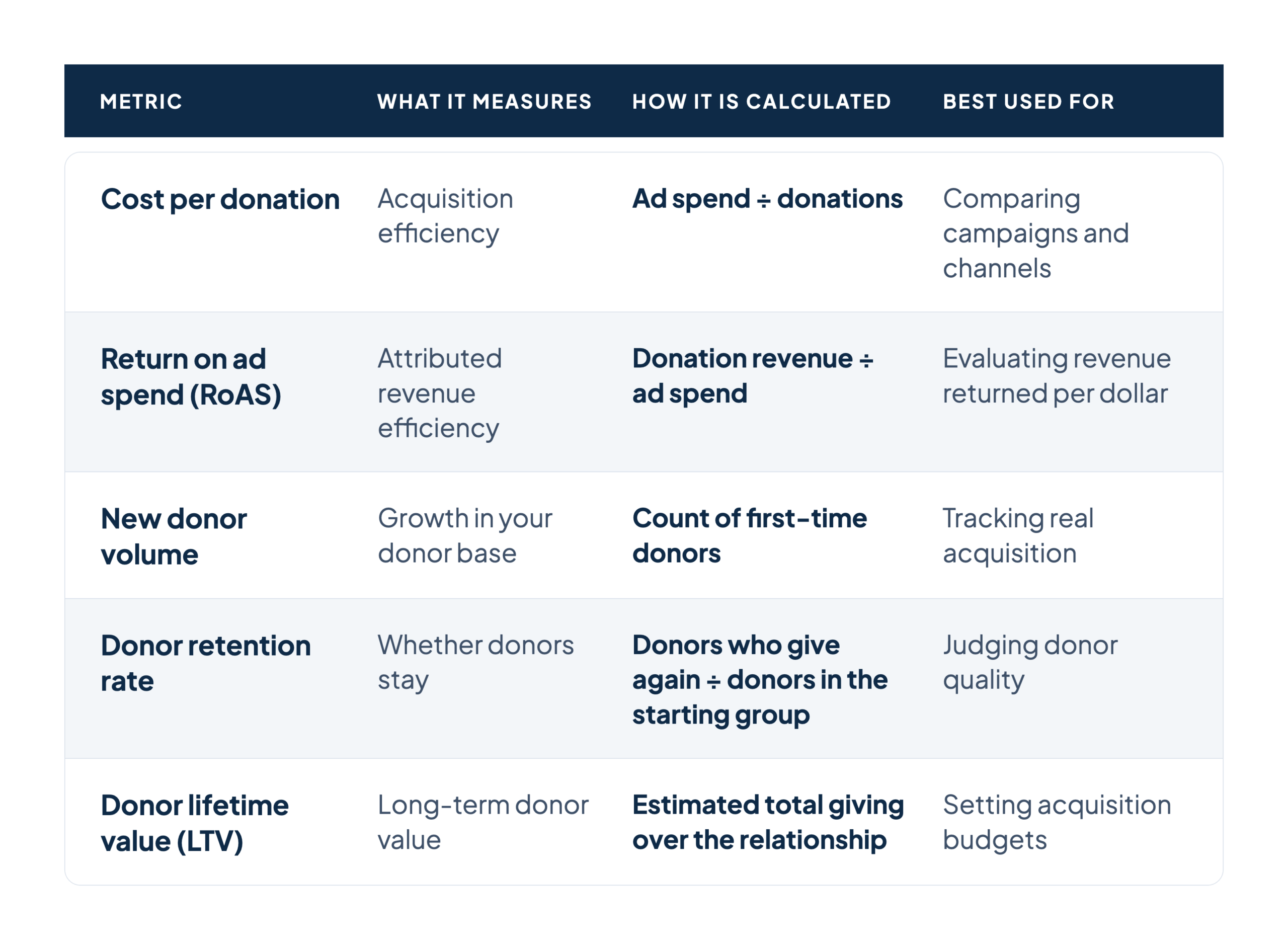 A worked example (illustrative numbers): A campaign spends $10,000 and generates 200 donations totaling $25,000. Cost per donation is 50(10,000 ÷ 200). RoAS is 2.5 ($25,000 ÷ $10,000).
No single metric tells the whole story. RoAS shows revenue efficiency, cost per donation shows acquisition efficiency, and retention and lifetime value show what happens after the first gift. It is also worth checking whether your campaigns are generating incremental donations and reaching genuinely new supporters.
In Delve Deeper’s Digital Fundraising Performance Index, which tracked Google Ads paid search for 15 nonprofits across 8 consecutive quarters (Q4 2024 through Q3 2026), the gap between the strongest and weakest programs came down to how consistently a program was managed year round, not budget size, and that gap widened over time.
9. What is the difference between RoAS and donor lifetime value?
RoAS measures the donation revenue attributed to advertising relative to what you spent, while donor lifetime value estimates how much a supporter will give over the course of their relationship with your organization.
The distinction matters because a campaign’s immediate return does not necessarily reflect the long-term value of the donors it acquires. One campaign might produce strong initial RoAS but mostly attract one-time donors. Another might produce a lower initial return but acquire supporters who become monthly donors.
That does not automatically make the second campaign better. It means you need retention and recurring giving data to know. Reviewing RoAS alongside retention, recurring giving, and lifetime value leads to better decisions about how to allocate acquisition budgets.
10. How does first-party donor data support programmatic advertising?
First-party donor data supports programmatic advertising by informing which audiences to build, test, and measure across display, video, audio, and connected TV.
Depending on platform capabilities, privacy requirements, and data eligibility, nonprofits can use donor insights to develop audience segments, inform modeled audiences, and evaluate how campaigns reach new prospects. For example, an organization might analyze the characteristics of its recurring donors to create hypotheses about new audiences worth testing.
Programmatic can also reach potential supporters who are not actively searching for your organization or cause. The important distinction is that first-party data should shape a broader audience discovery and testing strategy, not simply recycle the same donor lists across more channels.
11. How can nonprofits use donor data to acquire monthly sustainers?
Nonprofits can use donor data to acquire monthly sustainers by analyzing how current sustainers were acquired, then building campaigns, creative, and conversion tracking around those patterns.
Start by looking at which channels and messages brought in your existing monthly donors and how their giving developed over time. Then test whether certain groups of one-time donors respond to recurring giving invitations, and measure whether those sign-ups turn into sustained giving.
The value of getting this right is significant. A $15 monthly sustainer gives $180 in the first year and $540 over three years, and sustainers can be worth around 7.5 times more over their lifetime than one-time donors. For dedicated sustainer campaigns, look beyond the initial sign-up to cost per sustainer, payment retention, and cancellation rates.
The goal is not just to acquire more monthly donors. It is to acquire sustainers who continue giving.
12. What is a good cost per sustainer?
A good cost per sustainer is one that is comfortably lower than the lifetime value of the sustainers you acquire, and there is no single benchmark that applies to every organization.
To evaluate your own number, compare cost per sustainer to your expected sustainer lifetime value, and look at how many months it takes for a sustainer to repay the cost of acquiring them. For context, face-to-face fundraising vendors have commonly been paid around $500 per sustainer, which gives digital teams a useful comparison point. Most digital programs do not isolate this number because they optimize toward any donation instead of sustainers specifically.
Setting up offline conversions (question 5) is usually the first step toward measuring it.
13. How is first-party data different from third-party data and Google Signals?
First-party data is collected directly by your organization, while third-party data comes from outside providers and Google Signals comes from Google’s own signed-in user data.
Third-party data is gathered by companies with no direct relationship to your supporters, and the cookies that traditionally supported it are increasingly limited by browsers and privacy rules. Google Signals is a Google Analytics 4 setting that uses data from signed-in Google users who have turned on ad personalization, and it belongs to Google, not to you.
First-party data is the only one of the three that you own and control, which is why it becomes more valuable as outside data sources become less reliable. Starting June 15, 2026, Google Consent Mode also became the primary control for how advertising data flows into linked Google Ads accounts, which makes passing donor consent choices correctly more important than before.
14. What should nonprofits consider before activating donor data across advertising platforms?
Before activating donor data in advertising, nonprofits should evaluate five areas: data quality, privacy and consent, platform requirements, audience strategy, and measurement.
Data quality: Are donor records accurate, current, and consistently formatted?
Privacy and consent: Does the organization have an appropriate legal basis and any required permissions to use the information for advertising?
Platform requirements: Does the plan comply with each platform’s customer data policies, eligibility rules, and restrictions?
Audience strategy: What specific marketing decision will the data inform, and how does it support your fundraising goals?
Measurement: How will you determine whether the activation improved performance?
Not every donor data field should be shared with an advertising platform. Sensitive information, including details that could reveal a person’s health, religious beliefs, or other protected characteristics, requires particular care and may be prohibited for advertising use.
Start with a clear use case, activate only eligible data, and decide how you will evaluate results before you scale.
Turning Donor Data Into Better Fundraising Decisions
First-party donor data is a powerful resource for nonprofit marketers, but its value comes from how it is used. When organizations connect donor insights with audience strategy, digital media, and measurement, they can make better decisions about where to invest and how to reach supporters.
At Delve Deeper, we help nonprofits turn data into actionable marketing strategies, from audience discovery and donor acquisition to campaign optimization and long-term performance measurement.
Better data activation is only one part of building a connected fundraising organization. For a closer look at the organizational challenges behind fragmented donor relationships, read Who Owns the Donor? 8 Fundraising Problems That Are Really the Same Problem.
Get the must-read newsletter for digital fundraisers.
Written by Delve Deeper team members in the thick of the work, the newsletter explores practical solutions for challenges like disconnected data, weak segmentation, lack of personalization, and inefficient media.