The Channel You’re Underfunding by 50%

FEWER DONORS. MORE MONEY. A SHORTER LIST OF PEOPLE WHO MATTER.
Here’s a number that should stop you.
In 2025, roughly 57 million Americans gave to a charity. By 2030, that’s projected to be just over 50 million. Down 27% from 2021.
Over that same window, total individual giving is expected to go UP 38%.
Fewer people. More money. Average gift per donor from about $1,400 to about $2,620.
The market is CONSOLIDATING. Every donor still in the pool is worth nearly double what they were five years ago, and there are fewer of them every year.
So the job isn’t “reach more people.”
Actually — scratch that. The job IS to reach more people. Just not the same ones we keep reaching.
It’s reaching more people at the TOP OF THE FUNNEL. People who have never given to you. Who aren’t in your CRM, aren’t on a co-op list, aren’t retargetable — because they have never once raised their hand. The people with the potential to be NEW TO FILE.
It is HARD. It takes plumbing, patience, and a fight with your own reporting. But it’s possible.
WE’RE ALL FISHING THE SAME POND.
Most nonprofit digital media is pointed at people who ALREADY KNOW YOU.
Take branded search — somebody typing your name into Google. That’s not acquisition; that’s order-taking.
Or take retargeting in social — people who already hit your site and gave in the past.
Or co-op files like Wiland — the same aging pool of direct-mail responders, rented back and forth between the same charities.
All bottom of the funnel. All of us bidding against each other for the same shrinking list.
Then we act surprised when the donor count goes down.
Meanwhile the channel that actually CREATES demand is the one charities fund LEAST.
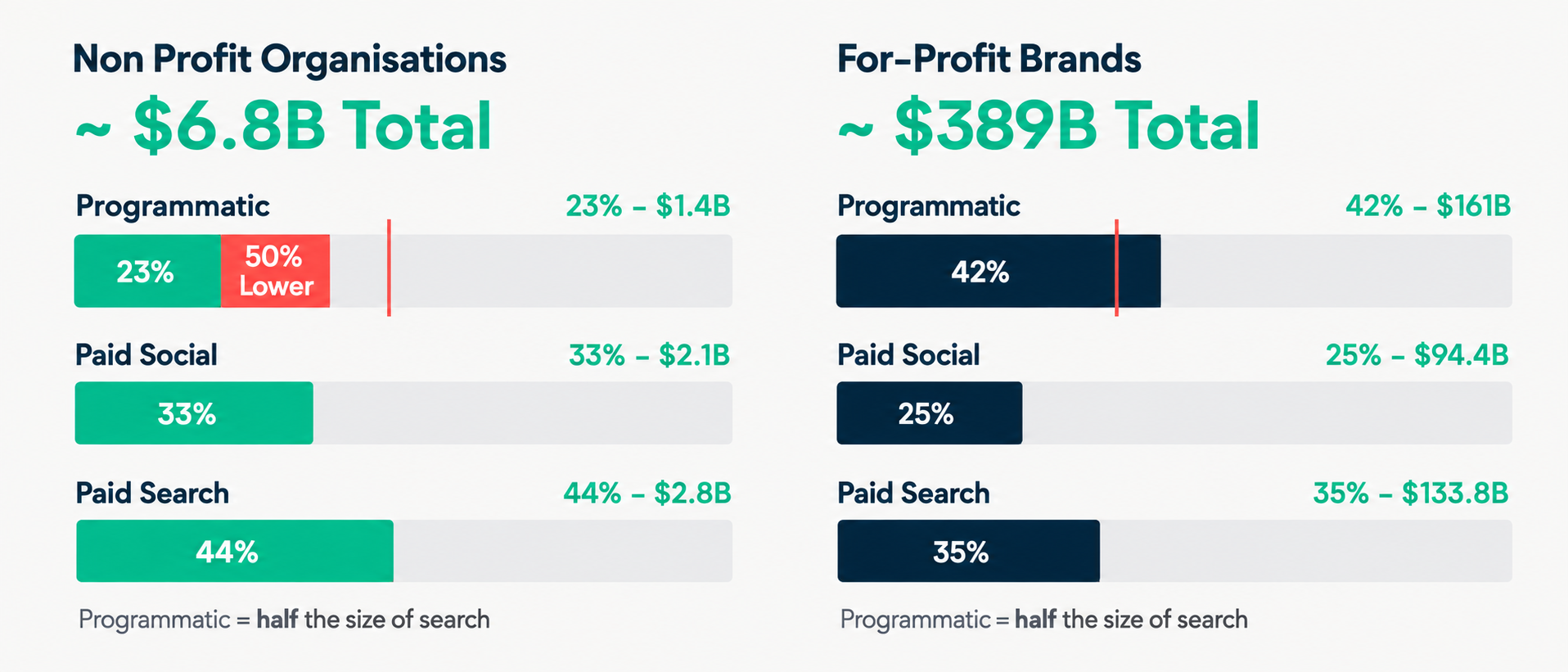
Nonprofits put 23% of digital media into programmatic — about $1.4B of $6.8B. For-profit brands put 42% — about $161B of $389B.
A 50% LOWER allocation to the top of the funnel. And look at the flip side: we put 44% into paid search, mostly branded. They put 35%.
For-profits spend most of their money PROSPECTING.
We spend most of our digital fundraising RETARGETING.
RE-INTRODUCING PROGRAMMATIC. (YES, IT’S BIGGER THAN SEARCH.)
Programmatic isn’t experimental. It’s the BIGGEST channel in digital and the FASTEST GROWING.

Programmatic is already 19% bigger than search, growing at double the rate.
By 2028 it’s projected at $215B against search at $154B — a 40% gap.
Search is plateauing. Programmatic is accelerating.
So what IS programmatic? Here’s the simplest definition–the one I use with boards:
Everything that is not paid search (Google, Microsoft) and not social (Meta, TikTok).
That’s it. In practice, 81% of it is display and banners (38%), online video (25%) and Connected TV (18%).
CTV alone should get your attention — that’s your prospect on a television screen, bought with the targeting precision of a banner.
WHERE MOST NONPROFIT PROGRAMMATIC TESTS GO TO DIE.
The channel is only half of it. The other half is HOW YOU MEASURE IT.
Paid search and social get measured on LAST CLICK into the CRM. Fine — those are closers, and last click is roughly the right yardstick for a channel whose job is to close.
Programmatic is a TOP-of-the-funnel channel. Its job is to INTRODUCE.
Watch what happens when you measure a top-funnel channel with a bottom-funnel yardstick:
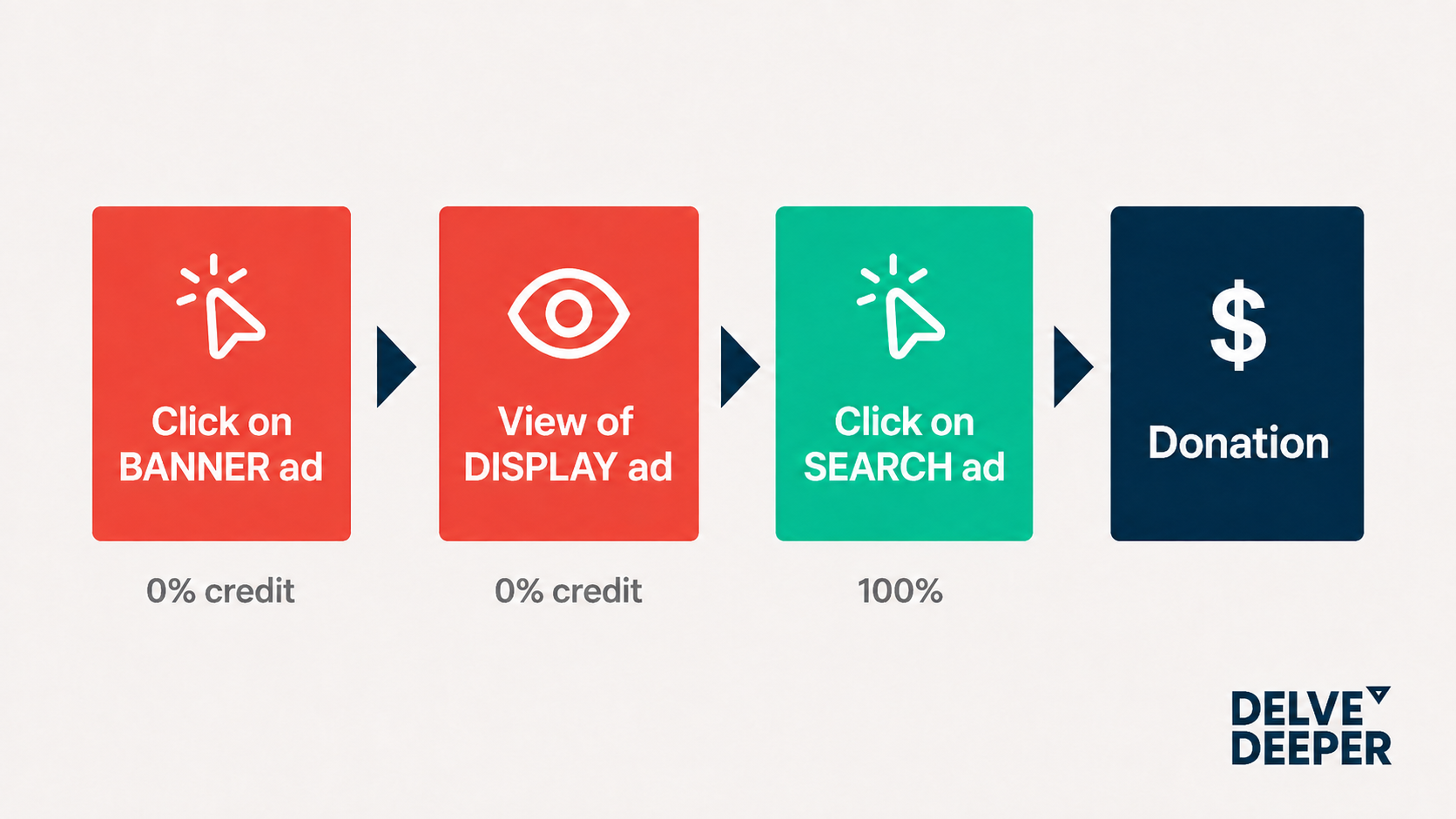
SEARCH gets 100% of the credit for a donor that PROGRAMMATIC went and found.
Then somebody pulls that report into a QBR and says “programmatic drove no revenue — move it to search.”
It is IMPOSSIBLE to justify top-of-funnel programmatic when your measurement is structurally incapable of seeing it.
This isn’t a media problem. It’s a MEASUREMENT problem.
The fix is what for-profits have run for years. Google’s Campaign Manager 360 sits above the buys and logs every step — post-VIEW and post-CLICK from programmatic, alongside the search click, alongside the donation. Programmatic gets measured on first click or view. Search keeps last click. Both are finally honest.
Three things have to be true: the MINDSET (programmatic as a performance channel measured to donor revenue, never a brand channel reporting impressions), precise AUDIENCE targeting with rapid CREATIVE testing, and real ENTERPRISE ADTECH access.
THE PAYOFF: A NUMBER YOUR BOARD CAN ACTUALLY COMPARE.
First, you reach donors where nonprofits currently AREN’T. The top of the funnel is close to uncontested in this sector. Uncontested inventory is efficient inventory.
Second, the economics work. One international animal-welfare organization we work with: same budget, 38% more new-to-file sustainers, cost per NTF sustainer from $960 to $604, in six months. Another, over six years: programmatic revenue $5.2M to $12.1M, ROAS 0.69× to 1.80×, total program doubled. And programmatic didn’t cannibalize search — it FED it. The new-to-file donors it introduced became the audience search then closed.
Third, you finally get a like-for-like number. Digital gets judged on ROAS while F2F and Direct Mail get judged on cost-to-recruit-a-sustainer. Close this loop and you get cost per new-to-file sustainer, digital — on the same line of the same spreadsheet as F2F and DM.
Now go back to the top of this article.
Fifty million donors by 2030, each worth close to double what they were in 2021. The organizations that WIN will be the ones acquiring sustainers efficiently enough to keep the pyramid fed.
That’s the move. Not “we tested programmatic.” It’s more of the high-value donors in a shrinking pool, at a cost you can defend, feeding a sustainer file that feeds everything above it.
The biggest channel in digital, growing faster than anything else — and our sector funds it at half the rate of the for-profit brands we compete with for the same attention.
That’s not a threat. That’s an OPENING.
Go take it 🙂
Get the must-read newsletter for digital fundraisers.
Written by Delve Deeper team members in the thick of the work, the newsletter explores practical solutions for challenges like disconnected data, weak segmentation, lack of personalization, and inefficient media.