DV360 Is Replacing Its Brand Safety Controls
Google is making a significant change to how brand suitability works in DV360, and the terminology shift is just the surface of it. Starting in Q3 2026, the legacy controls that most teams have been using for years — Digital Content Labels, Sensitive Category Exclusions, and suitability-related topic exclusions — will be deprecated and replaced by a new framework built around Inventory Modes and Content Themes.
This is not a cosmetic update. It changes how you think about and configure brand suitability across your entire DV360 account, and it requires a transition plan before Q3 arrives.
What is being deprecated and when
Digital Content Labels — with the exception of Content Not Yet Rated — will be deprecated in Q3 2026. These are the labels (DL-G, DL-PG, DL-T, DL-MA) that have long been the primary mechanism for keeping ads away from inappropriate content based on content rating.
Sensitive Category Exclusions for third-party exchange and Google Ad Manager inventory will also be deprecated in Q3. These exclusions have been the standard way to block categories like tragedy and conflict, sensitive social issues, and sexually suggestive content from serving environments.
Suitability-related category exclusions — including News and Politics and similar topic exclusions used for brand suitability purposes — will be deprecated across all DV360 line items at the same time. Note that not all category and genre exclusions are going away, only those related to brand suitability specifically.
What is replacing them
The new framework has two main components.
Inventory Modes — previously called Content Categories — give you broad control over the type of inventory your ads can serve across. The modes are being renamed from Expanded, Standard, and Limited to Maximum, Moderate, and Limited respectively. The underlying logic is similar but the new naming is more intuitive about what each level actually means for your reach and risk profile.
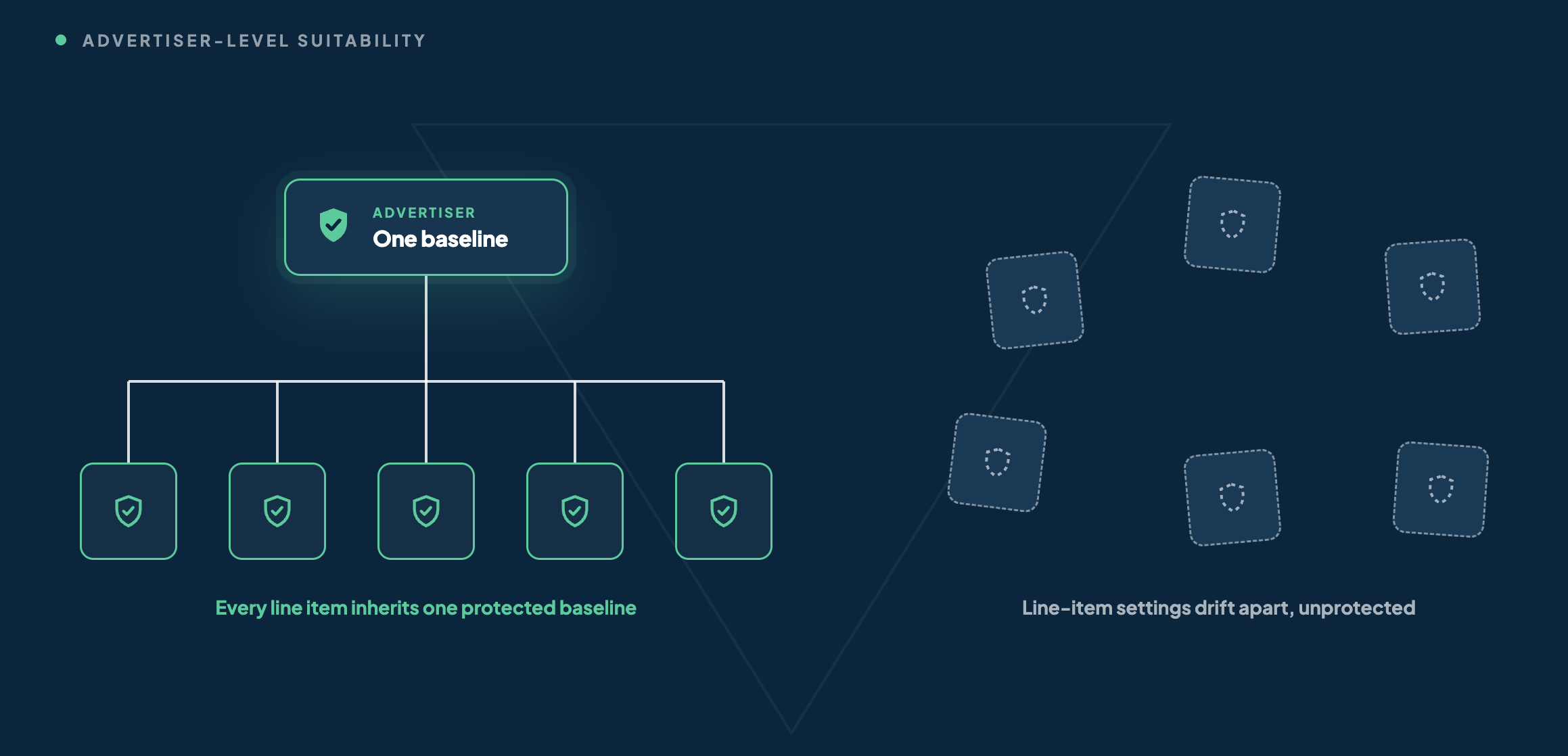
Content Themes are the more granular tool. They let you exclude specific content themes — violence, misinformation, profanity, and others — at the advertiser level rather than the line item level. This is both a simplification and a meaningful change to where these controls live. Previously suitability settings were often managed at the line item level, which meant they could be inconsistent across campaigns. Advertiser-level Content Themes create a consistent baseline across everything running under that advertiser.
Why this matters more than a rename
The practical implication of moving suitability controls to the advertiser level is significant. Right now many teams have suitability settings that vary across line items — sometimes intentionally, sometimes because they were set up at different times by different people and nobody audited them. The new framework pushes you toward a consistent advertiser-level baseline which is better for brand safety governance but requires you to make deliberate decisions about what that baseline should be.
It also means that if you have been relying on Digital Content Labels as your primary suitability mechanism, you need to map those requirements to Content Themes before they are deprecated. The mapping is not always one-to-one. A DL-MA exclusion covers a range of content that does not map neatly to a single Content Theme — you will need to think through which themes actually cover the content you want to avoid and configure accordingly.
If you do not complete this transition before Q3, your line items will continue to serve without the legacy controls once they are removed. That means potentially unrestricted inventory until you apply the new framework — which is exactly the kind of brand safety gap that creates problems.
What to do before Q3 2026
Start by auditing your current suitability settings across all active DV360 advertisers and line items. Document which Digital Content Labels and Sensitive Category Exclusions you are currently using and what content risk they are designed to protect against.
Map those existing controls to the new Content Themes and Inventory Mode settings. For each content risk you currently manage through legacy controls, identify which Content Theme covers it and confirm the coverage is equivalent.
Configure your advertiser-level brand suitability settings in the new framework before Q3. Do not wait for the deprecation to force the migration — a rushed transition under deadline pressure is where gaps get created.
Once your new settings are live, test a sample of line items to confirm they are serving in appropriate environments. The new controls are more sophisticated than the legacy ones but they need to be configured correctly to work correctly.
The broader shift
The move from Brand Safety to Brand Suitability is not just a rename — it reflects a real philosophical shift in how Google thinks about this problem. Brand Safety was a binary concept: safe or not safe. Brand Suitability acknowledges that different brands have different risk tolerances and that suitability is contextual rather than universal.
The new framework gives you more nuance and more control. But it also requires more intentional configuration. The legacy controls were blunt instruments — easy to apply, easy to understand, and imprecise. The new tools are more precise but they will only protect your brand if you understand what they are doing and set them up accordingly.
Q3 is closer than it feels. Start the audit now.
Get the must-read newsletter for digital fundraisers.
Written by Delve Deeper team members in the thick of the work, the newsletter explores practical solutions for challenges like disconnected data, weak segmentation, lack of personalization, and inefficient media.