6 Things Nonprofits Get Wrong About How Gen Z Gives

Giving Tuesday and year-end are almost here, exactly when Gen Z’s sharing and network-driven giving peaks. Want to build a fundraising strategy that captures it?
Reach out to Duncan Stewart, VP of Business Development at Delve Deeper, at duncan.stewart@delvedeeper.com.
Nonprofits have spent years asking the same question: how do we get Gen Z to give? New research from GoFundMe and GivingTuesday suggests that’s the wrong question. Gen Z is already generous. The opportunity is building fundraising strategy around how that generosity actually moves.
Here’s what the data says nonprofits are missing.
1. Gen Z doesn’t have a generosity problem
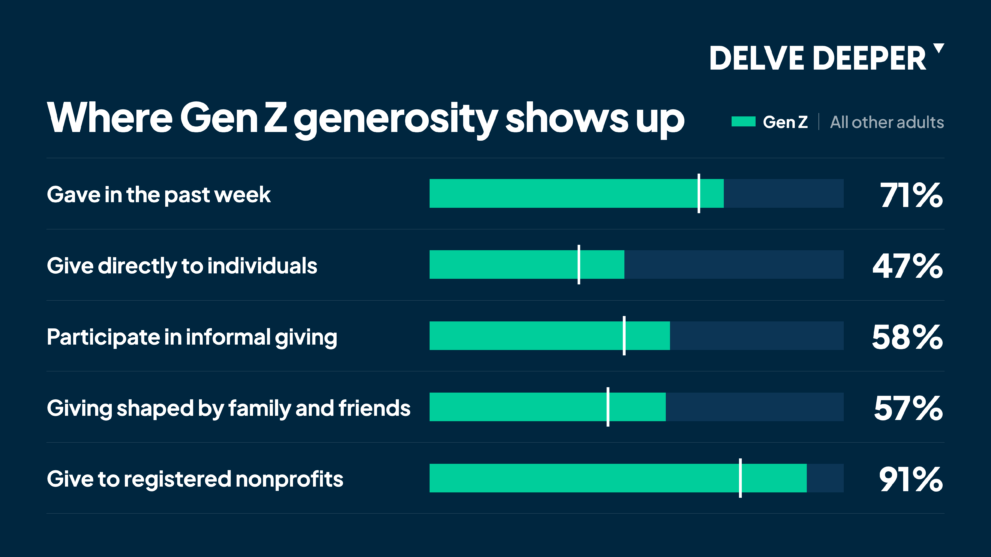
About 71% of Gen Z adults reported giving in some form in the past week, compared with 65% of other adults, and 43% gave money outright, despite being more likely to have lower incomes, be students, or be unemployed. Most fundraising programs simply aren’t built to capture how that willingness already shows up.
2. Their generosity runs through relationships, not organizations
Gen Z significantly outpaces other adults in relational giving: 47% give directly to individuals (versus 36%), and 58% participate in informal giving (versus 47%). Family and social circles shape 57% of their giving decisions, compared to 43% of other adults. Their giving journey often starts with a friend or a cause moving through their network, long before your website ever enters the picture.
3. Sharing is generosity too, and it has a measurable return
Gen Z is 8% more likely than other adults to publicly share or advocate for causes. That’s not just goodwill. GoFundMe’s research found fundraisers shared within their first day raised 10% more on average. Someone who shares your campaign without donating is a channel your mission just reached through, and that has value of its own.
4. Crowdfunding builds nonprofit donors, it doesn’t replace them
Here’s the stat that should put a common fear to rest: 91% of Gen Z crowdfunding users also gave to registered nonprofits, 16 points higher than Gen Z who don’t use crowdfunding platforms. Crowdfunding works as a front door into broader charitable giving.
5. Your reporting probably isn’t built to measure any of this
Traditional fundraising reporting measures transactions well and networks poorly. Who brought a donor in: your campaign, or the friend who shared it? Which supporter created more value: the $100 gift, or the $20 gift that inspired five more? Shares, fundraisers created, and network reach deserve a place next to dollars raised, and they become far more useful once they’re connected to real donor strategy instead of tracked as vanity metrics.
6. Participation only matters if it leads somewhere
Getting a Gen Z supporter to share or start a fundraiser means little if the relationship ends there. The real opportunity is building a path from that first action toward sustained giving, whether that’s another share, a peer-to-peer fundraiser, a first gift, or eventually, a sustainer commitment. A supporter who arrived through a friend’s fundraiser shouldn’t get the same cultivation journey as one who came through a branded search ad. Their entry point tells you something. Use it.
The takeaway
Gen Z isn’t a future donor base waiting to be convinced. They’re already giving, sharing, and mobilizing their networks, often outside the funnel most nonprofits built. The opportunity is meeting that behavior where it already lives and giving it somewhere to go.
With Giving Tuesday and year-end fundraising right around the corner, this is the moment Gen Z’s network-driven giving matters most.
Reach out to Duncan Stewart, VP of Business Development at Delve Deeper (duncan.stewart@delvedeeper.com), to talk about what that could look like for your organization.
Get the must-read newsletter for digital fundraisers.
Written by Delve Deeper team members in the thick of the work, the newsletter explores practical solutions for challenges like disconnected data, weak segmentation, lack of personalization, and inefficient media.