Why digital fundraisers can't leave marketing to marketers

In many nonprofits, fundraising and marketing still sit in different lanes.
Fundraising owns the money. Marketing owns the messaging.
That split is understandable. Fundraising grew up around gifts, stewardship, direct response, major donors, annual giving, and the pressure to hit a number. Marketing grew up around audience, message, story, brand, and why anyone should care in the first place.
But the state of the donor file is making that separation harder to defend.
The Fundraising Effectiveness Project reported that charitable dollars rose an estimated 5.0% in 2025 while donor counts fell 3.6%, extending a donor-count decline that began in 2021.
The sector can raise more money while reaching fewer people.
That is not just a performance problem. It is a pyramid problem.
If revenue growth depends more heavily on fewer, larger donors, the base gets weaker. Small-dollar donors become easier to ignore because they do not move the short-term number. First-time donors become harder to convert into loyal givers. The file can look productive while the future pipeline thins out.
In this environment, digital fundraisers cannot only be operators of the fundraising machine. They have to care about the conditions that make someone choose.
They can’t leave all the marketing to the marketers.
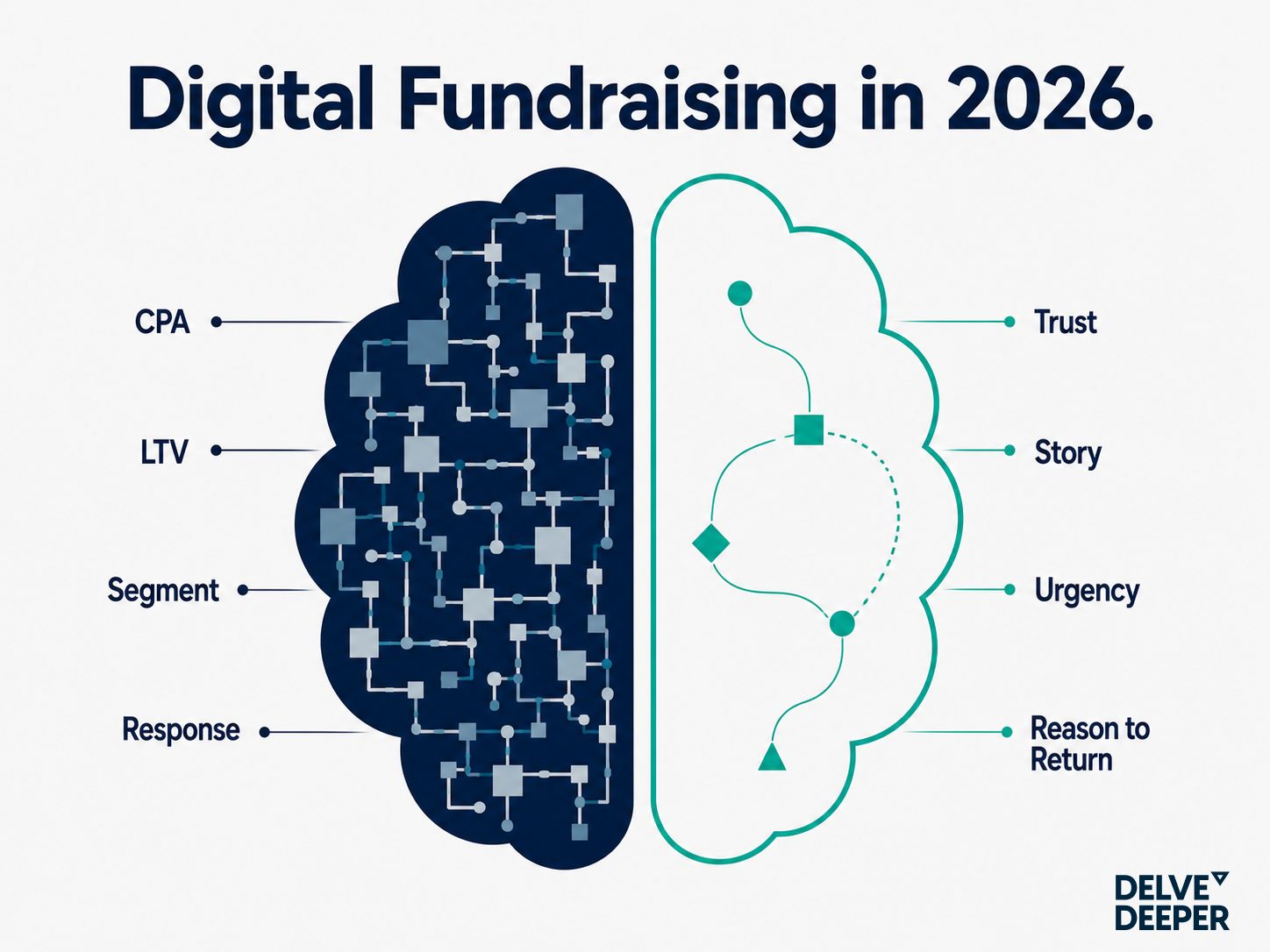
I’m NOT arguing that every fundraiser becomes a brand strategist executing campaigns.
I’m talking about a higher-level shift, adopting a marketing lens that, as Denise Lee Yohn described it, is “about understanding people’s fundamental needs and drivers.”
Fundraisers are also Marketers.
Digital Fundraising should ask:
- Why would someone give to us instead of another organization?
- What makes the cause feel urgent when there is no obvious emergency?
- What does a first-time donor need to believe before they give again?
- Which message builds trust, not just response?
Those are not abstract brand questions. They are fundraising and marketing questions now.
Because a donor relationship does not begin when someone gives. It begins when someone notices, understands, trusts, and decides the organization is worth acting on.
That is why the marketing lens matters: it helps teams see whether a campaign is building a donor relationship, not just producing a response.
After all, a campaign can beat its CPA target and still bring in donors who never return. A team can be disciplined about revenue and still miss the story or audience insight that would have made the relationship stronger.
This matters even more when the goal is recurring giving, when Sustainers matter.
If nonprofits want donors to give like subscribers, they have to think harder about what donors get in return: proof, progress, access, belonging, clarity, or a reason to feel that staying close to the mission is worth it.
So before the next campaign, let’s not just ask for the revenue goal. Let’s ask what donors will value.
Let’s not only ask what a donor is worth but what the donor has shown interest in.
Before reviewing creative, let’s not ask whether it will drive clicks. But whether the creative gives someone a reason to trust, believe, or come back.
And, before reading the report, it’s less about which channel won. It’s more about what kind of donor segment the campaign built up.
That is the kind of marketing judgment digital fundraising needs now.
The next gift is not won by proving you got the last one efficiently.
It is won by building a reason for the donor to stay.
Get the must-read newsletter for digital fundraisers.
Written by Delve Deeper team members in the thick of the work, the newsletter explores practical solutions for challenges like disconnected data, weak segmentation, lack of personalization, and inefficient media.