Why Most Fundraisers Are Already Using Behavioral Science - Without Knowing It

Get one
powerful idea.
Subscribe on:


EPISODE SUMMARY
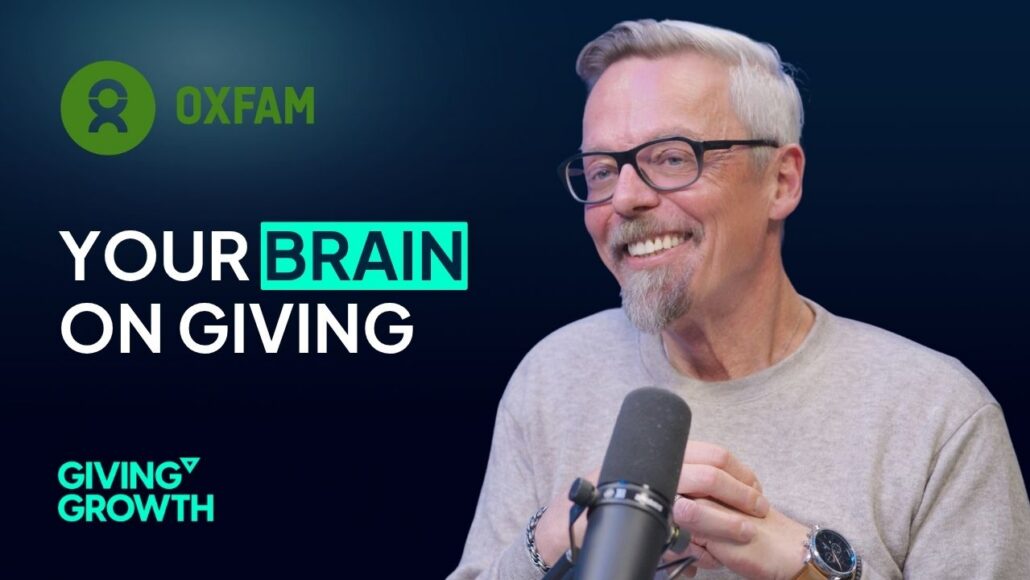
Thomas Kurmann, Vice President of Resource Development at Oxfam America, explores how understanding human psychology can make every part of a fundraising program more effective, from donation page design to donor communication strategy.
Thomas draws on 25 years of fundraising experience across Doctors Without Borders and Oxfam, and makes the case that behavioral science isn’t about revolutionizing your baseline overnight — it’s about making deliberate, evidence-backed improvements that compound over time.
In this episode:
- What is behavioral science — and why should every fundraiser care about it?
- How do cognitive biases like loss aversion and the paradox of choice affect donor decisions?
- Why does reframing a monthly ask as a daily amount increase conversion?
- What does the crumbling donor pyramid really mean for long-term fundraising strategy?
- Why do ambitious goals make teams more effective — and how do you set the right ones?
EPISODE TRANSCRIPT
Giving Growth Podcast – Thomas Kurman (transcript)
Brought to you by Delve Deeper: https://delvedeeper.com/
Greg Sobiech
There is a problem that not-for-profits can’t ignore. The traditional giving pyramid may be crumbling a bit. Older donors are aging out.
Younger generations aren’t filling the gap the degree that we need them to. Volatile economy is squeezing non-profits from all sides. This is Giving Growth, the podcast where we talk to leaders who are reshaping the not-for-profit world and tackling these challenges head-on.
Sign up for the Giving Growth newsletter and learn about one idea worth sitting with by going to DelveDeeper.com slash podcast. This week, my guest is Thomas Kerman and he’s the Vice President of Resource Development at Oxfam America, one of the world’s leading organizations fighting inequality and poverty across more than 80 countries. Thomas has spent his career at the intersection of humanitarian work, philanthropy, and behavioral science, helping global non-profits understand not just how people give, but why.
And at Oxfam, he is rethinking the traditional donor pyramid and exploring how behavioral insights can drive deeper, more meaningful generosity. I’ve actually never had a conversation like this one on the podcast before. It’s always fascinating how every person I talk to has a different story and a different point of view on what’s most important right now to maximize impact.
So I’m excited to spend the next hour with Thomas. Welcome to Giving Growth, Thomas.
Thomas Kurmann
Thank you, Greg. Thank you for having me. I’m excited to be here.
Greg
One place where we could start is just kind of letting the audience understand who you are. You’ve been in this industry for a while. I wander through the lens of behavioral science.
I know that’s something that you care about deeply. Is there a moment that you can think of where something happened that really made you connect the dots around behavioral insights being a thing that you care about right now?
Thomas
So as always, or often, there is a mentor or somebody that teaches you something about something you didn’t know before, which is kind of the trigger for learning something new. That happened for me like four or five years ago with Bernard Ross, one of, in my opinion, the best fundraisers in the world, who chatted to me about this topic and about donor psychology and how we can influence actually donor behavior through better understanding psychology. Actually, behavioral science and together with neuroscience and evolutionary psychology are three elements that describe us how our brain works.
And when we understand that better, we are as fundraisers in a better position actually to influence people’s behavior and for the good, right? It’s not, we are not changing people’s minds. That’s very important because there is an ethical concern about influencing people, but it’s really influencing people’s behavior, not their mind.
That’s a very important distinction. And that was for me really a new insight that I got and I started to dig deeper into that topic. And it’s a vast topic, right?
There are more than 150 heuristics or biases that we have as human beings and starting to learn about them and to think about how can I kind of insert that into my fundraising framework is a fascinating task.
Greg
How would you describe Oxfam’s fundraising philosophy and does it connect with your philosophy? Is there a reason why you’re Oxfam?
Thomas
The biggest part of my career was with Doctors Without Borders in Switzerland, Germany, and the United States. And after 16 years, I thought I would like to see another organization. And obviously as a fundraiser, you always look for a mission that aligns with your values or I assume for most fundraisers, that’s the case.
And Oxfam was for me a mission that really attracted me. The mission of Oxfam is to fight inequality, to end poverty and injustice in the world. And actually the organization does that on the short term with humanitarian response to crisis situations and in the long term trying to impact systems and to change systems.
And again, that’s a long term exercise. And the organization does that along four axes. One is, as I said, the humanitarian, the second one is economic justice, the third is gender justice, and the fourth is climate justice.
And the intersection, all these four areas actually intersect with each other. That makes, in my opinion, Oxfam a unique organization in the world because a lot of organizations focus on one or the other axis. We are looking into the intersection of all four.
Yeah, that’s the lens we are looking through, right, in order to make this world more equal in the future.
Greg
And tell me more about the intersection. What is at that intersection?
Thomas
Because everything is connected, right? The humanitarian crisis might be triggered by an economic crisis or a climate crisis. People are on the move because of wars, because of lack of water that is triggered by climate change, etc.
So things are interconnected. Women’s empowerment, for instance, is definitely connected with economic justice. We all know that, unfortunately, still today, women for the same job do not earn the same salary, things like that.
But especially in the Global South, how can we empower women to get into leading positions, be it in the private sector or in the public sector? Because that’s my opinion. If women would be more empowered and in charge of many leading positions, the world would be a better place.
Greg
I don’t hear other charities speak about their mission this way. Typically, you know, we want to simplify it. And so what you’re describing, like intellectually, sounds actually very attractive because I get it.
These are interconnected systems and we all know it intuitively. I have to imagine that even though that’s an attractive value proposition to you after all these years with Doctors Without Borders, it’s also a complex thing to explain to a donor. True, false?
So what are you hearing?
Thomas
Absolutely true. I mean, for Doctors Without Borders explaining the mission, it’s already in the name.
Greg
I know.
Thomas
It’s about saving lives.
Greg
It’s a beautiful, like, simplicity in messaging.
Thomas
You don’t have to explain much. People get it apart from the fact that obviously the organization is very well known. The awareness is very high in the US. It’s over 45 percent.
If you look at Oxfam, it’s at 16 percent, much lower. And the reason is, apart from the fact that Doctors Without Borders is always at the forefront of humanitarian crisis, which are highly on top in the media, right, is the fact that Oxfam is difficult to explain.
It’s very irrational. And that might be the link to behavioral science. We have a hard time to understand complex things by nature, right?
And Oxfam’s mission is complex. It’s not as simple as Doctors Without Borders saving lives. It’s about long-term impact, systemic change.
And that’s, you know, when it comes to behavioral science, we can explain this present bias. We prefer short-term rewards over bigger long-term incentives. What does that mean?
We, for example, there were studies being made. If I offer you $50 today or $200 in a year, what would you take? Most people would take the $50.
Even if that’s not rational, I offer you $200, but only in a year. So what people have the tendency is to prefer short-term rewards. And saving lives is a very much short-term reward.
Systemic change is way in the future. That’s why climate change is so difficult to get people rally around, really in a meaningful way, also from a donation perspective, because it’s just way far out. That’s why politicians do not so much care as they should, because it’s not in their voting cycle anymore.
It’s long in the future. It’s not in the present. So they prefer to have the short-term wins as opposed to long-term, maybe bigger wins.
And that’s also the human behavior. We prefer short-term gains over bigger long-term gains that we might have. That’s why we take the $50 over the $200.
Again, not a rational behavior.
Greg
So you strike me, and this is going to be judgment, Thomas, about you. You strike me as a thoughtful, intellectual thinker. And I wonder if the reason why you’re at Oxfam is because, from a behavioral perspective, it’s a great fit for you because it is complex.
But it’s also, I have to imagine, for me, what you’re describing is actually strangely attractive, because I am just naturally wired, factually, for long-term rewards. Like, I think I would take the $200.
Thomas
Yeah, there’s always outliers.
Greg
Yeah, there’s always people who are a little strange, right?
Thomas
No, rational, more rational.
Greg
So I also wonder, when it comes to Oxfam’s donors, is there a connection between the ambition of the mission, because that’s a very ambitious, complex mission, and the kind of donor that Oxfam attracts? Or it’s not like that?
Thomas
I mean, I do believe that because it’s about systems change and long-term impact, we definitely attract a slightly different type of donor than, for example, Doctors Without Borders would attract. It’s really the alignment on the deep values that make people actually connect with our organization, I do believe, the world-aware people, people who are concerned about what is going on in the world, not only what is going on at the front step of your home or in the U.S., even if you are also obviously working a lot in the U.S. in terms of lobbying and advocacy. But this is a type of donor that is worried about future generations, about what kind of world do I want to leave to my closest people, to my kids, in the future.
And again, this means a rational reflection process, because, as I said before, the present bias, which is the emotional trigger, would mean that we just care for what is happening tomorrow, not what is happening in 10 years, right? So we have to fight against that. And Kahneman, one of the most influential pioneers for behavioral science, has described that with System 1 and System 2.
System 1 is the emotional reaction. And emotional reactions are not bad. It’s just two different ways that we have to be aware of how our behavior works.
System 1 is the emotional, intuitive way of making decisions. And System 2 is the more reflective, rational way of thinking about or making decisions.
When you walk in the street and you turn left, you are in System 1. You are on autopilot, so to speak, right? You know where to go most of the times. And so you don’t have to think about it.
When you think about your pension or what happens in your future, you might get into System 2. How can I make sure that I save money in order to have a life that is comfortable? Like 20 years down the road, or if you want to buy a house, you go into System 2 because you have to process a lot of information. Mortgage, etc. Capital that you have, etc. So that’s not a System 1 decision.
If you buy an ice cream in the street, you might be in System 1. You see a color that attracts you, etc. And you make an emotional, intuitive decision.
So we have to be aware of in which system we operate. And that’s very important for our donors as well. That’s where influential fundraising comes into play, where we try to influence the behavior of people.
Greg
So then when I think about behavioral science, and I’m wondering in the context of Oxfam maybe, so System 1 is more emotional, System 2 is more reflective. Is there a connection between what Oxfam is doing, I guess it’s System 2, and behavioral insights?
Thomas
Yes, for the long-term impact, it’s definitely System 2. As I described the donors, these are donors who think about the future, about the impact and the world we leave behind for our future generations. But when it comes to humanitarian response, that’s typically where we see System 1 behavior.
People see a catastrophe happening in the world, and what they do, they go online, they make a donation without thinking a lot. And that’s where you actually have the possibility to influence the behavior with your ask string on your homepage, with anchoring the ask string, with social proving in terms of saying most people give at this level. So that’s where you really can influence, because people are in an emotional setting and are actually much more likely to give in to these biases that we all have, because they are not in reflection mode.
So humanitarian response is the typical example of System 1 behavior. And so we have both, but we have both short-term response to humanitarian crisis and long-term impact. So I would definitely compare that to System 1 and System 2 in terms of behavioral science.
Greg
Give me a textbook definition of how behavioral science helps improve donor engagement and thus helps me go after a bigger share of wallet. What would be a textbook definition? Let’s say you’re sitting down with a young fundraiser, someone who just joined the industry, and you’re explaining to her or to him what behavioral science is in the context of donor engagement and how it leads to helping you raise more money.
Thomas
Yeah. So obviously we could talk now for hours about the topic, but one thing is evolutionary psychology has already made some things in our brain that is hardwired. You know, some behaviors that are hardwired.
For example, risk aversion. If you see a stick in the floor, it looks like a snake. So what are you doing? Are you lifting it up or not? You go probably for the safe method. That comes from our evolution from millions of years of learning and actually teaching our brain how to react in certain situation.
So because it could be deadly, right? So if it’s a snake, it could mean your death. So we are more risk averse in that sense.
Behavioral science is looking more at the soft area on decision-making. How do we make decisions? And again, system one and system two, the emotional versus the rational way of making decisions come into play very much.
It’s all about how can we influence our behavior? If I want to lose weight, how can I actually influence with that objective in mind my behavior? Because how many people have signed up for a gym and then never gone, right?
How many people have told themselves on January 1st they will stop smoking but actually continued smoking? How can we, and these are non-fundraising examples, how can we influence a behavior for the better of ourselves in terms of wealth, health, well-being? But the same is applicable also to donors and their behavior.
How can we nudge people’s behavior in a way that actually increases their retention, increases the value they are giving or the frequency? So, and that’s where we have to look at all biases that we are all kind of have the tendency to be not victim of, but just a part of our system as human beings. And when understanding those, you are in a position actually to influence people’s behaviors.
Greg
Can you think of an example where maybe 10 years ago or five years ago, you would have approached a program, a campaign, some sort of outreach one way and now armed with what you know, what you’ve learned over the last five years, you now would have done it differently or you have done it differently. Give me some before and after with behavioral science kind of in the middle that as the divider between what you would have done versus what you will do now. Yeah.
Because you believe that the new way is more effective.
Thomas
Yeah. I mean, for example, we, but that goes back to my Doctors Without Borders time when we run, that was at the beginning of my learning about behavioral science. We did tests with our donation form and most fundraisers actually already intuitively do the right thing by applying behavioral science in their way of fundraising.
What do I mean with that? We all use default, for example, on our donation page. Why using default?
The simple reason is that we as human beings look for cues that help us making decisions more easily. Why? Because our brain uses a lot of our energy.
So we as human beings have to be very careful with the resource that we have and actually always try to find ways to make decision without using a lot of brain power. And default, defaulting to a certain ask amount on your donation page helps us. We don’t have to think about it.
We see it already default. The decision is taken for us. That’s why most of the people just leave it on where the default is on $80 or $60, whatever that might be because of that.
So you can increase conversion rate by defaulting your ask on a certain amount. That’s one way. The other way is, which I like a lot, is the paradox of choice.
You know, we tested having seven options of gift amounts versus three. We all would agree that if you go in a clothing store, you like to have as much choice as possible. You don’t want only to have three pairs of jeans that are offered to you.
So you would prefer a store that has 25. So you think you have much more options. The problem is that our brain doesn’t like too many options.
Too many options lead to inaction. Why is that? Because we are overwhelmed.
We have so many options. We go to this one. We don’t know this one.
I like it a little bit better than this one. So fewer options actually helps with conversion because it doesn’t overload the brain. We have just fewer options to choose from, right?
That’s why it’s always wise actually not to overload the ask string with too many options. We found that three is actually the right amount. And then we have the Goldilocks effect.
When you have three, you want to default on the middle one. Why? Because our brain automatically always goes toward the middle.
It’s funny, but if you can observe yourself, if you have three options or five, most of the time people have the tendency to opt for the middle one. So these are little nudges that help actually the donor make a simple or a decision more easily. So that helps then ultimately conversion or social proving.
A lot of organization use point towards a gift amount and say, most people give at this level. And why is that important? Because we like to be like others.
If you go, I was in Boston last month and I was in the street with roughly 10 restaurants. Nine of these restaurants were almost full. One restaurant was totally empty.
Why is that? People, if you see an empty restaurant, would you go into it? Probably not.
Because you think there must be something wrong with that restaurant. Why is it empty? And the others are full.
So we try to follow other people’s example. So social proving plays an important role. But the example that I like most is about loss aversion.
We are fundamentally loss averse. So actually Kahneman found out that the driver for, actually loss aversion is twice as strong as the prospect to gain something. People were told, okay, would you play the game?
There’s the risk that you lose $20, but you have also the possibility to win $20. What would you choose? Most people choose not to risk it.
They don’t want to lose $20. Kahneman made a lot of experiments around that. The breaking point was when people were offered 2.4 times, 2.2 or 2.4 times more than the potential loss. Meaning in that example, if I tell you you have the possibility to lose $20, but you have the possibility as well to gain $50, that’s when people would switch from the loss to the gain. So the driver, loss aversion is a very strong driver. And I applied that theory in the monthly ask on the website.
We all frame kind of monthly giving, give monthly $20, $30, $50. I reframed it on a daily basis. So you give $1 per day, $2 per day or $3 per day.
And $2 per day, by the way, that’s $60 a month. That’s a good amount for a monthly gift. And by framing it on a daily basis, and then you can compare it to the cappuccino that you take in a coffee store, right, et cetera.
So you can expand on it, which we didn’t do. We just offered that daily framing. And that’s linked to loss aversion, right?
Because loss aversion is all about how you feel, like with the economy. You know, stock market can thrive, but if you feel that going to the grocery store is more expensive than last month, that is what matters. So the same is loss aversion.
It’s all about how do you make people feel? If I offer you $60 a month or $2 a day, that makes a whole difference because you kind of see only that number two, and it doesn’t feel as heavy as $60 in terms of what you give away, right? In terms of donation amount.
So the framing on $2 a day was incredibly successful in that test. People opted in, and then you have the default as well, obviously, all the other techniques. The 50% of the people were opting for the $2 per day, which increased the average amount significantly.
So these are little things. Behavioral science will not revolutionize fundraising, no. But by applying little by little, one or the other bias or heuristics on fundraising frameworks and tools can help increase a little by little your baseline.
Greg
What you’re describing is almost depressing, frankly.
Thomas
What is depressing?
Greg
What you’re saying, what I’m hearing is that humans are intelligent apes, right? Who are product of evolution. And we can’t forget about that, right?
Like the classic thing I remember, I realized years ago before I had kids was that the purpose of humans is to procreate. That’s why we exist. And in some ways, it’s not just that.
It’s what a simplification of why we exist. And yet from a biological perspective, that’s the only reason why we exist, to multiply. And to me, that statement is at the core of what you’re describing, that if I am in any role that deals with humans, like fundraising, I just can’t forget about the fundamental biology of humans and of how the brain is constructed.
And I know even with my team, right? We talk a lot about, for example, scientific methods, because I feel that to be undeniably true that scientific method, hypotheses, validate, invalidate in marketing especially is the way to go. But if you strip that of psychology, if you just focus on the science and you don’t remember that the brain is a lump of not meat in this case, but cells that has evolved over millions of years, you’re missing a big point of what messaging is about.
So that is how I interpret what you just said, that there is this classic, right? There is a science of marketing. You’re describing the art, but you’re really describing the biology of communications.
Thomas
Yeah, but the science or the marketing techniques are actually built on the psychology.
Greg
Say more, yeah. Like what does it mean to you?
Thomas
Yeah, most of the times, right? But if you, and again, as I said before, a lot of fundraisers do things intuitively already right by following the behavior and the underlying principles or biases we all have like the default, like the anchoring of an amount that the higher ask string might pull people or might pull the average donation up until a breaking point, right? If you go too high, that might depress or reduce conversion.
But yeah, psychology and science comes into play in terms of testing. I did tests where actually the assumption of the human behavior would be the correct one, but then the test didn’t really work. So you always have to test as well and digital fundraising is the best place to do A-B testing.
And that’s what we did with the tests I described before, where we saw a significant average gift change for monthly giving with the reframing on a daily basis. So it needs both. Science, I mean, psychology is a science by itself, studied so much in depth.
It’s just that oftentimes we do it not, we don’t do it systematically.
Greg
Mm-hmm, it’s uncodified.
Thomas
Yeah, we do it intuitively, but by understanding the biases we all have as human beings, you become more systematic and conscious in terms of applying these principles in your fundraising program.
That’s what I would like to get to, that fundraisers actually, and that’s why I’m teaching behavioral science on conferences for fundraisers, because I truly believe we can all together learn so much more in terms of psychology and human behavior that impacts fundraising. And we are at the early stages. Uber, for example, Uber runs 10,000 tests per year and has a behavioral science unit that is massive, right?
Why? Because they understood that by having experts in terms of behavioral science and psychology and then running tests based on assumption and hypothesis to get back to the science is bringing the company forward. And that’s all what it is about.
We don’t have these resources, but we can little by little start to think about one or the other bias and how could we apply that in our fundraising program and in communications, by the way. So for example, in Doctors Without Borders Mexico, I love that example. It was at the World Cup in Russia.
If I tell you 1 million as a unit, what kind of triggers that in your mind? 1 million is such an abstract figure. We know it has seven digits, but then how can we imagine 1 million?
And we use this example because people have a hard time to process so big abstract numbers. So what tell us psychology? You have to break that number down.
And you have to create the reference that people can actually understand. For example, in that case, we use the size of a stadium and people who go to soccer games, they know roughly MetLife in New Jersey, 100,000 people, something like that. So there we have now a mental image of what a big number means.
Seeing a full stadium means 100,000. So starting to reference things where people can access to in their brain much easier than to an abstract number helps. So telling people that 5 million people are displaced, people have a hard time to understand what does that mean?
Yes, it’s a big number, but how big? So making them references to something that people can access to much easier in terms of symbology. Would help to process this kind of information and say, oh, wow, that means 50 stadiums full of spectators in the MetLife, that’s massive, right?
So things like that, that’s just another example and that helps people process information easier than if we just throw around numbers and starting to think that way through the lens of these biases that we all have helps actually improve the way you communicate to people and actually influence them, their behavior at the end, which is our objective as fundraisers, right?
Greg
So you teach this, right? You speak about behavioral science, like you said at conferences, right? In breakout sessions, master classes, just give the audience like a handful of quick rules of thumb or principles that you teach that you would want them to keep in mind.
Is it possible to do that? What are some things that we need to remember as fundraisers through the lens of behavioral science?
Thomas
Yeah, what I always say is crawl, walk, run. What do I mean with that? Start slow, start to look into certain biases that are more, I mean, again, there are more than 150 recognized biases as of today.
Start to just take some of those, three, four, five, and discuss with your teams. You know, what is the psychological bias that we have and how could we apply that bias into our fundraising program? So just start with really start slow, crawl, and then test things, test assumptions that you make.
Okay, we could frame our ask this way rather than the other way and test wherever you can test. Some areas might be more difficult to test, but test things out. For example, I just take an example from an offline, from direct mail, the dollar sign, right?
They tested, especially on menus in restaurants. Why do you think the higher level restaurants, they take off the dollar signs on their menus? Why is that?
Because we immediately, if we see a dollar sign, we see the potential loss. We combine it with money in our pocket. If you just have the pure number, this connection is made less.
We still know that’s the price, absolutely. But it feels like, again, it’s always about how something makes us feel. When I see a dollar sign, I immediately am worried because it’s money, directly money.
And by just simply taking off the dollar sign, they saw higher conversion in terms of people taking menus that are more expensive than others. Same thing for us. We should take away all our dollar signs because people know that if they see an ask string, that’s about money, right?
You don’t have to double down with a dollar sign to make it understand. And again, it would potentially reduce conversion. Or people write often on an ask string, other amount at the end with an empty field.
This sounds like other amount. This is so unpersonal. Why not saying this is the amount I would like to contribute to your organization or this feels right to me.
Something that is more personal, more feels more connected than just other amount when asking for an amount that people can choose on their own. These are all simple things and they will not change your fundraising baseline. That’s why I always tell people manage expectations.
This is not revolutionizing your baseline in terms of revenue, but it helps every little thing helps to make progress on your journey towards higher revenue. And when you go little by little one after the other bias and you think it through and how you can apply it to your fundraising program at a certain point, you get just better in the ways you talk to donors and actually are in a better position to influence the behavior towards the better.
Greg
You know, what I’m taking away so far is with my team and how we work with charities, I think we over-index on the science because I feel like I’m ultimately in the money management business. It just happens to be called advertising, right? And I don’t have legally fiduciary responsibility, but I feel like morally I do because we are saving lives.
And I really like that, by the way, I like that pressure that we’re saving lives. It feels it’s very meaningful to me, but I can be very mechanical when it comes to, I can be very mechanical explicitly when it comes to managing those dollars to drive conversions, to drive donations. And to your earlier point, I think I am naturally intuitively leaning into behavioral science, but not explicitly.
So the thing I’m taking away is that I need to really not just, I need to continue to do what we do with let’s say the scientific method, which is testing at its core, but add to it a more explicit like definition of behavioral science. So that’s just an observation for me. And I think for maybe for the audience.
Now I want to shift gears and talk about the giving pyramid because when we were preparing earlier, you told me that you don’t just look at one donor segment, right? Classic pyramid, right? Mass mid-major, right?
Up to a thousand, up to 10,000, 10,000 over, right? That’s typically when I talk to charities, kind of the cutoffs, right? And yet we also know that donors are really moving seamlessly across that pyramid.
And the thing that I always open this podcast with is my worry that the pyramid is crumbling. And I always feel honestly a little uncomfortable when I say it because I feel like I’m a doomsayer, right? And I’m a glass half full kind of a guy.
Like I think the world is awesome and this is beautiful, right? It’s the best time to be alive. But it does worry me that poor get poorer, rich seem to be getting richer, right?
I think that’s why the pyramid is crumbling. Just what are your kind of observations on the long-term sustainability of the sector in the context of what I said? Or what are you hearing? What are you seeing happen?
Thomas
First of all, for me, the fundraising pyramid is a model, right? It’s a model. It’s a representation of the way we segment audiences.
I like the model very much and I speak to my team a lot about the pyramid because I always say we have to make sure that the pyramid is in swing and that we have the right dynamic in the pyramid. What do I mean with that? We all know that donor acquisition has become more expensive.
I mean, it’s crazy where we are right now. I mean, we are, you know, one time donor acquired through direct mail is $180 plus. A regular donor in canvassing, we are at over $300 of acquisition cost.
But obviously we have to look at the lifetime value over a certain period of time. In our case, we look at five year segments. So that is one challenge.
And oftentimes organizations’ budgets are not increasing. In our case, it’s actually decreasing. And so you have to make, you acquire less and less donors.
And that’s a challenge because we all know about the trend since many, many years now that in the U.S. we are now below 50%, I think, of households that are giving. Beginning of 2000, we were over 60%. So we all know less people give.
Average value is increasing. That’s why the fundraising market or the philanthropy market in the U.S., individual donors is still growing, but with fewer people. And the same is happening because we bring in fewer donors into the pyramid at the bottom.
That has obviously then an impact on the upper part of the pyramid over time because you bring in less people. It’s just logic in the funnel and less people stay medium to long term. That’s number one.
Number two, there’s a demographic explanation. The boomers are dying out. I think-
Greg
They’re moving on.
Thomas
Yeah, they’re moving on to another world. In 2036, I think that’s when where the boomer generation will mostly have disappeared. And the following generation that I’m part of is just smaller in size, more than 10% smaller in size.
So you already bring less people into the funnel. That means we will go through a period of where the donor pyramid will even be more challenged because there are fewer bodies, as we call it, which is horrible to speak about donors this way, but fewer people to work with in the first place, just from a pure numbers perspective in terms of the demographic elements. It will get better again with the millennial generation, which is again in numbers significantly higher, but it will go through a valley from the 2030s onwards.
So the pyramid will come under pressure even more from that standpoint soon. Actually, on the other hand, we still have now this incredible plan giving opportunity where $40 trillion of dollars are moving from one generation to another. And that’s the time to be in plan giving right now over the next 10 years. But that’s also the top of the pyramid.
So there are some elements that tell us and that the base will become narrower. And you already mentioned that the richer become richer. That’s something that Oxfam is fighting actively, the poorer get poorer and the distance becomes or the variance becomes more significant.
I always say we have to be, that’s where the swinging comes into play of the pyramid. I have to make sure that on each segment that we are working on within the pyramid, we have a strategy to upgrade.
Because the objective obviously is you bring donors in at the bottom of the pyramid and you want them to ladder up over time. And numbers tell us actually that, and that’s why I continue investing in the base of the pyramid. Not only because we know there’s attrition and we need to actually replace donors who attrite with new donors.
But also because 70%, this was the case for Doctors Without Borders and the case for Oxfam, of major donors have started as a low level at the bottom of the pyramid, 70%. So if we take off that fuel at the bottom of the pyramid, we actually also cut our revenue at the top of the pyramid. So it’s important to continue to invest into direct mail, even if costs have increased, because in the long term, it will pay off.
The same actually is true for plan giving. 60 to 70% of plan giving donors have started as a low level donor. So investing in the base of the pyramid is critical.
But for the reasons I mentioned before, I don’t think the pyramid will collapse, but it will be under pressure and the base will, I mean, the baseline will be more narrow and less wide than it has been in the past. So, yeah.
Greg
I call it the Eiffel Tower, right? That’s how we call it in my firm, that it’s less of a pyramid. There’s really this bulge on the top.
And when you think about that, it’s almost like a water tower, right? And it kind of, on the one hand, like it’s okay, because we’re raising more money. But I also feel like there’s something societal here where I think, like I try to be grateful.
I think it’s important to be grateful, to be thankful. I think giving is an expression of appreciation. And yet, when I think about people in their 20s and 30s, they’re very giving.
They’re very, very loving. They’re very conscious. They want to be part of systemic change.
So how I think about this is that in one, on one hand, yes, the pyramid is shrinking, the base is shrinking, but that’s no excuse for not having relevant messaging. That’s not no excuse for not investing in the bottom, becoming stronger. Because to your point, it’s still a huge market.
In any given charity, what did you say Oxfam has 16% recognition? And Doctors Without Borders is 45?
Thomas
Name recognition, yeah.
Greg
Did I get it right? If I remember correctly?
Thomas
Yeah 45, 46. Three times more.
Greg
Yeah, three times more. So if I think about even about Oxfam, we’re scratching the surface, right?
Thomas
Yeah.
Greg
There’s an 85% opportunity, which, you know, that’s obviously aggressive. But what if we doubled Oxfam’s brand awareness? And, you know, the way I’m wired, I care less about brand awareness. To me, that’s a means to raising money, right? So what if I had increased Oxfam’s impact by 20% from 16 to 20? I mean, honestly, that doesn’t sound unreasonable, right?
So even for Oxfam, sure, maybe it’s shrinking a bit, 10% fewer kind of guys our age, right? Like you said. But it doesn’t mean that I can’t grow Oxfam by 20% in the next several years.
I should want that, right? If I’m not pushing for that, and I’m using the pyramid as an excuse, maybe you’re in the wrong industry. You know, maybe you shouldn’t be here.
Thomas
I think it’s exactly the right thinking to frame it in the way of, let’s assume we have 16% of the US population who give to us, which is not true. That’s the brand awareness. But 84% of people do not give to us.
So how can we reach those? Obviously, we wouldn’t want to reach out to Trump supporters, because we know that probably the value alignment might not be there. So you still have to target the right people that you assume that there is value alignment.
And there’s still enough people that haven’t given to Oxfam, obviously. And frame it that way as an opportunity rather than a risk is a great way to motivate also your teams. And one thing I think is very important that the value alignment is a critical piece in terms of reaching out to the right people.
But one thing that comes into play, at Doctors Without Borders, which is a massive organization in the US, over $700 million of revenue, we are around 70, 10 times smaller. You also have smaller marketing budgets. So when I was at Doctors Without Borders, we tried to move the needle of brand recognition by investing significantly, millions of dollars, in visibility.
And we could hardly move the needle by 1% up, 1% down. So it needs in our attention economy so much more dollars to invest in terms of increasing your brand recognition. That’s for smaller organizations.
And Oxfam might be a medium sized organization. It’s just, we don’t have the budgets for that. And very small organizations don’t even speak about it in order to increase your brand recognition.
So you have to work with earned media, with maybe social channels, be innovative in terms of how you can reach your target. But the budgets, the richer become richer also in the nonprofit landscape. I mean, Doctors Without Borders doubles its revenue probably every five years.
But this is not the case for Oxfam. So the difference is there as well.
Greg
I want to start to slowly bring this home. And I always share show notes before these conversations to have a blueprint, right? And there’s always something that I didn’t think about that happens during these discussions.
Something that I didn’t think about is to ask you if there is an intersection from a behavioral science perspective between how can we motivate our teams through the lens of behavioral science to see the world the way that you and I just described. Because if I again, look at the reality of the giving pyramid and I get a little depressed, that is demotivating. But when I think about Oxfam’s, and I’m using Oxfam as an example, 16% brand recognition, I think about 19.
And I’m using brand recognition as like a proxy for revenue, by the way. So if we just agree that Oxfam could grow and any charity could grow because the opportunity is, regardless of anything else, immense, how can I talk to my team and say, and help the team and motivate the team to increase impact, increase donations through the lens of behavioral psychology. And despite all the dynamics that you discussed around the giving pyramid changing, what comes to mind?
Thomas
So one thing that comes to mind is ambition. Because it’s interesting. It’s again, an example from my past, but when I came to the US with Doctors Without Borders, we did a strategy mapping session.
So we tried to define our strategy and strategy starts also with an ambitious goal. We were at $200 million revenue at that time. That was in 2013.
And I got into the room with my leadership team and we said, okay, what should be our ambition for the next five years in terms of revenue? People said maybe 250, maybe 280. I said, what if we double revenue?
Or if we say we wanna get to 500 million and people were saying, no, that’s not possible. But we actually did put a significantly higher number. I think it was 400 or doubling revenue in four or five years as the ambition.
What happens there is that your brain automatically shifts and sees that. It’s like an automatic process of adjusting your lens towards that goal. And you adjust then also the activities you put in place because the strategy is what we want to achieve.
And then it comes to the, how do you do that? By having an ambitious goal, you automatically adjust the initiatives you put onto paper in order to get there. So I always say, let’s be ambitious, not over ambitious.
I shouldn’t have said 1 billion or something like that, which is totally unrealistic. But having an ambitious goal puts the team automatically from a mindset perspective into that direction. So that’s one thing.
The other thing is the present bias that we have. I still hear that people say, oh, we have to send out another mail piece in order to get to our fiscal year goal. I always say, no, no.
We have to think long-term. And that goes to the present bias, right? That we prefer short-term rewards rather than higher long-term rewards.
I think donor relationships building is a journey. And donors do not know or do not care about what our fiscal year is, if it’s from January to December or from, as in our case, April 1st to March 31st. They don’t care.
That’s an artificial line that we put ourselves. It shouldn’t guide our way of reaching out to donors. So I always preach to be in the long game.
And of course it’s important in many organizations to reach your annual targets, but oftentimes for the wrong reasons. It’s important for building your reserves, et cetera, et cetera, and other things. But it shouldn’t be at the expense of the relationship you are building with your donors.
If you squeeze in another outreach, that might be too much and actually turn off certain donors. So that’s for me a principle that I apply. And somebody tells me, oh, we have to hit the annual target.
And I feel like it’s at the expense of the relationship and that we are trying to build with donors. I would say no, even if then we might not reach. I say, okay, if we hit the goal by 50,000, that is not the end of the world.
We’ll get the money over the medium long-term back more than back because we really value the journey and the relationship that we are building with our donors. By the way, it’s interesting because we as fundraisers always think from our perspective and oftentimes forget actually the perspective of our donors. But I wanna say with that, we overestimate the ability or the interest that people dedicate to our material.
You know, we built direct mail pieces and we always want to create a new one because we do believe every person who gets our mail reads it.
Greg
They do.
Thomas
They don’t.
Greg
Oh, come on.
Thomas
And unfortunately, I mean, it’s interesting in Germany, we did a test actually, how many people are really opening your direct mail piece?
Greg
What did you learn?
Thomas
20%.
Greg
That’s not bad actually.
Thomas
So one out of five reads your material and maybe the next time is another fifth that reads it, not exactly the same one. So what I always say, and I like what Roger Craver, he wrote a book about retention fundraising said, be boring because the amount of time you invest into creating a new idea for a direct mail piece or a new email, that’s a lot of work that goes into that. He said, be boring, reuse direct mail piece from last year and adjust it to the current environment.
But you don’t have to invent all the time new stuff because people anyway, even if they have read your piece last year, they would not remember, oh my goodness, they sent me a similar piece last year let me find it now. Let’s be efficient also with the resources we use. Let’s think from a donor perspective and they don’t read everything that we sent them, unfortunately, but it’s the truth.
And then from the 20% who reads really every single letter, every single sentence in the direct mail piece, even less. So it’s the same funnel that we find in marketing. So yeah, let’s think from the donor perspective when we develop our fundraising material.
Greg
So one thing I’m taking away and I want to move to our final question from a behavioral science perspective, and this is kind of earlier what you mentioned, but I think it’s important and really is set ambitious goals for your team, but not so ambitious they’re overwhelming and yet ambitious when they push their thinking and they have to shift gears. And I really liked that because I know that it’s hard to do that because you feel like you don’t want to overwhelm your team. You want to make it believable.
But I think what you’re saying is it has to be believable, but stretch. That is kind of my takeaway. Final question is, what do you know about behavioral science and giving today that you wish you had known when you started your career?
Thomas
Everything.
Greg
Oh, come on.
Thomas
Everything.
Greg
Give me something Thomas.
Thomas
No, if I knew about how our brain works, right? And I really would recommend to everyone, fundraisers listening, start to get into it. I don’t get any commission for that.
I really suggest because my career was all about, I mean, I was a lateral entrant into fundraising. I started as a journalist, sports journalist, by the way, at the age of 19, studied Italian literature, nothing to do with fundraising at all. And then got into public relations and then I got closer to it.
And then I found it really fascinating, not only to talk to people, but to convince people to do something, which is fundraising or marketing. We were told the RFM model, recency, frequency, monetary value to segment your people, all very mechanic and useful. But if we had, if I had known much more about human behavior and psychology early on, you know, of my career, which is now 25 plus years, so at the end of the nineties, I would have taken another course in the way I would construct fundraising programs.
So it’s really, that’s why I would tell everyone who is at the beginning of the career, study human behavior, donor science, donor decision-making architecture, because it will help you from the get-go frame your donation or fundraising program the right way in line with what we know about donor behavior or human behavior actually at large.
So if I say, I wish I had known much more about or studied actually psychology or, you know, decision science early on, I do believe I would have become a more successful fundraiser because again, I would have applied certain principles that we all know about since many, many years about human behavior early on in fundraising programs.
So this is a call to action for everyone who’s watching for the young fundraisers.
Greg
Young and mature, right? Young and mature. We’re all learning.
I mean, and I think you’re right. I think that that makes sense to me that let’s make what is maybe intuitive, more explicit so we can be more aware.
Thomas
That’s exactly it. Because again, a lot of things we do it already intuitively in our fundraising programs, but we don’t know why. If we know why we do it, because it’s anchored in deep human behavior, we then are able to transfer it to other things, right?
But if we are just living in the intuition, we are not aware of the underlying principles, we cannot transfer that.
Greg
Well, and to our point over coffee, that if I’m aware of it, I can turn into a system or process, right?
Thomas
Exactly.
Greg
It becomes a lever to pull.
Thomas
Yeah.
Greg
And then also, again, ultimately that stays with the mission, right? The organization can benefit from that being codified.
Thomas
Yeah. Yeah, absolutely.
Greg
So Thomas Kurmann, thank you. This was really fun for me.
Thomas
Thank you so much. It was a big joy. Big pleasure.