Why Every Fundraiser Needs a Testing Strategy - Not Just Tech

Get one
powerful idea.
Subscribe on:


EPISODE SUMMARY
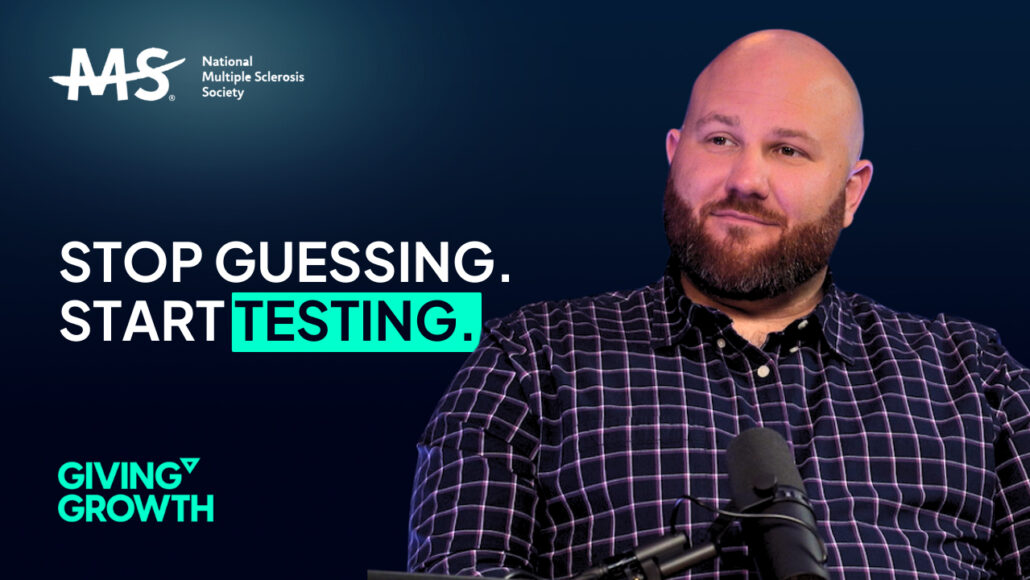
Ethan Wasserman, Senior Director of Paid Media at the National Multiple Sclerosis Society, joins Greg Sobiech on Giving Growth to unpack what really drives effective digital fundraising, and why timeless fundamentals matter more than the latest tools or trends.
Drawing on his background in both for-profit and nonprofit marketing, Ethan argues that the sector’s biggest challenge isn’t a lack of technology, but a lack of curiosity, experimentation, and donor-centered thinking.
In this episode:
- Why declining donor counts aren’t a generational problem, but a relevance problem
- How experiential and peer-to-peer fundraising unlock deeper engagement
- The importance of data fluency for modern fundraisers
- How to test, learn, and fail responsibly in a risk-averse sector
- The biggest misconception about technology
- How AI can save time and sharpen thinking without sacrificing authenticity
EPISODE TRANSCRIPT
Giving Growth Podcast – Ethan Wasserman (full transcript)
Brought to you by Delve Deeper: https://delvedeeper.com/
Greg Sobiech
There is a problem that non-profits can’t ignore. The traditional giving pyramid is crumbling. The count of individual donors is declining, as reported by the latest GivingUSA report, and older donors are aging out, younger donors don’t seem to be filling the gap fast enough, and a volatile economy is squeezing non-profits from all sides.
This is Giving Growth, the podcast where we talk to leaders who are reshaping the non-for-profit world and tackling these challenges head-on. Sign up for the Giving Growth weekly newsletter by going to delvedeeper.com podcast and get one idea worth sitting with every week. My guest this week is Ethan Wasserman and he is the Senior Director of Paid Media at the National Multiple Sclerosis Society.
Ethan is a digital marketing leader with over 14 years of experience running successful campaigns across every major platform and channel. He has managed multi-million dollar budgets, built and led high-performing teams, and delivered significant results for mission-driven organizations. At the National Multiple Sclerosis Society, Ethan is helping reimagine digital fundraising, bringing a test and learned mindset, a belief in timeless principles, and a relentless focus on engaging the next generation of donors, whether it’s optimizing campaigns at scale, developing new peer-to-peer fundraising strategies, or turning data into smarter storytelling.
Ethan’s approach combines innovation with a deep respect for a human side of giving. Well, thank you for being here. We are here in Denver.
Ethan Wasserman
Thank you for having me. Good to be here.
Greg Sobiech
So you have over 15 years of experience in digital marketing, both for for-profits and then for not-for-profits. Are there specific moments that you can think of, specific formative experiences that you’ve had that shine light on who you are today?
Ethan Wasserman
Yeah, absolutely. I think back to right after college. I was lucky enough to join a mom-and-pop business, a smaller business, but they were growing really fast.
I think 10 or 20 million a year by the time I joined. And I got to kind of jump in the director of marketing seat. So I was young, had a lot of responsibility, and Google decided to give the company a manual action, which is when Google delists you from search engines, which if you’re an e-commerce business is a death sentence, essentially.
And so here I am, I don’t know, 24 years old, something like that. And the CEO of the company comes in, he hands me a credit card, and he says, you don’t leave this office. We need to figure this out.
Get us relisted. So spent the next few days. What we ended up discovering was a lot of websites were linking to our site, and it looked like we were buying links, which early SEO, very important was web links.
So before Google kind of allows you to say, hey, we didn’t order these. This is just a natural link. They make you show an effort that you’re trying to clean the links up.
So we try to approach this problem. The problem one was how do you collect all the links? So we created a bot crawler to just crawl the DNS information and kind of figure out who’s the webmaster, what’s their email that’s linking to us.
And then we were thinking, well, how do we reach them in a way that’s interest? What I learned early on was the first thing they say is, well, my link removal fee is $15. So it’s kind of like an early Wild Wild West where they’d link to you, you’d get penalized, and then you have to pay $15, which in and of itself is not a problem, but when you’re talking 20,000 links, it’s expensive.
So we tried to be creative about it, and we made this graphic, and we said, arg, webmaster, you’re making the seas stormy for us. And we tried to be funny about it. And a lot of them responded, I’m going to wave my feet because you made a good laugh.
But so we got a lot removed, but it still wasn’t enough. But we kind of ended up getting the manual auction repealed in a few days. But what was interesting was, it was a big moment for me, because I see marketing as essential to a business, but not mission critical.
It’s not finance, it’s not legal, it’s not like sales, let’s say, but it’s important. And what this was kind of like the nexus of all those things, it was the business completely stopped without Google. So there was power over influencing that decision.
There was the problem solving and the botting of just trying to figure it out. And in the end, it kind of, I don’t know, I was kind of hooked on marketing ever since that it’s essential, but not too crazy, but unique and really challenging. So I never looked back.
Greg Sobiech
I mean, I love how you had fun with it. But also you had to be methodical, right? There were many of these backlinks that you had to remove.
What did the process look like?
Ethan Wasserman
So the first the first challenge was just identifying it. And so you can manually go, so Google had this tool where it would download all the URLs and the backlinks that were negative reviewed were classified as such. And so you end up with this giant Excel doc.
But now you need webmaster contact info or even webmasters is light because a lot of webmasters are webmaster at domain, and it’s not really the person who needs to see it. And so the first thing was creating a bot. So I had this really good Selenium coder, I want to say, and he just made sure that it would enter the domain, pull the info and export it in Excel.
So step one was just identifying who we needed to reach out. Then we needed to figure out how to do it in a way that it’s not going to be ignored. Because, again, maybe this was the young person in me, but Google said you need to show genuine try.
You can’t just say this is a bad link. So I think in trying to determine what genuine meant, I was really being genuine about it and trying to be funny. What was really cool, too, is we even turned it into a positive because as soon as that was done and it was live and sales were back up, we pitched all the search engine marketing journals, search engine online, search engine land, and said, look at this cool thing.
Until today, the links exist on the site and our method is there. And so we turned it into positive backlinks in the end. So it went from negative links and delisting to domain boosting genuine links.
And it was a good push from the marketing team, too.
Greg Sobiech
If you think about that experience, and I’m sure there’s a number of great stories that you can share from the last 15 years. And now imagine that you’re going to, let’s say, Stanford Business School, right? It’s the number one business school in the world.
Let’s use that example. And you’re a professor at Stanford Business School, teaching a course on digital marketing. What would be three modules that you would want to teach and why those three modules?
Ethan Wasserman
Yeah, it’s a very good question, because it’s hard to distill it down to three. Two seemed obvious to me. So one is how to collect and analyze data.
What does data tell you? So just getting your hands wet and familiar with what is data? How can you use data?
You know, it’s a word we throw around, but really, it just means information. So how do you take the information of who you’re trying to reach, what your business is doing, what your campaigns are doing, and turn that into something actionable? So I think that’s a critical skill.
It’s really a skill that’s only best learned doing it. So maybe it’s more of one of those hands-on clinical modules where you’re – I kind of remember when I was in business school, I remember you had like this fake stock portfolio where it was fake money, but you get to play the stock market. And I remember learning a lot from that.
So similarly, maybe there’s a version of that in like some Google Planner tool or something out there. So I think hands-on with data is number one. Number two is experiment creation, maybe.
Maybe it’s like the scientific method. I’m not as formal in it now as I was years ago, but I think understanding how to try to control an experiment so you can learn from it. So setting up your experiment, what are you measuring?
Controlling as many variables as you can so that the thing that’s affected is from the thing you’re changing. So you can try to understand it that way. So some basic experiment design.
I mean, this is an intro course, so it doesn’t have to be too crazy. But I think just understanding that that’s important. If you’re testing too many things at the same moment, you don’t really know what drove the result.
So at the same time, I don’t think it needs to be one-to-one. So I think understanding that. And the third one’s a little cheesy, but I really think like a communication course or I don’t know if it’s how to communicate, how to write, how to talk.
But marketing is one of those topics, especially digital marketing and especially performance marketing. When you start going there, it’s really a data-driven exercise. And eyes instantly glaze over when you start talking ROAS, CPAs, conversion rate, whatever it is, CTRs.
And sort of explaining every single time what the acronym you’re using is. Communication is huge. And so some of the best things I’ve done are so simple.
Following up after a conversation with notes. Maybe I’m a reading learner. I’m not a visual learner.
I need to read it. Best way is to write it. So if you’re someone like that, notes are important.
Following up with key takeaways. Using visuals. This is maybe where AI is really helpful in creating really nice visuals without being a creative person.
I’m not a creative person, but I can throw something in chat and say, hey, make a little chart of this for me. And so I think being an effective communicator is especially in non-profit critical. I say especially in non-profit because in my experience, there’s less technically savvy, technically experienced people.
And so you even more so have to explain your point of view and help move them along to where you’re going. And so communication is almost as important as the data aspect of it.
Greg Sobiech
So I’m super curious, actually, if you were to pick those three communication, better communication skills, better data skills and experimentation, if you were advising someone on just pick one of those three as a successful character trait or skill to have, what would you out of communication, data and experiment? Which one really stands out the most?
Ethan Wasserman
It’s a tough question. It’s 50-50 between data or communication because communication serves you in a lot of places.
Greg Sobiech
You can only pick one.
Ethan Wasserman
I’d have to go data. For me, data, an interest in information and an interest in what something means, it has so many benefits. It’s not just in your work.
It’s how you learn as an individual. It’s how you approach relationships in your life. It just comes from an innate curiosity of why something is.
And without that, I don’t even know what I would do.
Greg Sobiech
So I want to shift gears to what’s happening with the industry right now. And I think that you have a very valid perspective because you have come from a for-profit world and now you’re working for a charity. And I think that’s beneficial because you probably see things slightly differently than someone who has been in the vertical their whole career.
And the thing that everyone talks about right now is the fact that the donor purse is shrinking, yet giving is actually kind of increasing in terms of dollars because older donors are giving more, but younger donors are giving less. And that obviously is also a simplification of what’s really happening. What do you think is going on with the industry at a high level?
Do you think that these changes in count of donors are driven by the fact that younger populations just aren’t at that interest in giving? Is it a trust issue? Is it simply because there’s so much fight for attention?
Charities are struggling to win that fight? Or is it something altogether? What are you seeing as the major shift and major drivers behind those shifts in the industry?
Ethan Wasserman
Yeah. I mean, it’s a very good question. And it’s certainly, I feel like the question of the year.
My opinion, I don’t have data to back it up. It’s just from testing I’ve done and from experiences I’ve had. But in my opinion, what we’re experiencing is not a generational shift or not a persona or personality shift, but more, I think the younger demographics for sure, but just society in general is more aware.
There’s more data, there’s more social, there’s just more things giving you information. And I think people are just more acutely aware of like the behind the scenes aspects of businesses. So I think what we’re seeing is a requirement to deliver value.
And it’s not just, oh, I find it fascinating that the end of Q4, like the last three months of the year, huge fundraising times. And I’ve honestly thought about why. And I think it can be rooted a little bit in like religion, a little bit in habit, a little bit in it’s the time of year where we’re all getting these things and being with family.
And so you’re forced to be thoughtful. But I see it really as sort of like a historical time. I don’t know, I think of my parents, like they always gave that time of year because it’s just the spirit of the season.
And so I think what we’re seeing now though, is you’re not given by these more, maybe the word I would use is traditional, but more of these milestones, these traditional, oh, I’m giving now because it’s expected of me or because it’s the season. And more, I want to give because I’m tied to it personally, because I believe in it or because it’s actually doing something. I think like the modern consumer is more concerned with, am I giving it to an org that’s fiscally responsible?
Am I giving it to an org that is efficient and they’re not just wasting money where a dollar here, where let’s just say 90 cents goes to the cause or here we’re 50 cents. I’m not saying that they think of it so mathematically, but I think there’s this hyper alertness to the social aspects of giving and the organizations that can tie the giving to that feeling and that effect, I think are going to be more successful. And so what you’re really going to is more of like an experiential based giving.
You’re not giving because it’s tax season. You’re not giving because it’s the holidays. You’re giving because you’re helping a mission.
You’re doing X, Y, and Z. So I think how it affects marketers is it’s how you talk about what you’re doing. It’s no longer, okay, give to the society because support us.
It’s give to the society and do X, Y, and Z. And there’s a more of like a one-to-one connection. And I think it’s a combination of really just technology making these informations available.
And so now that you see it, how could it not affect your calculation for where you give and what you do? I don’t think young people don’t want to give. I think young people want to give where it helps them, affects them, but also makes them feel good, not in a selfish way, but that it’s actually doing what the funds are said to be doing, or you’re thinking about it.
And so the storytelling becomes a part of that.
Greg Sobiech
I’m especially curious about your point of view on this question, because in the world of charities, I would judge you to be a young person, relatively speaking. And I think that there are a number of people like you who are in their thirties, early forties, who would be considered relatively young in the industry. And I frankly wish that more of the people my age, in their fifties, who often are in these C-suite roles, listened to what you and others like, you have to say.
I like how in our prep, you talked about your belief that it isn’t about young versus old. It’s not about these labels we put on people, but it’s about the level of engagement that we think about in kind of getting them fired up. When I say engagement and donors, what are you hearing?
What does that mean to you? Can the industry obviously do a better job of engaging donors or what are you doing to make sure that at the society you’re engaging donors so they give?
Ethan Wasserman
Yeah. Well, I think ultimately, whether you use the word persona, audience, constituent, whatever the word you use is, but you really have to get in the mindset of who you’re asking what. Because I mean, a healthy exercise for me, and maybe this is a product of my age that you said before, but I asked myself, would I give in this instance?
And so, you know, talking about the society, I am not a biker. I would do some of the extra experiences. They had a jet pool experience, which was really cool.
People pulling a literal jet on tarmac and making teams. And so I think the first thing you can kind of do is just think through like what is important to you. And so obviously your perspective comes into play, but the empathy of thinking of others.
But I think the most important thing is to just think about the messaging and who you’re talking to. And so I don’t think of it as all people in this age group fit a category. I think of if someone is moved by the impact their dollar will have, go that way and talk to them about that.
If someone is moved by an experience that they can make a memory with their family, I mean, there are certain rides and at the society for the bike MS series that are family friendly events, people doing it with their kids. And so the message there isn’t riding, donate to the society or support the cause. The message there is have a great time with a good cause.
And so I think you think about who’s the intended message and then craft those stories. So, you know, there’s a lot of words and buzzwords and marketing for how you describe that, but at its root, it’s you’re telling them what their contribution can do. And also giving them something that’s unforgettable.
I mean, for me, going to a Walk MS event like you and, you know, I managed it for probably a year before I went to one, which is kind of crazy. And then you go and then you just like you feel the feelings and you’re there because we’re supporting people we love. And that’s the root of your message.
And it has to be, it’s not just registered today or you’re going to miss the sign up. It’s registered today and make an impact. And I think it’s going to become more critical as we talk about these generational shifts.
I will say equally as important is authenticity. If it feels fake, if it feels contrived, I don’t think, I think that’ll hurt you. And so it has to be genuine and how you get to genuine is something to think about.
But I think it’s the root of being successful today. And I think it’s only going to get more important as we go on.
Greg Sobiech
I mean, I love how the society is doing all these activities because you would think that other charities, whatever is the problem, whether that’s cancer or heart disease or, you know, like memory issues, that any organizations could actually do what you guys were doing. And yet you’ve leaned so heavily into kind of experiences, providing experiences for donors. And I’m curious about the role of peer to peer in that process.
What’s the connection in your mind between engaging donors through experiences? To your point, I love how, because I agree with you, like, you know, I’m married, I have three kids. And I mean, honestly, would I attend and spend a half an afternoon because I care to give to charity?
Or would I do it because it’s almost an excuse. I’m hiring the society for a job, which we spoke about earlier, that jobs to be done framework, right? The job is help me hang out with my wife and daughters.
And that’s why I’m attending. And by the way, it’s also an educational experience for me and my wife and our kids. We’re teaching them something.
So it is one of those two birds with one stone situations. It’s a win-win for everyone. And I love that you guys are doing this.
And what is the role of peer to peer in that process?
Ethan Wasserman
I mean, quick side note before I answer. It’s funny because at any walk event, you’ll see a balloon maker, a balloon.
Greg Sobiech
Yeah, yeah.
Ethan Wasserman
They make balloon art.
Greg Sobiech
One of those like, yeah, yeah, one of those like shapes.
Ethan Wasserman
Yeah, because I think people are bringing their kids to your point. That’s being cognizant of what this event is. If it was a 5K, you don’t have that, but you have it at the walk, which is more casual.
I think, so peer to peer is interesting because first of all, and I had to learn this, I don’t want to say the hard way, but like the hands-on way, it’s very different. You’re not asking someone to donate. You’re asking someone to fundraise on behalf of your organization.
So already you’re talking about the higher, the more involved constituent. It’s not someone who’s going to give once or go to an event. It’s a big ask.
And when you talk about bike and other things, I mean, some of the routes are 50, 75, 150 miles. And so, and some, I mean, there are entry-level routes in all cases, but it also is something that’s not just, you don’t decide tomorrow you’re going to just do this necessarily. So there’s a little bit of a training period.
Think twice about that. For sure. So I think number one, you’re already dealing with like, because someone’s willing to fundraise on your behalf with your group, I think that’s that.
That’s already a level of like commitment. I think it’s also important because the messaging from a marketing perspective is very different. It’s not just join us.
It’s join us and like work on our behalf to an extent. That said, there’s also ways around that. If that’s not the audience you’re reaching, I think bike’s a great example.
This already was really mostly baked by the time I joined the society, but I joined on the tail end of like the re-imagining of like the bike MS New York City event. And the sort of challenge we were facing when we started was young people don’t participate number one. And number two, the fundraising is a hurdle in New York for whatever reason, just that, that, that event versus others.
And so we sort of re-imagined what the event could be and messaging video ads, everything sort of changed around instead of the traditional bike MS angle, which works in a lot of places. It was see New York, like you’ve never seen it before. The FDR is closed right up.
It’s an experience. And then we didn’t go this far, but we’ve talked about even just saying, instead of doing a fundraising minimum, just saying $3.99 for the day. And it comes with the bike and the this and the that.
And so really angling it not towards a fundraising event, but towards a chance to see New York in a way. I mean, when is the FDR closed? I lived there for six years.
It’s never closed of three, four events a year. I don’t know. And so now you’ve shifted it to the younger audience where it’s an experience.
And I have to say the second most successful group from a registration perspective that year was the 18 to 29, which was awesome. They didn’t fundraise as much. So that’s like, that’s a different challenge.
It’s okay. So they’re registering. So now how do we, if we want to fundraise more, how do we do that?
But at the end of the day, the challenge that young people don’t participate in bike wasn’t really true by talking about it in an experiential way and a once in a lifetime chance and writing with your peers, getting the support and just being in New York without getting, I think the, the ad ad don’t get a ticket. Don’t get honked at. Don’t get hit by a car, just relax and ride.
And that spoke. And so I think if you have the luxury or for certainly for your bigger events to really think about how you can talk about it in such a way and shift your audience.
Greg Sobiech
I love that example and thanks for sharing it because I talk to many charities, tens of charities every year, and I wish more, more of them lean into that example. So if you like what Ethan spoke about, reach out to Ethan Wasserman at the National Multiple Sclerosis Society. I’m sure he can share those examples with you.
I do want to shift to something that you shared with me during the pre-interview and you talked about timeless principles. And one of those principles is one of the three things that you said you will teach at Stanford Business School, which is experimentation. And I have a question about failure.
In my experience, failure is a lesson. It also bites you in the butt a little bit when it happens, right? But my judgment of the sector is that it’s a little risk averse.
I wish it moved faster and I wish it failed faster and learn from those failures. What’s your take on failure and why is it important in experimentation?
Ethan Wasserman
Yeah, I mean, you really can’t be failure averse and I understand the why. In my assessment, especially, I mean, the society has been around 80 plus years and so I think you’re fighting, number one, just the longevity of the org and how it’s been done. So I think, and that’s true for any org, it’s not true, it’s not unique to the society or anywhere really, but I think nonprofit maybe has a little bit more where you have these longer legacies and sort of like this reputation to uphold and this very rightful concern about the legacy.
So I think you’re fighting that. You’re also, in general, in my experience, nonprofit is not as technologically advanced as like a for-profit or something where clients are coming to you and saying, I want the new thing, how do we do this? So I think you’re fighting through those things a little bit.
But if you can get kind of past those, I think the biggest hurdle is risk adverse. And I understand why also you’re dealing with donor funds and so you don’t want to go to a donor and say, oh, we tried this and it failed. But I also don’t think it needs to be failing in such a fashion that you’re like really wasting.
I think it’s a mentality and approach to how am I going to learn from everything that I do? I mean, I’m setting up experiments with even the smallest of things. Even it’s as simple as changing this line in it or changing the CTA from like maybe sign up or register now to join us, little things like that.
It could be color. I’ll never forget one year, this was actually at the same company I was talking about with the diamonds. We were trying to figure out what color is the best CTA and we tried like eight different colors and ironically, the society orange was the winner and highest CTA when we did that test.
But I think it’s more of like an approach to trying to learn from everything that you’re doing. Recording it is huge and probably the hardest part. I’ve been at orgs where we’ve built wikis.
I’ve been at orgs where we have a Word doc that’s 80 pages long. At the society, it lives within Asana, a tool we use. But it’s hard to have the learnings accessible for future iterations.
That’s probably the hardest part, not actually the experiment. But you can’t be failure averse because if you’re going to be avoiding failure, you’re not going to try those little things. But again, you set your parameters and be responsible.
So an example might be if you’re trying to reach people who are newly diagnosed with MS or potentially newly diagnosed with MS and we’re trying to showcase the experts we have available for free or the webinars or the checklists we can have to just kind of help you on your journey, we might want to test multiple audiences. And so it might be audiences available in the platforms. It might be based off what people search.
But again, if you’re afraid to try something new and risk spending a little bit of money trying to find it, it might be difficult. But if you’re open to saying we’re not wasting, we’re trying to find the best audience for this. And then when you find the right audience, I like to say fuel on the fire.
And again, data is important because you keep adding more until it sees diminishing returns and you kind of max that out and then go to your next channel. And so it’s this constant effort of like you imagine like a dashboard of all the levers you can pull and the returns you get and the results you get and maximizing the ones with the highest and then you find the others. The only way you get there is by testing.
And so you have to be open to some level of failure. That’s not to say disrespect your org and the donors. You are funded by donors.
And I think that your root has to be we’re not wasting money that’s not ours. Someone gave to this mission. So you have to.
But if you’re doing it in the effort to find people who need the resources you offer, it gives you a little bit more of a drive and like an effort to do it, I think.
Greg Sobiech
And is there a methodology or an approach like again, back to Stanford, you’re teaching this class about experimentation. You know, you’re sharing the fact that failure or lessons are and by the way, I think we all learn from failure, right? It’s hard to learn sometimes from success.
I find in my life that failure is where I actually listened to universe telling me something. And I think that’s kind of happens with all of us, but you shared your perspective on failure and why it’s important. And now you’re saying, here’s some timeless principles or rules of thumb, steps to go through when doing testing, when experimenting, what would be some of those steps in the testing process that you feel are really important to remember about?
Ethan Wasserman
Yeah. So if I was teaching that course, I would brush up on scientific design. It’s been a minute and I think it does need to be rigorous and it needs to be sort of in your understanding, like the key fundamentals.
But I’d start with very simply, first of all, and this is easy, but it’s not easy. It sounds basic, but it’s not easy. What are you testing?
What are you trying to learn? That’s number one. Number two are what are the variables you’re manipulating to test that?
And I think the hardest thing to do is to limit it and not do too much because this has happened too many times where you’re trying to learn too many things and then something happens and you’re not sure what drove it. Was it the change in CTA? Was it the design of the ad?
Was it the audience? And so you really have to have a situation where you have two identical things. One is your leave it like it is.
It’s your baseline. And then one is what you’re testing and you ultimately measure lift. I mean, one of the experiments I think of we ran recently was of the people that searched for the term National MS Society and landed on the homepage.
They landed on the homepage and there’s a percentage of those people that don’t donate. And the question is, can we increase that donation by changing the experience of the homepage slider? And so 50% of people got the website as it is, whatever it was in that moment.
Whether it was a new research that came out, some news, an event, whatever. It could be a thousand things. And one specifically got the first homepage slider that was a donate ask and what it was going to.
Haven’t gotten the results yet. We’re being, we’re literally finding the results now. This is something we just finished in August.
We were able to control everything except for that one thing on that page. It was to the same audience. It was to the same ads, everything.
If you had changed too much, what really is teaching you? So I think those are like some key fundamentals, but I definitely recommend like brushing up in scientific design. I’ve done it in my career and it’s been helpful and maybe it’s time for a brush up, but it just helps you make sure you’re learning the right things because probably the only thing worse than failure is learning the wrong thing and going down that way.
Cause now you’re confident and you’re doubling down and you don’t want to do that. So I think you do have to be careful what you learn.
Greg Sobiech
I like what you shared. And also I literally have this on my, on my, um, uh, night stand, which is a little like super geeky for me to share, but I have a book by Claude Hopkins that he wrote in 1932 called Scientific Advertising. And I think this just tells you that, you know, I’ve been in digital for the last 25 years and I really do enjoy it.
And I, I, I read the book once and I really don’t know why it’s still there probably because I just didn’t move it. Right. There’s no other reason, but to your point, it’s fascinating that over a hundred years later, those principles are still relevant.
Obviously in the world of direct mail, I think if I talk to anyone who is a direct mail professional, they would talk about test controls and to your point, holding one variable, you know, holding everything constant except one variable. And yet in digital, we kind of outsource much of the thinking to an algorithm. And I think it’s both good and bad.
So I love your point. I completely agree. Like if you’re going to do anything, just change one thing.
Right. That’s, that’s, you can’t go wrong with that approach.
Ethan Wasserman
Yeah. Right. You make a good point that it almost feels, is it archaic because it’s sold, but I don’t think it says that.
I think it says it’s like a really true fundamental and it’s kind of my argument for just general approach to paid media. There are so many platforms nowadays that can manage it for you. I can do it for you.
But the risk is you become disconnected from the very thing you’re expected to control. And so like one of the greatest fundamentals I preach is hands-on platform. Don’t use the tool that’s between you and Google.
Don’t use the, the Facebook tool that lets you like streamline it. Yes. Efficiency is important and scaling is important.
And maybe one person can manage three platforms instead of one. But when you lose that, you lose the ability to manipulate the little things that make the difference. And so when you talk fundamentals, I think that has existed this long because it’s so, so core to what we really should be doing.
Greg Sobiech
Yeah. Which I think goes back to like your point about curiosity and having hypotheses. Right.
I mean, I even, even there’s just this idea of know your customer or know your donor. Like, of course I can go to ChatGPT or Gemini and I can talk about National Multiple Sclerosis Society and, and what are some different reasons for giving. And it’s going to give you probably like good ideas.
Like even that actually is a great start, just getting in the head of the donor or, or the customer. And I know, you know, we both know Francesco De Flavis, right? Who I’ve known forever.
And then you is you report to, and he talks about this a lot. And I like how he talks about they need to see the world through the eyes of the donor. Hopefully in our, in our kind of foreseeable future, the machine still won’t be able to replace us.
And I think as marketers, that’s where we add lots of value. And I think that’s where to your earlier point, creation of hypotheses starts with seeing the world through the eyes of the donor. And, you know, I, in my career, I get stuck behind the scenes, the screen so often, right?
It’s hard to see that. It’s hard to like, get, get outside of the office, get outside of the spreadsheet.
Ethan Wasserman
Yeah.
Greg Sobiech
I think about tests and ideas.
Ethan Wasserman
Yeah. So you kind of, you talked about the book on your nightstand for me, the thing I preach and people I work with are probably sick of it. But the adage I go by is like, what gets measured gets managed.
Sometimes simply looking at the number, not even deciding to influence it is enough to change it. I mean, think about like we talked earlier about this isn’t just a marketing thing. This is your personal life.
Just weighing yourself is enough to make you conscious of the decisions you make that affect your weight. And it’s true about anything in your work. I mean, sometimes it’s enough just to be cognizant of it.
So you give yourself that framework for like understanding what are you measuring? What are you looking at? And sometimes it’s as simple as just looking at it because naturally if you are curious and you want to do better at your job, you’ll think about, oh, I can improve that number.
I can change this thing. And so I don’t know what you just said resonated with me in that. What gets measured gets managed.
Simply start measuring it. Step one, just record it. Measure it over time.
Look at it on a trend chart. Look at it in different times of the year, different season. And that’s often enough to just like start you on this data-driven journey of improving over time.
Greg Sobiech
I mean, because between the two of us, we probably have 40 years of experience doing this stuff. What you just said, again, seems so simplistic and simple, and it’s yet profound. My wish for the industry is that whether it’s just change one thing at a time, measure what matters, see the world through the eyes of the donor, the customer.
Yeah, it’s simple, but there’s this quote that I love, which is, to know and not to do is not to know. And I think it’s one of those things that we know intuitively is the right thing to do, but we don’t do it. So do we truly know it?
Do we truly embrace it? Do we truly live it? But I want to shift gears to a question that you liked because you told me you like it.
And that’s a question about technology. And when we were preparing for this, I wrote in the notes this idea that vendors seem to oversell charities, but also for the for-profit sector, on like magical solutions and these unicorn technology stacks, right? That you just have to spend lots of money, millions of dollars preferably, and they’ll solve all your problems.
And what in your mind is the biggest misconception about technology in the sector?
Ethan Wasserman
That technology is a replacement for, the word that came to mind was talent, but maybe I mean skill. That technology is a replacement for skill. I mean, to your example, what you just said, you don’t know until you do.
If you think hiring an agency or hiring a partner or a consultant is going to solve your problem, I mean, it’s not not valuable. It helps you see things in a different way. Agencies can upskill your staff.
Agencies can help you fill gaps that you don’t have talent for today. Or maybe they have clients that went through something differently and can give you a different perspective. Those partnerships are critical to business, but when they replace the thought and action of those in your org, that’s when you’re at risk because you need someone, they’re never going to be as committed to you as you are to it.
You are committed to this one client, this one organization, the National MS Society and the mission to cure MS. Your agencies probably resonate with it. So many times staff in our agencies have someone in their families connected to MS, so it is personal, but you also are a client and it’s not their job to do that for you. And so I think it’s easy to think of a technology and say, oh, I’m just going to sign up for this new Google product or there’s this new thing and how many times it’s like a $50,000 onboarding cost and then a retainer.
And those things can be valuable, but if your staff and your team is lacking the core understanding to like run them themselves, or at least maybe it’s, I could do this, I just don’t know it today, that’s okay. But I think that mindset is just, it’s almost a cop-out. It’s, oh, I can throw money at this problem and it’ll solve.
But if you’re talking about the longevity and to not be dramatic, but the survival of your organization, you and someone on your team needs to know how to manipulate these things, how to understand them, what to ask, and it’s okay to do it with a technology. Technology makes us more efficient. I mean, at our org, if we didn’t have Asana, I don’t know what we would do.
It’s just helped centralize the production line of what we need to do. But at the same time, it’s not a genuine replacement for a project manager or someone who understands how to organize and make sure work gets done. So I think the message for me is, use it to supplement, but not to replace.
And I find way too often, I mean, this isn’t unique to non-profits, it’s in for-profits as well, that the fancy new technology is going to solve your problem. What happens when that technology goes out of business, when it, there’s an update that limits it. Now you’re stuck for months scrambling and you don’t even, you can’t even make due in the meantime.
And so it’s just, when you talk about risk, I think like that’s a risk. A risk probably not worth taking is relying too much on someone else for your outcome. Support it, test it, learn it, but don’t replace it.
Greg Sobiech
My take on this question is very similar to yours. You know, I obviously run an agency, right? So you may think, or I want the client not to know too much, because technically that would be to my advantage, because I could take advantage of the client if they don’t know too much.
And in fact, that’s obviously a win-lose thinking. I subscribe to win-win-win thinking. We can all win together and create more value.
So I actually love it. Like I truly love it when the organization or the people I work with know a lot, where they see me as an arrow in their quiver, right? I am meant to be one of the elements in their tool belts, but you need to know as a technician, do I need this drill or that drill?
What do I use this tool for? And what do I use this agency for versus not? What do I use this piece of technology for, right?
Same with my team, right? You have people on your team and some of them are better for some things and some of them are better for other things. So we always have to make these trade-off decisions about what do we use an asset for, including a piece of technology, but we can only make these decisions smartly, like in a way that actually makes sense, if we get it, if we have some level of understanding.
And it always scares me to your point when anyone, including on my team, by the way, it doesn’t just decline. Some of my team just thinks that magically Google ads, for example, will, because it’s a piece of technology, that it will do what’s right for me, forgetting that Google is a publicly traded company. And of course, like I like Google, I’ve been around Google forever.
We are a Google partner, but their goals are tied to their shareholders and stock price. So are they really driven to minimize CPCs with PMUX? I don’t think so.
I think PMUX, as an example of technology, is a great algorithm. It works fine. But honestly, I often see it giving 30 to 50 cents on a dollar.
So is it working for the society or other charities, or is it working for Google, PMUX? I think it’s working for PMUX. I think it’s important to know, and I think it changes how you actually use that technology and how much you rely on it.
So I totally agree with you.
Ethan Wasserman
Yeah, I mean, I couldn’t agree with you more about leveling up your team, because, you know, in my role as overseeing paid media at the society, a lot of that means managing agency relationships. And I mean, how I met your team years before I met you was through that value add. And some of our other agency partners, it’s the same thing.
When we scale up together, we’re now at such a sophisticated implementation of our plan that if you didn’t treat it like that, and it was antagonistic, where it’s, oh, like, honestly, I do feel that sometimes with Google, where the recommendation is always add more budget. It’s always the recommendation. It is.
But when you get deep with your rep and you can get the good reps, it’s nice. But with your agency partners, when they’re scaling up, when you’re scaling up, what you can do together is just amazing. And I don’t think the goal always has to be in-house everything.
That’s not the answer, because at the end of the day, I’m dealing with just the society. And I know you and our other agency partners, you’ve got clients in numerous spaces that can bring lessons from other things. I mean, a lot of what I’ve done at the society, I learned in my time in automotive.
Automotive loves targeting car lots of competitors to try to bring people from their lot to, like, a Ford’s going after Chevy, Chevy’s going after CDJR, and they’re just all going after each other. And I came to the society, and the question was, there are a ton of people who attend walk events that don’t sign up. How do we reach them?
Well, guess what? We geofenced the finish line and subtracted those that subscribed, that signed up, excuse me. And so that left us with a group of people that didn’t sign up, but attended.
So that means they have some connection to the society. And now we’re testing, how can we reach them? What messaging?
That was something I learned from working on automotive, and I don’t think I would have in fundraising. And so if you’re open to the lessons your agencies and learn, and I want them to upskill as much as we do. And then it just evolves from maybe, like, setting up the fundamentals to now trying some really crazy, fun things.
But they shouldn’t be antagonistic. And I’d argue, it’s probably, like, really unhealthy for it to be like that.
Greg Sobiech
Makes sense. And I want to shift gears to another question. But before I do, if you’re enjoying what Ethan and I are discussing, go to delvedeeper.com slash podcast and sign up for our weekly email. This goes out to a list of about 3000 people right now. And you’ll get into your inbox, one idea worth sitting with every week, takes 30 seconds to read. And I think that you’ll find it quite valuable.
So back to the show, Ethan, we spoke about technology, but I like how you have this quote, and I quote you. You often say, treat internal partners like clients. So treating internal partners like clients, what does this mean to you?
And can you give an example of why that’s important?
Ethan Wasserman
Yeah. I mean, I would say this is maybe one of the best takeaways from our conversation today, which is interesting because it’s technology-based, but this isn’t. But, you know, I come from an agency background.
I spent, of those 15 years, probably 12 in an agency. And so, and with an agency, you’re dealing with your clients. And, you know, to an extent, that is, like, clients are always right.
It’s not always true, but you have to listen. And you have to treat it with a certain respect. So it’s easy when you work for a business or an organization to think, oh, we’re on the same team.
And you kind of lose that hand-holding explanation part of it. And you sort of maybe get to a little bit, like, of a telling stance. So this is what we’re doing, or this is what we’ve tested.
I treat all internal partners, especially ones not in marketing, as clients. And what that means is I’m automatically hand-holding a bit, explaining. Like, one of the best things that served me when I had clients directly, and at one point I had 120 clients at one point on my desk, which was a lot of work.
One of the best things I did is after every single call, just follow up with notes and just, like, a to-do list. So they didn’t have to think about what was coming next and when it was coming. I try to do that internally as well, because if you treat them like clients, you give them a little bit more grace with, like, what they do and don’t understand.
You’re more consultative and more collaborative than you are, I’m in marketing, I’m in charge of paid media, this is what I’m doing. And often you find better work. I’ll never forget, you know, my first year at the society, I didn’t understand necessarily the fundraising cycle.
And so I had mapped out and flight planned the whole year. And I love her. Someone on my team called me and she said, you need more budget in December.
And I said, what do you mean? She goes, just trust me, you need more budget in December and here’s why. And I honestly didn’t understand it.
I didn’t have year-over-year data to really inform it, but I trusted and I listened. And that was, again, I cultivated an environment, we cultivated an environment where we were open like that. And I, till today, like, I feel like two weeks ago, we joked about it.
Like, I’m so thankful she did that because if you’re not budgeted, you’re not going to show. And the ROAS, the return on ad spend for that month is five, six, seven, eight dollars on something that’s normally two or three, let’s say. So it’s just the season.
And so had she, had I not listened to her and gone with, no, this is my work and I know what I’m doing, I would have lost a lot of opportunity. But by cultivating a client-first mentality and working with other people, I think we got the best outcome. So it’s absolutely essential.
I think a nonprofit where maybe a little more, that’s not true, nonprofits have it too, we’re very siloed. One of the first things I did was just connect with our development partners. What are your goals?
Is it our job to make events successful and make sure people get to events? Or is it our job to fundraise more money? Or is it our job to get more people on the mission?
Whatever it is. And so it’s working in collaboration with other teams and not necessarily dictating those terms.
Greg Sobiech
Switching gears to just the future, I’m always curious to understand what you think will be the major changes or shifts or headwinds that the sector should be thinking about or what are you thinking about in the context of the next several years to make sure that you stay as, let’s say, future-proof as possible?
Ethan Wasserman
I mean, it’s going to feel cliche. I feel like it’s over, overdone. And maybe even as you’re listening to this, you might eyes glaze over, but I really think you need to figure out where you interact with AI.
I mean, it’s interesting. I’m naturally technology-averse, interestingly. Like, I’m all for technology, but I always understand that there’s an ulterior motive here.
And so I’m always like, what’s the motive? I mean, Google products is a great example, excellent tools that you need. But if you don’t have your interests in mind, it can easily overcome you.
For me, it’s how do you work with AI? I mean, if we lose track of how this is going to affect our teams and our workforce, I up front was really resistant to it because I expected it to be like it was in the past, where the answers were close but never not exactly right. And the more I use AI for different things, the more I realize how scary it is.
When I say scary, our work is going to change if it’s not already. And so I genuinely believe it’s not going to, at least not yet, going to fully replace the needs for people and what we do. I mean, just look at LinkedIn.
I think over the last year, LinkedIn went from a place where people were posting content that I loved learning from to what I feel like is an AI post central. Like, it’s 90% of what I see nowadays, you can tell, is just is AI generated. And so it loses this authenticity.
And I think humans, we can bring that authenticity, but you need to figure out for your org, for yourself, for your talent, what that means. And it’s a scary thought. I’m, you know, Google, our Google reps give us access to this thing called VO, which is like video creation.
And I really, I said to myself, this can’t work. And I played with the tool and oh my gosh, it’s scary what you can generate just with some prompts. But now the skill switches from maybe from a video person sitting and managing the full breadth of the video, to managing and editing and doing what they do.
And they’re creative, but also maybe supplementing their work with that. I saw this fancy post from Ikea, where they use the tool and made this really good commercial. And watching the input on that prompt was, I thought of it, think of it very differently now, the way they prompted the AI engine to give you what you wanted.
So again, it’s cliche. And I feel like it’s so overused. I mean, if you got a penny for every time someone say to AI nowadays, but it’s critical.
I mean, you got to figure out where it fits.
Greg Sobiech
I agree with you. The one thing that I run into when I talk to charities is there is this huge desire to use tech like AI, but there is also confusion about, so what exactly am I supposed to use it for? Besides, you know, writing about your email, right?
Or having kind of a surface conversation about, I’m in this situation, what do you think I should do? And to your point, I think that’s where an opportunity is for anyone who’s like data, technology, creative, curious, who’s a digital marketer, that how can we bring specific solutions almost to the organizations that if anything, save time, right? That help us focus on what’s really most important.
So I know even working with you guys and other charities, that’s one of our big mandates right now. How do we provide the sector with ideas? And we have a bunch of those.
Ethan Wasserman
I think it comes down to what you said earlier. You have to do it, play around with it. For me, hands-on is the way to do it, is the way to figure out where it fits.
And listen, you have to be very careful because there’s been examples of the data being made public. But one thing I took was, I took like a log of conversions, essentially. Removed anything personal, like obviously there’s nothing personal in it.
But I just, I uploaded and I said, help me spot trends. And it helped me realize spikes in times and maybe other outside influences that might have explained why a spike happened. It’s very hard to be aware of all the dates things happen in the real life.
But AI was able to say, hey, this spike, which corresponded with this sporting event was a dip. And then this was a spike, something I might not have realized. And so it wasn’t a replacement, it was a supplement to my way of thinking.
One of the best examples, and this I’m just so happy how much time it saved me, is we were running an RFP and there was over 180 questions submitted. And my promise to candidates was, I’ll answer every question. The other RFP I ran had like 30 questions.
And so now I got 180 questions that I have to answer. And I promised by the end of the week, I would answer. And so what I did was, again, I took the questions that were sensitive, but the ones that I uploaded and I said, talk to me like you’re interviewing me and ask me the questions.
And when an answer applies to multiple answers, put it in most. I had a 30 minute old school AIM chat with chat GPT answering questions. And the result was 180 questions answered.
And not all of them were satisfactory. I had to hand manage some of them and some of them were just too sophisticated, but it saved a lot of time. And so it was an engine for me being more efficient and not a replacement.
It wouldn’t have spit out the right answer. I tried without that coaxing, but together it made me a lot more efficient and I’d say probably saved me eight hours, probably.
Greg Sobiech
So maybe the answer to the question of what are some headwinds or tailwinds and how do we stay future proof if anything as individuals is just to use more AI, right? Just to get better at using these tools, because I find that the more I peel the onion, the more I realize what the possibilities are. And maybe that’s already like a great takeaway, just use more of it more often.
Ethan Wasserman
Use more of it and don’t be afraid of it. I think it’s easy to think this is going to replace so much work and jobs and it might to some degree, but I think that fear shouldn’t justify not using it. And then now you’re completely agnostic to what it’s going to do.
So I think run into the fear. We talked about risk averse. Don’t be afraid.
Hands-on.
Greg Sobiech
So final question. And I ask everyone this question. What do you know about digital fundraising today that you wish you knew at the start of your career?
Ethan Wasserman
That’s a good question.
Greg Sobiech
Digital marketing, by the way, just digital marketing in general.
Ethan Wasserman
I’ll answer both if it’s okay. For the fundraising, I really think it has to be people focused, which again I think sounds obvious. And when you say it, you’re like, of course it’s people focused.
But how many times is your marketing planning completely disconnected from the people you’re talking to? It’s done in a vacuum. From donors.
From donors. It’s done in a room where you’re thinking about, oh, what’s the coolest creative? What’s the nicest messaging?
This isn’t on brand. That’s not the right color. This isn’t the right date.
But you’re forgetting, and that stuff’s important. I’m not diminishing the work, but you’re forgetting what you’re ultimately trying to do is reach an individual. And when you put the fundraiser, the constituent, the person you’re supporting at the center of it, I think it changes.
And again, I feel like fundamental is the buzzword of the day, but it’s something you know. You kind of move away from it to something more fancy or more exciting and more advanced only to come back to the core, which is you’re speaking to an individual by whatever medium you’re doing it in, and it needs to be at its root speaking to them. From a digital marketing perspective, it’s learn how to consume and make decisions on data.
Again, I know we talked about that, but I just think we get so caught up in the summaries the Google overview gives you, or the meta overview gives you, or what ChachiBT says, or what industry blogs are saying. Those things are important, but you need to have your own point of view and figure out to understand what are you looking at? What does it mean?
And I think it was true 15 years ago for me, and it’s true today. And it’s a little weird. It makes you feel like, am I missing something?
Or is it really all just like fluff? And at the end of the day, you need to get to these root skill sets, root concerns, and it’s okay to do the other things, but don’t sacrifice your ability to think, your ability to spot patterns, your ability to set up a test. Don’t lose that in favor of the fancy tool or you’ll really be obsolete at one point.
Greg Sobiech
Well, thank you so much, Ethan Wasserman, Senior Director, Paid Media at the National Multiple Sclerosis Society. Thank you for the time together. And I just love your observations about, I do think it’s about timeless principles, right?
It’s actually refreshing to hear you say it because I agree with everything you said, not because you’re the guest and I’m the host, but because I truly agree with these principles. When I look at industry research, our sector is supposed to 3X from $600 billion to $2 trillion in the next 15 years. So we are kind of in the right place at the right time.
You and I both, right? And anyone who is in digital fundraising or digital marketing, we’re actually one of the top five industries of the future, according to McKinsey’s latest annual report, where they talk about industries that are going to lead the future. Strangely enough, digital marketing is right next to AI and robotaxis and space exploration, which I found to be super cool, you know?
So I think it’s totally okay that we combine things like AI and new tech with old school tried and true principles.
Ethan Wasserman
Yeah, I agree. And thank you for having me. I think I talked about the LinkedIn posts.
I think it’s content that helps drive thinking a little different. It’s so easy to just get the question from the bot or whatever, but to have these kinds of conversations to kind of help you like frame it. And I mean, I’ve watched the content over the years and it’s been very helpful in forming my own previews.
So thank you.