Why Child Hunger in America Is a Policy Failure

Get one
powerful idea.
Subscribe on:


EPISODE SUMMARY
- Why are SNAP cuts more than just a political debate?
- How does hunger “hide in plain sight” in middle-class communities?
- What role do schools really play in ending child hunger?
- How can nonprofits work hand-in-hand with government without losing flexibility?
- Why is hunger a solvable problem — and what’s standing in the way?
- What would a truly bipartisan solution to child hunger look like?
EPISODE TRANSCRIPT
Giving Growth – Rachel Sabella (transcript)
Guest: Rachel Sabella
Title: Why Child Hunger in America Is a Policy Failure
Brought to you by Delve Deeper: https://delvedeeper.com/
Greg Sobiech
There is a problem that non-for-profits can’t ignore. The count of donors seems to be going down and yet the donations, the fundraising that we do actually continues to go up. Older donors are aging out and younger generations struggle sometimes to fill the gap and a volatile economy is squeezing non-profits from all sides.
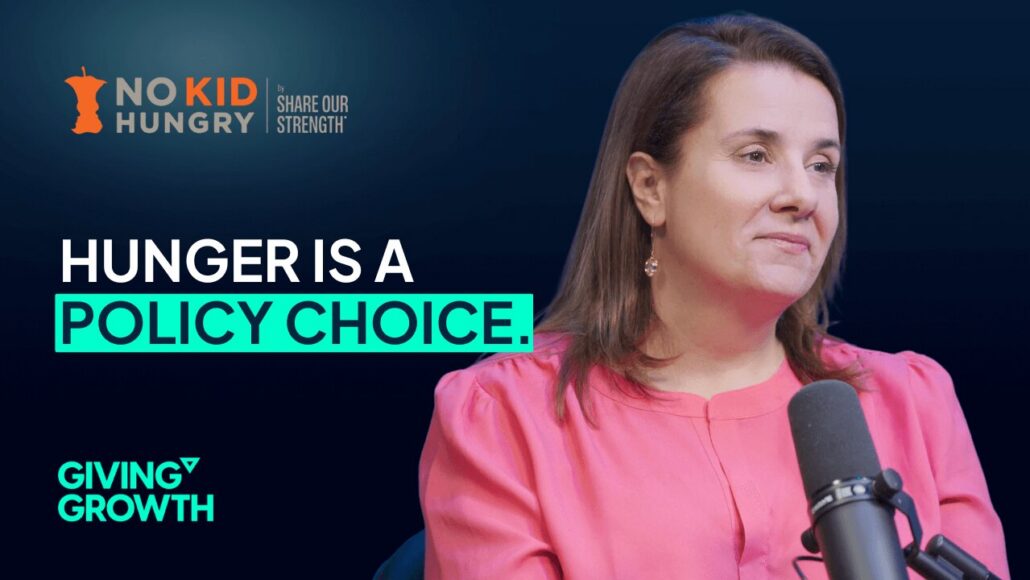
This is Giving Growth, the podcast where we talk to leaders who are reshaping the non-for-profit world and tackling these challenges head-on. Sign up for the Giving Growth weekly newsletter and learn about one new idea worth sitting with by going to DelveDeeper.com/podcast. My guest this week is Rachel Sabella and she’s the director of No Kid Hungry New York.
Rachel is a strategist, she’s a policy advocate and a partnerships builder whose work has reshaped how children across New York access food. At No Kid Hungry she’s expanded the organization’s grant making, lobbying, communications and outreach directing nearly $10 million to schools and communities in New York and Puerto Rico, especially those under-resourced to make sure kids are fed safely. Rachel has led campaigns to restore more than $30 million in New York City’s budget for school meals, passed state laws expanding SNAP access and advised city leaders on programs tackling food insecurity.
And what I think is especially interesting about No Kid Hungry is that this organization versus other organizations I speak with rely so heavily on partnerships with communities and with the government. So this is something that we’ll talk about in another podcast. To close off about Rachel, whether she’s mobilizing community organizations, securing bipartisan policy wins or amplifying the mission on national media, Rachel’s work is about turning advocacy into action so that no child has to start the day hungry.
So Rachel, welcome to Giving Growth.
Rachel Sabella
Thank you so much, Greg. I’m so happy to be here and to chat with you today.
I know, but this is the moment we need and we have a lot to talk about, so I’m excited to be here.
Greg
So talk to me first, like I really want to talk about SNAP, but I’m already curious about how No Kid Hungry and the organization’s mission fits into your career journey. Has there been a moment that really connects to the role you’re in right now and the organization that you’re at today?
Rachel
So it’s been interesting for me is I graduated college with a political science degree. At one point to get a job in the summer months, I worked in a special ed summer program. And after, you know, as a poli-sci major, and at the time the West Wing was all over TV, and I wanted to be Josh Lyman and work in the White House and do the things.
But then I was working in this program with Title I students, special needs, and I was completely inspired by them. And I thought, maybe it’s time to change my career path. It’s to go into schools and it’s to work with kids.
And then at the end of the summer, I got ringworm and pinkeye at the same time. So I decided I was going to help children a little differently. And from that moment, it really solidified that I wanted to work on policy change, on advocacy, on helping communities.
So I started in DC, worked in education organizations. If you can hear it in my accent, I am a lifelong New Yorker, and it was time for me to come back home and be with my family and friends and support the community that I so loved and made me who I am. And I started working in afterschool programs here.
And then I had the opportunity to go work for the food bank for New York City. And while I had touched on nutrition at different points in my career, that was the first time food access was so prevalent and learned so much. And then an opportunity came to join, share our strength and to lead the No Kid Hungry campaign and establish it as a statewide entity in New York.
It took my interest in kids, it took my passion for hunger, and it allowed me to combine it in one place. And I’ve been here for the last eight years working to connect more kids and families with meals.
Greg
Can you tell us the story of No Kid Hungry? Because I think that it’s such a galvanizing way of explaining what the organization does. Why No Kid Hungry?
How did this come about?
Rachel
So the No Kid Hungry campaign was launched more than 10 years ago, and really as a way to bring about significant change. So whether that was, you know, advocating for policies to make breakfast mandatory in schools or no-cost breakfast or expanding access to summer meals, you know, it was something that people grasped upon. When I walk into a room and I say, hi, I’m Rachel from No Kid Hungry, everybody knows exactly what I want.
And it’s something that is when you hear that term of No Kid Hungry, it’s not about politics. It’s not this theoretical message that’s hard for people to understand. It’s very clear.
And everywhere I go, people say, thank you for the work you do. How can I help? So I think it’s something that’s also helped people understand and recognize they have a role to play in this.
Greg
I’ve been in marketing since 1999, which, you know, for a Polish immigrant who came here in 1992, just, you know, that’s not typically the thing that my friends have gotten into. But I love the mix of science and art that’s in communications. I love what Share Our Strength has done.
I think it’s really a brilliant move that I wish more charities had the courage to take because there are a number of charities, you know, have names that are very obvious and some are hard to understand what you do exactly. So I just from a purely marketing perspective, I love it.
Rachel
Well, I will pass that on to our leadership and our comms team. They will especially appreciate that.
Greg
I’m sure they would love to hear from me.
Rachel
They really will.
Greg
Yes, yes. But as a lifelong marketer who loves to geek out on things like this, I think it’s underappreciated. I think maybe it’s taken for granted.
Yeah. I just wanted to set the record straight.
Rachel
I appreciate that.
Greg
Now, I wonder what you think people get wrong in terms of the ripple effect. Catting SNAP benefits, for example, is a thing, you know, longest shutdown in the history, right? Yeah.
But it feels like things are back to normal. Are things back to normal or is there something that we maybe don’t pay attention to that you could you could help me understand?
Rachel
Yeah. So I would say, no, things are not back to normal or whatever normal is in this. You know, SNAP, the SNAP Supplemental Nutrition Assistance Program.
Some people know it by its former name, food stamps, but it provides eligible people with a grocery benefit to help them. The first lesson I learned when I joined the anti-hunger community was SNAP is the first line of defense against hunger. And so people could have dignity.
They could use this grocery benefit, go to local stores, go to farmers markets, access the food and the nutrition that they wanted to give to their family at a time when they were eligible based on income or family size or where that is. And so with the shutdown, this is the first time in the history of the program that SNAP benefits did not go out. In the past, they’ve been able to draw down from other funds or made provisions.
And this time with politics at play, they did not do that. So now that the shutdown is officially over, benefits are going out. So eligible families will receive it.
But this is also after, you know, over the summer, a bill was passed and signed into law that rolls back the progress. H.R. 1, some people know it as the big, beautiful bill, rolled back SNAP. It will cut $200 billion from the program over the next 10 years.
It will make it more difficult for people to access the program. So at a time when people are struggling, when prices are rising, you know, yes, do they need the benefit now? Absolutely.
But this is just the start of a situation that if we don’t roll back, is going to have devastating consequences. And I think going back to something else you started with is what do people not know about? And I think the biggest thing is everyone knows someone who is a SNAP recipient, whether it’s your neighbor, whether it’s your family member, whether it is a child in the same class as someone’s in school.
I hear so much from people who say to me, thank you for your work. I grew up on SNAP. I grew up on free school meals.
And if it wasn’t for that, I would not be where I am today. And how can I help people? So I think something is that people don’t know, they know someone who uses this benefit, who, you know, relies on this to supply their family with food.
And so that’s something I want to remind people when they talk about this or the misinformation out there. You know someone on this program. You want to help them.
We all do.
Greg
From what you said, and when it comes to fighting hunger, what have you seen as the biggest shifts over the last decade? Like what has changed? Where were we maybe 10 years ago and when you started in this role versus where we are today?
What are you hearing? What has changed? What has not changed?
Rachel
I think how people look at their role in this. When I first started right around that time, more than 10 years ago in the food and the anti-hunger space, people looked at it as, well, you’re the food advocates. We’ll call you and we’ll make referrals and you’ll help on this.
Or can you tell me about food? And I’d hear that from organizations that maybe worked on, you know, youth development or education or different issues. Everyone sort of saw themselves in silos.
And then really, I think when COVID hit, people looked at this differently and they started to recognize and organizations recognized that everyone had a role to play and we couldn’t be in silos. So, I mean, my phone rang nonstop from people saying, how do I set up a pantry? Or, you know, I worked with the YMCAs to set up community markets.
We helped with startup costs and infrastructure. So, I think a big change is just how people have approached this and have come together. I’ve seen more creativity from organizations.
You know, so many food pantries and soup kitchens are volunteer-run in small spaces. And we’ve seen partnerships of larger organizations saying, hey, I don’t need to set this up, but we have space. People don’t have to wait in line outside.
They can wait in line in our building in the heat away from the rain. So, people looking at the creativity in this and, you know, recognizing that they have a role to play in this and that they can do more. So, that’s something I’m really proud of.
I also think everywhere I go, somebody stops me and says, how can I help on this? I was, we were talking earlier about a conference I went to last week. I couldn’t walk three feet without somebody saying, what can I do on SNAP?
Can I help on contracting? What am I going to do to help the kids in my district? So, I think it’s very much a collaborative spirit and really no longer defined by smaller groups, you know, groups with one narrow focus working on it, but others coming together to see what they could do on this issue.
Greg
So, let’s imagine that you are in a position of power, but you are in a position of greater power. I love it. Greater power.
And you can truly re-imagine from scratch what it means to ensure that no kid goes hungry. What, I’m just curious, what would that look like?
Rachel
Oh, I could do a lot of things with that question. I think the…
Greg
Let’s let the imagination roll.
Rachel
My imagination is excited about this. I love to have ideas. And I think number one, we start with the root causes of poverty.
And we really look at minimum wage, are people being paid fairly? We look at different programs like the tax credits, like child tax credits, are they going to the families that are the lowest income eligible for it? How is that set up?
I think we look at housing. Housing costs are so hard. I often talk about, we talk about hunger, I say hunger hides in plain sight.
Because somebody will always say to me, they have a house, how can they be hungry? Okay, well, you’re paying to keep the roof over your head. For those of us in New York, we’re paying rising Con Ed bills.
And no matter where you are in the country, your heat, your electricity is going up, your transportation costs are going up. Right now, for many Americans, your healthcare is going up. These are things you can’t move in your budget.
But what people can play with or reduce is food. And so that’s why I think let’s look at some of those root causes. But then when we think about specifically making sure kids and families have access to meals, I would make sure every child in this country when they went to school, had a free breakfast, and they had a free lunch, and that there was an after school snack or summer as part of their program.
So they got those nutritious meals, and everybody got the exact same one. So there isn’t stigma saying, well, you’re getting a free meal, or you’re getting a different meal, because you have less money than I do. Nope, I want every child looking at the world the same way.
I would also look at the adequacy of SNAP benefits and really say this is a supplemental program. These days, it’s about $6 a person each day. We don’t have $5 footlongs anymore.
How are you paying for three meals a day out of $6? So I’d look at benefit adequacy as well. Also recognizing that a SNAP benefit is good for the economy.
It’s being spent at local businesses. It’s supporting farmers and retailer jobs too. So it’s addressing child’s hunger, but it’s getting back to some of those economic issues as well.
I’d make sure every school had a pantry. That’s something I hear a lot about from school communities. And when I was at the food bank, we worked very closely with the city council, and we launched a million-dollar initiative to set up 25 pantries in New York City public schools.
They gave out food, but they also gave out personal hygiene products. And SNAP benefits don’t cover vitamins. They don’t cover deodorant.
They don’t cover menstrual products. And so what these pantries did was they provided the food, but they also had those items that gave families dignity. And it was always interesting to me.
We so often had dads come and say, thank you for making sure my daughter has this. Or I heard from a teacher who said, there’s a child in my class, a 13-year-old boy. He never raised his hand.
It’s because he didn’t have deodorant in his home, and he was afraid of what people might say or might, you know, about a smell. She was able to get him in that pantry and make that change. So, you know, when we’re hitting the root cause, it makes it so much easier for families.
But these other items may seem smaller, but they go back to the dignity element, and they make sure people have what they need to thrive.
Greg
So thank you for really reminding me and maybe the audience that I’m probably privileged, and we shop at Whole Foods, right? And I’m probably top 1%. And I don’t think about food as something that’s sort of disposable income.
I just think of this as something that happens. But you’re absolutely correct. I have to spend money on gas and electricity and the mortgage.
And food is one area where I can actually save if I choose to do so. And for some, it’s not just something they want to do. It’s something they have to do.
So I definitely don’t think about hunger and food scarcity that way. That’s very clarifying. And I really appreciate your perspective on this really being a cost of living problem.
Maybe it really isn’t. And I’m just interpreting a hunger problem, right? It’s really just the fact that, you know, something that I worry about is the rich are becoming richer, poor are becoming poorer.
I think this is destabilizing for society.
Rachel
I think also, you know, when you were saying about food costs and where this goes, we did a survey last year of New Yorkers, and more than half of New Yorkers told us they were going into debt in order to be able to afford the rise in grocery prices, more than half of the survey respondents. And when you think about that, that’s not people saying, I’m putting it on my credit card because I want some airline miles. That’s people that do not have that money.
We had people say they were taking funds out of their savings account. You know, I think about when I go to the grocery store and I recognize that I have privilege, but there are days I look at the cost of items and I’m like, I can’t justify this in my budget. And imagine if you are a single parent who is working and has to make these choices.
And then the responses we hear are, you know, they’re buying cheaper foods. They’re not buying the meat. They’re not buying, you know, the fresh berries and items.
They’re buying filler foods like rice and pasta to do that. Or the caretakers are either having smaller portions or not eating because they want the children to do that. And this shouldn’t be the case.
Everybody should have the food they need to eat.
Greg
You know, I rarely get, right, I do maybe 50 of these conversations a year, and I rarely get into the mission itself this much. And maybe with you specifically, this is something I’m choosing to just dwell on longer because if we talk about, you know, refugee causes or if we talk about, you know, access to health, maybe that just feels a little less tactile, less relevant to where I am sitting right now in this country. I just find it fundamentally wrong that No Kid Hungry has to exist in a way.
I wish I wish you guys didn’t exist. And I recognize that you must exist. And it’s very meaningful and important.
Right. I mean, look, every charity I talk to wishes it didn’t exist. Yes.
That we want to put ourselves out of business. Right. And then we know we succeeded.
But with you especially and with your mission, it just, I think it’s misunderstood. I think even I, not even I, including myself, I don’t truly understand it. So this is actually strangely educational for me right now.
So I don’t mean it to be about me.
Rachel
No, not at all.
Greg
But I hope the people who will end up, as I told you, you know, over a thousand people, a couple thousand people on YouTube, that this will make us think about not hunger specifically, but what’s happening in society.
Rachel
I hear that all the time. People always say to me, how do people oppose the work that you do? Or why do you even have a job?
This shouldn’t be a conversation. And it doesn’t matter what party they are. This is something Americans agree with.
No Kid Hungry has done polls across the country. Overwhelming support that says this is not a partisan issue. This should be solved.
So I appreciate the opportunity to get the word out and to keep doing this. And someday I will have to find a new job, I hope, because this problem is solved.
Greg
I want to take this in a different direction. Something that I care about when I talk to the sector is the fact that when I look at the giving pyramid, my judgment and people that I talk to have different perspectives on this. But I think we all agree that something is happening with this number of donors shrinking in general, and yet giving is growing in terms of dollars.
And my judgment is that, you know, you boomers are aging out. Then the people in my age, I’m 51, right? There are fewer of us from a generational perspective, just a count of count of human beings, right?
In this strata. Again, people at the top have more money than ever, which they thankfully are sharing and giving. What do you think is happening right now with donors?
Any way that you choose to interpret that?
Rachel
So I think one of the best things about, and we talked a little bit about this, the No Kid Hungry brand is that it appeals to everyone. And I get messages from kids saying, I just had a bake sale in front of my house. I’m going to donate the $25 to help other kids.
Or we’ll get calls from high school groups that are working on community service or things. Can you come talk to our school? As we are working on this, we want to raise money for you, which is great.
And we want everybody to do that. We want children to recognize that they have a role to play and that they want other kids to have the same food that they want. I think we hear from people of all ages.
You know, we have a dinner next week and speaking to a group of 30 something moms who this is something that they recognize and they see that their children have access to this. So they want to play a role in making sure others have the same. We have so many donors and champions who are boomers, who grew up at a time when their parents were coming out of the depression, where money was hard, access to food was hard.
And they look at this and they’re like, how is this the world? So we want to play a role. And I think for, again, for this mission, it is something that resonates everywhere.
So we do see the different voices. It’s something I’m really proud of. And we’re really lucky that we’re not navigating it in the way that other nonprofits may be navigating that challenge.
But nothing makes me happier than when we get a message from one of those kids and they are, you know, their mom is tagging them on Instagram. I didn’t take birthday presents this year. I want every kid to have meals like that shows you that they are ready to fight for change and that they, they see everybody is the same.
They don’t want somebody to be different. And I think on the tough days, that’s what gets me through.
Greg
Tell me if I’m interpreting this correctly. If I think about the classic giving permit, right? Mass, mid, major, you know, they’re moving up, right?
Yeah. It sounds like in your specific case, that permit is quite healthy, because it is a top mind issue.
Rachel
I think it’s a top mind issue, and it’s continuing to become one. I think the COVID crisis really changed people’s views on this. You know, with many of us working in the space, we knew there was a hunger crisis.
But once those videos were on TV of cars lined up for miles, or people waiting for food, and now with the snap crisis, I mean, it was so interesting to me going on social media. And it wasn’t just myself or my friends that work in this space posting about it, but it was friends of my parents. It was my college roommate’s high school age niece who messaged me and said, I have to help.
Why are people not getting their meals right now? So I think, you know, these two dire situations have also opened people’s eyes and, you know, brought them into the cause in a different way.
Greg
So the thing that I haven’t had anyone else talk to me about is going hand in hand, and I quote, going hand in hand with communities. Why is that special about what you guys are doing?
Rachel
So that is one of the reasons I was so excited to take on this job, and really this challenge and opportunity in New York. I’m going to keep saying it. You’re hearing it in my accent.
I’m a New Yorker.
Greg
I love the Yankees. You sound great. How about my accent?
Rachel
I love it. We are, you know, New Yorkers come together, and whether it was after 9-11, whether it was after Hurricane Sandy, New Yorkers take care of each other.
Greg
I was here, yes.
Rachel
These were devastating times, and New Yorkers know our, we believe our challenges are unique. And if a national organization came in and said, hi, New York, I know better than you how to feed kids, we would say, peace out.
You are not part of our community. And so, you know, having myself, having the team as New Yorkers who grew up here, who I, you know, we go into the schools that we went to, where our families are in communities that matter to us, you know, we’re able then to dialogue. So I think about, you know, what we’ve done on school breakfast programs.
And in some, we want to make sure every child has access to a school breakfast. In some school buildings, that means they need a cart to deliver meals to the classroom so everyone can eat together. Sometimes it means there is a cart at the door, and everybody grabs a breakfast, and they take it into their classroom.
Sometimes what a school actually needs is the cafeteria open early in the morning for kids that come early. But some kids are coming late for transportation delays or other issues. So they need to be able to get a breakfast no matter what.
I don’t know what the right answer is for a community. And what’s right in Buffalo is going to be different than the North Country. But what I can do is say to these school districts, here are some options.
Talk to me about your school. Talk to me about the families. How do we find the right solution for you?
So we were able to do that. We’ve been able to do that with the summer meals program. In the last few years, the federal government changed rules.
I don’t want to be too wonky. But it used to be in order to have a summer meal, you had to sit on site. A child could get one meal a day, and somebody had to watch you.
That way, obviously, there’s compliance. We want to make sure things are following the regulations. But in some areas, especially rural, that’s really hard.
I’ve visited schools that are serving kids across three counties. That takes an hour and a half to get to the school program. So it doesn’t always work.
So we’ve worked with school districts that now are eligible for some flexibility to say, what’s the right program? So I was in a school this summer, about an hour outside of Lake George, vacation community for those of us in New York. And for this school, last year, they served 25 to 30 kids every day for a summer meal.
This summer, they thought they were going to serve 150. They actually served more than 220 kids. And they are expecting to do more next year.
So what they decided to do was home-delivered meals. So we took a bus up some mountains, and we hand-delivered bags of meals, families registered, to those families. I was chased by a chicken bringing meals to one place.
The city girl was a little confused. But it really showed where you were going, and we were meeting the needs of the families there. In other school districts, they have set it up so families can pick up bulk meals, seven days’ worth of meals.
So a gallon of milk, different items, because that’s what works there. So we really want to go in and work with communities and say, what is the need? How do we make this work with you?
And how do we do this in partnership?
Greg
Well, I’m hearing, tell me if I’m judging this correctly, is that there’s an incredible amount of listening and really adopting the model and maybe not being patronizing and actually holding hands and putting yourself in the shoes and seeing the world through the eyes of the child and actually adjusting how the organization delivers help with a great degree of sort of flexibility. Which, you know, when I think about charities, and again, I work in the sector for years now, right? There is this perception of being a little kind of, you know, there’s a process that we follow, right?
And there’s a way that we do things, there’s some rigidity. But I’m not hearing any of that in what you’re describing.
Rachel
There is following some rules when it comes to leveraging, right?
Greg
Well, there’s food, right? I mean, I guess food safety.
Rachel
Yes, the food safety issues. And one of the things we do is help schools and community organizations maximize existing programs. So how can they leverage those federal programs to best serve their communities so that they don’t need private funds to do this?
Sometimes they need it for the startup or the technical assistance, but how do you take what’s there and make it work best for you? So when you said listening, that’s exactly it. When I first started, I did not see my apartment for a long time, because it was I want to come out there.
I want to talk to you. I want to listen. You know, I hired a staff member who’s based in Buffalo in the Western New York area.
And that’s a part of the state. I think when people hear New York, they think, oh, New York City. No, that’s eight hours away, closer to Ohio than New York City.
But there’s so many different needs there. And having someone who can travel to those communities to drive two hours away, to listen, to make the staff members feel valued, that’s something that I’m really proud of that we’ve done, recognizing the hunger heroes on the ground and how their stories are impactful, but how we couldn’t do this work without them. And I think listening to them, helping to understand their challenges and how we work through it is what makes this unique and so special.
Greg
I think it’s wonderful because because, again, you’re working within a rigid system. Right. There’s a there’s a way that schools operate.
There’s a way that government operates. And I always try to identify a leitmotif. Right.
I took class in college, which was about the connection between German literature and Wagner’s operas.
Rachel
Fascinating.
Greg
Yes. So I learned the term leitmotif in the context. But the leitmotif here for me is around the need to deliver, you know, what one would call programming in a way that’s truly custom made.
And it’s actually great to see that here in this city, the city that I used to call home for 15 years. And I wonder, like, in terms of how the organization is structured, how is this idea of fostering closer relationships and being hand in hand with community strengthened, right? On the inside, like, is there something that you see share a strength do to make sure that this adjustment to reality of what these kids go through and the environment from which they kind of operate is done?
Is that the systemic thing inside that you guys actively talk about? Or it just kind of happens organically?
Rachel
I think it’s something that was important to the mission from day one. Our founders, Billy and Debbie Schor, brother and a sister, nothing makes them happier. And I’ve seen it with them when they’re then when they’re in a school community and when they are out there and talking to people and listening and learning and bringing those lessons back.
I think that’s always really important, because we don’t want all that information to exist in a vacuum. And how is what I’m hearing on the ground then impacting my colleagues that work more on policy and white papers? How are they also getting those stories for those that look at data all day long?
We need that data. But how is that connection happening? And what’s happening on the ground informing their work, too?
So I think it’s something that’s at the core for so many of us, but it comes from our founders.
Greg
What is your take on the next 10 years? So let’s imagine that you are in this role or in a bigger role in 10 years. What is it that either from an impact perspective that you would like to see change?
Or just where would you like to be as an organization in 10 years? What would that look like in the perfect scenario, in a scenario that you kind of dream of? Any way that you choose to kind of think about this?
Rachel
You know, I think as an organization, we’re looking at how do we close the gap on ending hunger, looking at different metrics and different goals. I think the challenge is going to be this federal legislation that rolls back all of this. Where I would like to see in 10 years, I’m going to look at it with a little bit of a political lens.
I want to see more bipartisanship. I want to see where it is not about playing games. It’s not about making hunger a political issue, but it’s a moral issue.
And I think about in New York State in the last couple of years, we’ve made there to be a free breakfast and a free lunch for every child. That was done with Democrats and Republicans. When we increased funding for food pantries and soup kitchens, it was done with Democrats and Republicans hand in hand.
This March, I was so honored. The New York State Assembly and the New York State Senate recognized No Kid Hungry and National School Breakfast Week. When the Senate got up and made speeches, there was an equal number of Democrats and Republicans talking about the importance of school meal programs and ending child hunger.
You wouldn’t have been able to tell which party anyone was from because it was what was right and it was what was right for their constituents. I look at the in the last year, there were two governors that have done free breakfast for every child and opted into Summer EBT, a summer grocery benefits program. And it was Democratic Governor Kathy Hochul from the state of New York and Republican Governor of Arkansas Sarah Huckabee Sanders.
Most people don’t expect me to say those two names together, but both of those leaders have recognized there is a problem in their states and that they have a voice and a leadership role and an obligation to help those families and kids. So what I hope we see is what we’re seeing in states and we’re seeing in local communities reflected at the federal level. And we roll back these devastating cuts to SNAP.
You know, two of the biggest pieces of legislation that influence hunger in the country are the Farm Bill and the Child Nutrition Reauthorization. All of those are going to be worked on in the next few years. I want everybody to come together and say, what am I doing to feed kids in my neighborhood?
What programs am I setting up that are helping the agriculture industry in my communities and not making it about partisan games? And if we can get to that point, we will be in a better place. And those hunger numbers will have changed drastically.
Greg
What I think you’re saying, and it may be easier for me to say, is that in 10 years it would be amazing if we focus more on what the core issues are that we all care about versus a name tag that we wear. Because you know, when you think about it, none of us wants to be actually profiled, right? So when I’m profiled as a Republican or Democrat, in some way, that’s really short-sighted.
We’re more complex than that. If I look at research, we actually all agree on what the core issues are. You mentioned some of those issues, right?
Life should be easier. Things should be cheaper. I should be able to afford more.
I want my kids to go to a good school. I don’t want my kids to be hungry. That shouldn’t even be a topic.
I mean, 99.9% of the population can agree this is true. So if you ask me that same question, maybe the answer is that we just need to agree on some obvious things because we’re all human. And that’s all that matters.
Rachel
Yeah. I think you said that quite well. I think we’re on the same page.
There’s no reason for this to be a debate. This is something we could work together on and solve. I mentioned our founder, Billy Shore.
He always says hunger is a solvable problem. And I think that has also helped people engage on this issue. We can solve this.
We just have to come together and focus on what matters.
Greg
I wonder about, is there something that you know now that would have changed the trajectory of your career had you known this sooner?
Rachel
I don’t think it would have changed the trajectory of my career because I really believe that each one of those experiences brought me to this place and made me a stronger advocate. I can look at different people in other fields and say, wait, I know how this works. Let’s bring them into the conversation or have we talked to this partner.
And so for my career, I think each experience has brought me here. I think, you know, things that maybe we could have done differently is, you know, maybe, or though I don’t even know if it’s done differently. I don’t know if we could have anticipated being where we are right now in this point, especially like with the snap rollbacks and the snap cuts and things.
Maybe it would have been talking about economic benefits earlier. I just did an op-ed with the National Supermarket Association. And for many of these, our local independent grocery stores, some of them, their revenue is 70% comes from SNAP benefits.
I mean, that’s not something anyone would know. If SNAP runs out, or SNAP runs out, if the benefits did not go out this month, those businesses would close. And so maybe if we would have talked, the economic argument was always there, but maybe bringing that in earlier could have changed the conversation.
I don’t know if it was that, but I’m also excited that we have so many new voices on this and new angles to be talking about. So hopefully we can work towards rolling back these cuts, but also never getting to this point again. It shouldn’t have to have been this way.
Greg
I think that one of my, I think, rules is no regrets. Actually, one reason why I started my own business, I didn’t want to regret not starting it. That was honestly my, that was the plan.
It was that complex, right? That well thought out. It was really just based on no regrets.
So like you, I believe that there was really nothing that you could have done differently. But I’m always curious to see how people answer that question.
Rachel
No, I appreciate it.
Greg
Well, Rachel, thank you so much. Rachel Sabella, strategic communications policy advocate, partnerships builder. You’re at No Kid Hungry.
Again, I love the name, the clarity of the mission that’s embedded in the name. Again, I was telling this over kind of what we were talking earlier. I love someone had enough courage 10 years ago, because I’m sure now it seems so obvious to actually come up with this idea that we have to stand for something that can be easily understood in three seconds, right?
Kind of one of the rules in marketing, three seconds to grab someone’s attention. You guys have nailed that. Thank you.
And it’s great to hear that in terms of your mission, that not only is this mission more relevant than ever, but there’s also public awareness. And it’s really heartwarming to hear that you see engagement at all levels of the giving pyramid. I wish that more organizations could say that they are in a situation like you are in, which is where that we are paying attention.
Rachel
Well, I thank you, especially just the opportunity to talk about this, to continue the awareness. And I just really enjoyed getting to chat with you today. This was a treat.