How Amnesty International Builds Trust With the Next Generation

Get one
powerful idea.
Subscribe on:


EPISODE SUMMARY
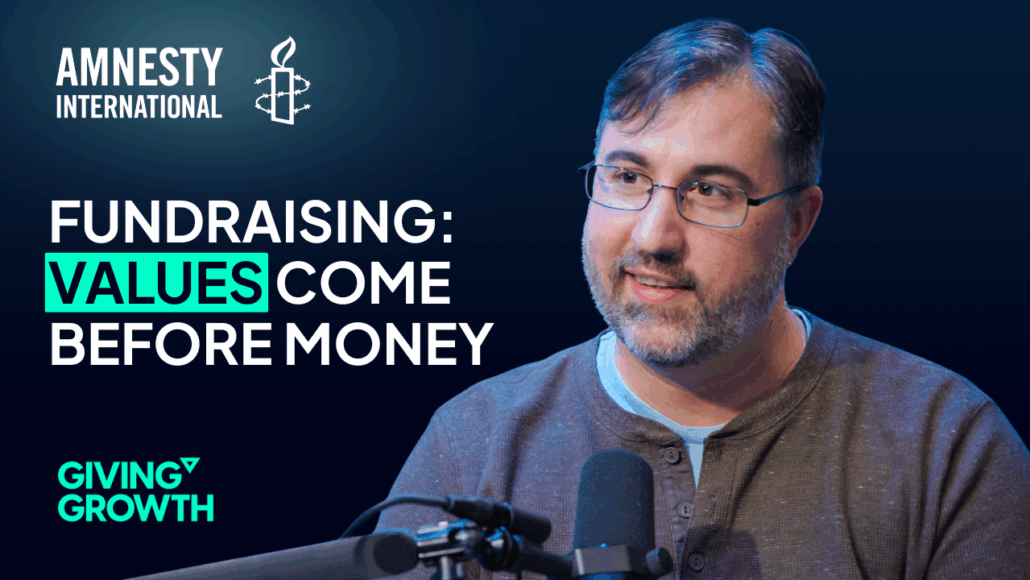
In this episode of Giving Growth, Bryan Colombo, Deputy Chief Development Officer at Amnesty International, draws on his experience leading one of the world’s most value-driven fundraising teams.
He unpacks how shared leadership, interdependence, and accountability fuel connection and growth, and why failing to deliver authenticity can mean losing trust, momentum, and funding.
Greg and Bryan discuss:
- How shared leadership strengthens authenticity and trust
- Why values must come before money in fundraising
- What “retail accountability” means for modern donor engagement
- How listening builds loyalty and long-term sustainability
- Why authenticity is the most powerful currency nonprofits have.
EPISODE TRANSCRIPT
Giving Growth Podcast – Bryan Colombo (full transcript)
Brought to you by Delve Deeper: https://delvedeeper.com/
Greg Sobiech
Amnesty has a really interesting setup for a large charity in how your donors or really anyone can become a board member. Can you just describe more what that means in terms of your board structure?
Bryan Colombo
We operate under what we call a shared leadership model. If you’re an active member of Amnesty International and after a couple of years of active membership you’re technically eligible to ascend to different levels of leadership. All of these people that are on our board are raising their hand in a way that they say they agree with the mission of Amnesty and they’re here to advance the cause and the values of Amnesty.
Greg Sobiech
It almost feels like the need to be in tune with donors is exacerbated because of that unique board structure. I almost wonder if there are any implications between how your board is elected and how true you have to be in your to reflecting your donors values back to them.
Bryan Colombo
I think having a values-aligned board and staff creates an exponential possibility of growth. Like what does it mean? Well I mean if we’re…
Greg Sobiech
I like the way it sounds.
Bryan Colombo
If you have programmatic pillars that are only come up with based on what’s happening in the news right now, we forget our history and we don’t think about what brought people into the room in the first place, nobody’s going to stay around long enough to rise into leadership and does not happen overnight. If you have two people working on something it’s better than going alone or having to convince someone all the time that no it’s this way or no it’s that way. Creating an active listening atmosphere and this shared leadership model we’re able to move forward together at a faster pace.
Greg Sobiech
Brian Colombo, Deputy Chief Development Officer at Amnesty International USA. Welcome to the show. Thanks.
Happy to be here. We had lunch before and we spoke about retail accountability. It sounds interesting, what does it actually mean?
I’ll say charity.
Bryan Colombo
You know I derived the saying from retail politics which is this very on-the-ground, person-to-person, door-to-door style of campaigning and it’s what I see with the younger generation. I have a 22-year-old half-sister who when I see her with her friends every day is interacting and being authentic with each other and holding each other to the values that they as a community share and making sure that they are demonstrating not just this is what I believe but also we share this value and if you violate that social contract I’m going to go ahead and hold you accountable. There’s a call-out culture in this level of retail accountability.
You make a promise, you keep the promise, you deliver on the promise. If someone breaks it you have to hold them accountable for that. So to me the retail accountability is as a non-profit frankly not just reflective messaging of what people care about.
I mean you want to listen to your donors, you want to listen to your members, and you want to listen to how they want to be engaged. When they raise their hand about a topic you really want to take note of that and you want to actively listen to how they’re bouncing their values and then you want to reflect those values back to them.
Greg Sobiech
Why do you think that someone in their 20s, so someone who’s probably 20 years younger than you feels the desire, the need to be so accountable? That’s a bit of a hard one actually. I’m doing my job if I ask those kinds of questions.
Bryan Colombo
Yeah, right. Yeah, no just delving deeper I believe is what just happened.
Greg Sobiech
Yes, maybe.
Bryan Colombo
Okay. Maybe. You know we live in a world where there hasn’t been demonstrated accountability.
A lot of these kids that are in their 20s now they were born in 2000 so they probably don’t really remember the Great Recession in 2008 but they remember coming out of that. You know they hear the stories of people were not held accountable for those actions that happened. All these pardons that just happened like that’s a lack of accountability.
If you have the money you can do it. I think for them they’re not in a position they don’t have the money. All they have is their own sense of self-worth which frankly our generation has raised them to have you know more so than I think we were raised as kids.
Like there’s an inherent human value. Their accountability is to maintain a level of dignity that they don’t see reflected in the news.
Greg Sobiech
Yeah look I don’t remember my mother caring about. She loved me and I know she cared about my sense of self-worth but I also remember her being quite stern. The idea of supporting a child was a little bit different.
We probably have raised people in their 20s to be more authentic to themselves.
Bryan Colombo
I feel like my generation was raised to be independent. Pull yourself up by your bootstraps. If you get stuck in a problem you need to work it out but we’ve acknowledged that’s not how society works right.
Everyone doing their own thing all the time. It’s not the best way to interrelate with each other. There’s an interdependence that the current generation has that they rely on each other for moral support, mental health support, even economic support and you see a level of depth to the personalities of kids nowadays where they have information at their fingertips in a way that we never did.
So they go really deep on topics. They go really far into well why is this this way? How did this start?
Where did it come from? Where is it going? They define themselves by being part of these deeper conversations and they want to have deeper conversations and connections with each other.
You know again my sister again she’s in art school and all these young artists they’re you know they’re testing out their skills. They’re trying new styles and they support each other. They make these little stickers like five bucks a pop and they buy each other’s stickers and they buy each other’s artwork and they’re not looking to the masters.
They’re looking to each other for support and this interdependence to say I’m here for you. You’re important. You have intrinsic value.
You know their engagement comes from fulfilling those obligations to each other.
Greg Sobiech
That’s a really lovely example. Very tactile example of retail accountability. Have you seen any other examples like that?
I mean sure. As you observe the world?
Bryan Colombo
The sticker sharing is essentially brand building right? I mean and that’s what we do as a non-profit. We want to promote our values.
We promote the projects we’re working on and the causes we care about and you know we build our brand through fun stickers. Some places it’s tote bags. Very infamously tote bags.
Sure.
Greg Sobiech
I have a bunch of those.
Bryan Colombo
Yeah but that’s the surface level reflection.
Greg Sobiech
Yeah.
Bryan Colombo
Right so that’s the first step to be like we you know we have a number of places and different things for them to sign up for a virtual action network, an urgent action network, task force organizing like all sorts of topic based and also community based mobilization things and a lot of times the first thing you get after that is an outreach from someone at Amnesty that’s a personal email. Just that first step is to say you’re interested. I’ve heard you and let’s talk more.
I mean we also do a lot of as base lead generation but which is you know but that’s kind of the sticker first right? So digital advertising is a sticker first mentality and that’s where you say here is my value.
Greg Sobiech
Yeah.
Bryan Colombo
Here is my value proposition and this is what I care about. You know is it human rights and gazette? Is it anti-death penalty and you know pick a state.
Sure. You know abortion rights somewhere else. This is the value we have.
Click here to learn more and then we want to engage people you know in those value lanes.
Greg Sobiech
When we met originally you said something that I absolutely loved as a marketer at heart. I’ve been doing this for 25 years. You said unless we keep ourselves accountable to reflecting back to them their values or affinities we will lose them.
Talk to me more about what this means to you.
Bryan Colombo
I mean Amnesty’s unique value proposition generally is to provide a bright eyed look at the truth. These are the policies that are hurting human rights. Here are the next positive steps you can take to help fix the situation.
So providing opportunity for young people to have the agency and the platform to speak up to demonstrate their authentic selves and to demonstrate the values that they espouse. That’s kind of what we need to do as a as a non-profit to make sure that they stay engaged with us. Until we provide that agency to do the next thing they’re not going to remain engaged for that long.
Greg Sobiech
To reflect something back to a donor I have to know first what is it that I am reflecting back. How do you think about finding what that something is that you need to hold a mirror against?
Bryan Colombo
I mean a lot of it’s just you know what they what they’re reading in our emails right and a lot of it’s what are they clicking on. I mean you know what a big part of our digital program is through these digital actions right. So we identify a policy that’s unfavorable.
We identify you know generally a legislative target or some sort of you know somewhere you can write a letter somewhere you can send a petition or a petition to sign and everyone that signs that is raising their hand to tell us this is what I care about I want to hear more about this.
Greg Sobiech
Do you think that the the cost of not getting that matching between that match between what a donor is really most passionate about and not reflecting missing that mark and not reflecting back their values is the cost higher now with younger generations than maybe before?
Bryan Colombo
Across the board in you know the non-profit industry return on investments for new donors coming in it’s longer and longer and longer right. We used to talk about a timeline for a successful acquisition campaign in 12 to 24 months. Now we’re talking 36 to 48 months.
You have to keep somebody engaged longer to make sure that you’re getting the value from them that you need. Unless you’re driving at that value all the time you’re not going to make back dollar one.
Greg Sobiech
Does it also mean that from if you could from the very beginning making sure that I know what this let’s say group of donors they know what they care most about having that clarity about their affinity that allows me to maintain that conversation to your point not just over the next year but maybe over the next four or five years. Is that the right way to interpret what you just shared?
Bryan Colombo
Again it’s I don’t know it sounds simple to just you know say we care about this thing and then just continue to demonstrate that you care about that thing right. I know it’s not simple it’s not easy. No I think for in the non-profit space we often talk about the donor centered fundraising right and a lot of that is rooted in the in reflecting these values and the benefit of doing that is unless your value forward you’re not going to be revenue positive without continuing to demonstrate the accountability to your cause and reflecting those affinities the interest will flag and the investment will be wasted. Given the longer return on those timelines being inauthentic will lead to bankruptcy.
Greg Sobiech
Amnesty has a really interesting setup for a large charity in how your donors or really anyone can become a board member. Can you just describe more what that means to Amnesty in terms of your board structure?
Bryan Colombo
Sure I mean we we operate under what we call a shared leadership model whereby as if you’re an active member of Amnesty International and after a couple of years of active membership you’re technically eligible to ascend to different levels of you know leadership. I mean we have member leaders and local groups we have student leaders and student groups but also our board of directors is directly elected from the membership. All of these people that are on our board are raising their hand in a way that they say they agree with the mission of Amnesty and they’re here to advance the cause and the values of Amnesty.
So you know when we go to sit down to make a strategic plan these value-based board members are helping us to come up with a plan and we have to go along with those. I mean we don’t have to go along with them but we have to have a shared value to maintain effective leadership across the organization.
Greg Sobiech
It almost feels like the need to be in tune with donors is exacerbated because of that unique board structure. I almost wonder if there are any implications between how your board is elected and how true you have to be in your role to reflecting your donors values back to them.
Bryan Colombo
I think having a values-aligned board and staff creates an exponential possibility of growth. Like what does it mean? Well I mean if we’re…
Greg Sobiech
I like the way it sounds.
Bryan Colombo
Right I mean essentially if you have programmatic pillars that are only come up with based on what’s happening in the news right now and we forget our history and we don’t think about what got us to this point, what brought people into the room in the first place, nobody’s going to stay around long enough to rise into leadership and to advance the cause and does not happen overnight. If you have two people working on something it’s better than going alone or having to convince someone all the time that no it’s this way or no it’s that way. Creating an active listening atmosphere and this shared leadership model we’re able to move forward together at a faster pace.
And a lot of it frankly is not about the money first right it is around the value first. A lot of non-profit boards they’re created to get resources to advance the mission.
Greg Sobiech
Well most boards I think are there because you have a trustee who donated a lot of money. Right but that’s what I’m saying. But you guys are unique because that’s not how it works.
I don’t actually have to even donate to potentially be on your boards.
Bryan Colombo
Right but you have some membership dues. Sure. But we also have dues waivers for students right so like the financial component is not the primary driver of your involvement in Amnesty.
The values is the driver.
Greg Sobiech
I feel that often in life we want lots of value from many things right in terms of how we feel, from our friendships, from our relationships. You have to be obsessed about something to create value but every obsession comes with a sacrifice. What is the sacrifice of not listening to what my members or donors care most about?
Bryan Colombo
I mean the hardest part is you’d be going it alone. We talk about Amnesty as a light in the darkness. One candle in the wind has a lot harder time lighting the way than when you have other people to help you light the way and come with you.
Reflecting values back to our members and having them come along and be mission driven advances the movement more. It creates more people-powered resources but also these people are going to grow into the leadership of our movement in the coming years. And we need to go on this journey together to ensure the survival of the movement.
When you’re agitating against powerful forces that run the government or control a lot of the money, sometimes all you have is your voice and sometimes all you have is your friends to help amplify that voice. And so making sure that your values aligned ensures that when someone violates those values and you want to hold somebody accountable, you have friends to help you and you have people that are going to help amplify that message. Do you guys talk about this analogy at work?
Greg Sobiech
I love the… Oh, the light analogy? Yes.
Oh yeah, all the time. Okay. It’s so logical and just natural and I like the implication of it too.
How I interpret what you said is that if I, as a charity marketer, if I don’t understand what fire I need to give more oxygen to and that fire represents what that donor cares the most about. Absolutely. If I miss that, I’m not only turning it up even more, which should increase the donations, contributions, but also if I put a bunch of candles together, a bunch of donors who care about a particular element of my mission together, that becomes a flame.
And there’s just something really, really nice about that analogy.
Bryan Colombo
The thing that actually drew me to amnesty as wanting to work here, there is a Terry Pratchett quote and I’m going to butcher it and I apologize, but it’s essentially is no matter how fast the light travels, wherever it goes, it always finds that the darkness has gotten there first. And to my mind, that’s kind of a depressing thought, but you know, it’s a good metaphor for amnesty. It’s like, we can’t be everywhere all at once and we can only focus on so many things at a time.
But the thing to remember is that the light might not get there as fast as we want it to, and the darkness may already be there, but every time the light shows up, the darkness fades. And the more people you can bring to stand against the darkness, the faster it will fade and the more progress you can make. And the only way you can fan those flames is to reflect the values these people and our members have.
And we have to be in it together to fuel our own fires. It keeps us going. It keeps our members going.
I mean, I come from a humans are generally good, you know, Jungian side of humanity. We don’t like to stand back and watch people be hurt or watch people be marginalized. And I think what’s great about the younger generation is they don’t do that.
They lift each other up. You know, they’ve seen the world tear people down. That’s not what they want for their future.
And that’s not what amnesty wants for the future. Our, you know, our whole raison d’etre is to, you know, right the wrongs and to say, we have a standard for human rights. This is the bar and you have to meet it or beat it.
You can’t go below it. And that’s what drives me coming to work every day. And yeah, I think it’s what drives our members.
It’s why they are willing to stand in the street with a sign. It’s why they’re willing to go to meetings on campus, write letters to show up at state houses and, you know, give testimony on state issues, on national issues. You know, we even have a group of dedicated country specialists that do interviews and they make trips and they write reports about very deep, complicated issues internationally.
And they bring that home and they bring that passion home and they bring it to the movement. And that’s, you know, that’s what drives amnesty forward is every piece of that needs oxygen and it needs more people to fuel it.
Greg Sobiech
That clarity that you have about the need to shine the light in the right places and how important it is that as a charity, I point that light in places that donors really care most to be lit.
Bryan Colombo
The light on the board is, is a full spectrum of things, right? You know, you learn in art school, white is not the absence of color. It’s the presence of all colors, right?
Every color exists in the white spectrum. For us, the challenge is how do you filter out the right pieces? Because, you know, on the fundraising side, it’s identifying the places where we can shine the light, the brightest at any given moment.
And it’s gearing our fundraising towards what are people raising their hands for? And then how do we keep talking about those topics? How do we keep communicating on progress being made on, you know, sometimes it’s state abortion rights.
Sometimes it’s, you know, again, more anti-death penalty. Right now, the big thing happening is, you know, refugee and migrant rights is a big pillar of what that we work around. And, you know, everyone should be able to have a life and a dignity around, you know, their work and their livelihood and their family.
And if you’re willing to, you know, pick up and leave everything behind to go somewhere else, you should be treated with dignity when you get somewhere. You know, we’ve, we financed trips down to the border to make sure, you know, when the CPB app was first launched under the Biden administration, and it was wonky right away. We had people on the ground documenting, like, what was happening?
How is it affecting timelines? How is it affecting things? What’s happening on the ground?
And again, it’s that evidence-based, you know, application of, you know, what’s happening here? What’s the story? And then communicating that back to our members to say, here’s what the law is, here’s what the human rights standard is, here’s the gap, and here’s the action you can now take to let people know that that gap is unacceptable.
We provide the information, and then we try to provide the outlet and oftentimes the political target to say, here’s the person that we need to talk to, to convince them to change their mind and get their act together.
Greg Sobiech
You’re ultimately here to raise money for the causes that you guys stand for. Reflecting values back to donors is a method of getting there. Is it harder right now to be revenue positive than before, in your experience?
Bryan Colombo
Absolutely. I mean, I mean, wealth in this country has been concentrating over the decades. Industry-wide non-profits have seen donor pools are shrinking, although ironically, average gift rates are up.
So we’re raising more money from fewer people, just in general. For fundraisers, it’s like, where is the money and how do we get at it? You know, understanding that that’s not the same place the money’s always going to be, right?
And the only way we’re going to continue to get access to it is to create an atmosphere of accountability to bring the next generation along and to get them to understand that we appreciate that you’re going out to the street. We appreciate you’re signing this petition. But at some point, it does take money to fuel the movement as well.
It’s not just candles anymore. Now it’s flashlights, and we got to pay for the batteries that go in the flashlights. And unfortunately, some of it takes money.
I think a lot of non-profits are very much scrutinized on how do you spend every dollar. Charitable rating organizations, left, right, center. There’s registration requirements for charities on a level that corporations don’t have to follow, right?
Corporations incorporate in one place, they do business wherever they want, and they’re held accountable because their customers are buying products. For non-profits, we’re not necessarily selling a product, we’re providing social change. And for the privilege of doing that, I have to register in all 50 states that we do fundraising.
It’s not just an incorporation in one place. Maintaining a level of standard and accountability with every dollar we spend is just the expectation of donors. And so I have to spend as little as possible on making the social change happen.
Greg Sobiech
Do you think that the constraint that you’re facing around having that extreme accountability for every dollar, having to be connected to some sort of revenue that’s positive, is making it harder for you to reflect donors’ needs back to them?
Bryan Colombo
In some ways, no, in that the importance of us listening is that we oftentimes only get one shot to say the right thing. It’s not necessarily about a cancel culture. It’s not about saying the wrong thing.
It’s about not resonating in the right way, not feeling authentic in the message that you push back out. Because frankly, it’s expensive to produce messaging. Ads cost a lot of money, and there’s competition for the ad space.
There’s competition just for attention in general. And the only thing that penetrates the noise is authenticity. Authenticity also comes from timing.
So if you don’t have enough money to be in the right space at the right time with the right message, you lose out on the connection. To your point, we get one shot. Companies like Amazon or Netflix, they didn’t make a profitable dollar for a decade in both cases.
They’re able to invest and see what is the market really doing and where are people going and how do we connect with them. In a nonprofit’s case, you’re not allowed to operate at a loss.
Greg Sobiech
I’ve been doing marketing for 25 years. Sometimes my best ideas are actually the worst ideas, because you need to validate hypotheses about what is an authentic message. For anyone, whether I am a charity or for profit, to nail that message fit with the market fit, I mean, you make a miss sometimes.
You never know. And there’s this famous rebrand right now with Jaguar, that there’s lots of discussion about how they seem to have missed the message. And that’s an example of a spectacular failure.
It’s part of the journey. And it’s also part of the success and value creation. We aren’t always right, but we’re often judged by the things we get wrong versus being praised for the things that we get right.
That seems to me like an unfortunate reality around charities, that it should be a healthy mix of being praised for what we got right and yeah, being called out for the things we got wrong. But can we be authentic in messaging if we cannot be wrong sometimes?
Bryan Colombo
You know, true character growth comes from being wrong and comes from analyzing your mistake and moving forward. The pace of people being wrong and not given the space to make a correction is an unfortunate part of society, right? I mean, that’s what drives cancel culture, right?
That’s what cancel culture is. The mistake happens. Learning from the mistake, there’s no opportunity to do it.
Like there’s, you know, and nonprofits have lived in cancel culture the entire time because the minute people don’t feel the impact landing with every dollar that they donate, they cancel their monthly donation. They cancel the check, literally argue the charge on their credit card. So for a nonprofit, it’s kind of like, oh, more of the same in that we’ve, we’ve lived under that do or die mentality for a long time.
Greg Sobiech
What can the industry do to have a little bit more permission to be like the for-profit industry when it comes to R&D or… Mailing that messaging right, right?
Bryan Colombo
Yeah, I think that’s very difficult in the sense of, I mean, how does Silicon Valley do it, right? It’s venture capital. It’s here’s a million dollars of unrestricted moonshot money, right?
Like Mackenzie Scott’s doing it right now, right? She’s giving out large block unrestricted grants to say, I know, and I’ve seen that you have demonstrated impact. And I know that you are cost constrained because, you know, the charity rating services says you can only spend 20 cents of every dollar on administration and experimentation.
Times have changed and it’s time to modernize. And here’s a block of money to catch up. But, you know, there’s not enough of those to go around.
So I, you know, you know, it’s, it’s this value reflective marketing, right? It’s this value proposition of that. If you are educating your donors and you are engaging your, you know, not even your donors, your future members, your members, your future donors of saying, here’s what we believe in.
We are authentic to you and you are authentic to us. They’ll probably, hopefully give you more grace as they grow with you. And as they move from student activist to middle-aged member to potential board leader, that when you come to them and you say, Hey, look, we think times have changed and we want to try this thing.
They’re then going to say yes. So that’s really how you ensure that that future trust and to engender that, you know, value forward proposition.
Greg Sobiech
This seems very paradoxical because on the one hand, what I’m hearing is this pressure that charities are under to get the message, right. And getting the message right means I listened and I’m attuned to the changing sentiment amongst my members. But to do that, I have to have the permission to experiment.
And it costs money to do research. It costs money to develop different versions of creative. It costs money to have the technology and data infrastructure to actually store these signals.
And yet I am held accountable to your point to certain ratios.
Bryan Colombo
It’s about incremental messaging, incremental values, building incremental trust. You know, even in our personal lives, we find that, you know, it takes years to build trust and it takes one 32nd YouTube video to destroy it. Trust is the most precious commodity that we build, which is the only real asset that any nonprofit has is their donor list and the check marks on their records that say, here’s what they’ve raised their hands for.
Honestly, our people are our primary asset. And I don’t mean that in a financial way. I mean that in a moral and a spiritual way as well.
Without our members, we have no movement. You know, and the other thing is, you know, I talk about this influx of cash to give you a chance to experiment. But even then, I guess you can still, you can be given a big swing, but you can also have a big miss, right?
And I think, you know, you can still lose trust, even if it’s like, oh, that wasn’t my money, but look, you spent all that money.
Greg Sobiech
It’s not clear cut. Yeah, it’s not. Having more money for experimentation doesn’t mean that you’re going to get it right.
You’ve been at Amnesty International USA for almost two years. What’s something that you really want to have an impact on in the next two years?
Bryan Colombo
I mean, some of it’s pretty structural in the sense of we have our hands on a lot of pots. I think we are not always as coordinated as we could be, realizing that, you know, our members are multifaceted and they also have their interests in a lot of places. And I think sometimes we are not as coordinated across our messaging platforms as we could be to really amplify the message back out to our members.
So I think a more consistent demonstration of our commitment to human rights and in the right places at the right times is really where I would like to see impact organizationally. We have dozens of local groups and dozens of student groups, and they don’t talk to each other as much as we talk to them. So it’s very kind of hub and spoke in a lot of ways.
And, you know, just last year we launched a new member center to kind of help foster more organization around the governance aspects of how we’re managing the movement, how all these groups are working and talking together, but also to kind of create more affinity-based communities within the membership, right? So that the local group in New York that’s working on abolishing the death penalty and the local group in, you know, Arizona also working to abolish the death penalty. Regionally, they were pretty separate, but hopefully in the member center, they can kind of come together and see effective tactics and effective strategies and share those across similar topics.
So really building a more interconnected community, and we need to do that organizationally. Our movement building and member engagement arm, which is more focused on coalition building and, you know, state-based organizing, is not as always in tune with our grassroots and leadership engagement, which is more the local groups and the student groups. Finding better ways to connect them and to connect our internal tactics with our external movement is just going to, again, kind of amplify our efforts.
Greg Sobiech
Is there a specific project? Is there a specific initiative that you’re just personally most excited to get done over the next couple of years? It can be in the context of community and we’re stronger together or in another context.
Is there something that you really want to nail in the next two years?
Bryan Colombo
It essentially boils down to a centralized affinity mapping of our movement. We have a lot of data on tactics that work and don’t work, and we haven’t really managed to centralize that in a way to really say, this is who we are as a movement. Building a better identity matrix, finding a way to reinforce our own internal values so that we can then be more authentic going back out to our members.
Because like I said, you know, we’re trying to build community in the member center, but we also need to build community within the organization across the different departments, you know, grassroots, mobilizing, development, our research group as well, as well as our, you know, we have a government affairs section that goes to the White House and goes to the Capitol and engages with national legislators. So making sure that when they’re going, they can say, oh, hey, also we have these 10 groups in these 10 different states and these 15,000 people talking to their local legislators.
You’re the senator for all of those local legislators. Like you should know that it’s up and down through and through. We’re centralized and connected and they’re dispersed and connected.
Greg Sobiech
If you ask me what my number one value is, I went through this exercise several years ago at this retreat, and you pick a bunch of values and then you get rid of one. And the idea is to see which value you’re left with. For me, that was authenticity.
And I really liked that. I love how the theme of this conversation was about reflecting values back to donors that they care about the most. Because if we don’t do that, we will lose them.
But the way to be relevant still is to be authentic to their values and to what we stand for and to find that match. That really resonates with me on a very personal level. And then your idea of interdependence, when you talk about the community building as aspect and having conversations between different chapters, that again, on a very personal level, resonates with me.
I think interdependence is healthy for us as a species.
Bryan Colombo
You know, going back to the candle and the light kind of thing. The difference between being an authentic light and being just a light in the dark is we want to create members and we want to build relationships such that it’s not like a moth to flame. We don’t want to just be a bright light where a moth is like, hey, and then the next bright light catches their attention and they flip somewhere else.
We want to attract other bright lights and we want to join that light together and build a brighter future.
Greg Sobiech
Brian Colombo, thank you so much for a very authentic conversation. Thank you so much for having me.