The Conference That Changed Parkinson's Research
Get one
powerful idea.
Subscribe on:


EPISODE SUMMARY
- Why did the World Parkinson Congress need to be a brand-new organization to succeed?
- What does genuine patient-centered care actually look like in practice?
- How did a roundtable conversation on shame lead to the first-ever clinical tool for assessing it in Parkinson’s patients?
- What can fundraisers and marketers learn from getting closer to the people they serve?
- Why is patience the most underrated skill in building a global movement?
EPISODE TRANSCRIPT
Giving Growth Podcast – Eli Pollard (transcript)
Brought to you by Delve Deeper: https://delvedeeper.com/
Greg Sobiech
There is a problem that not-for-profits can’t ignore. The traditional giving pyramid may be crumbling a bit.
Older donors are aging out. Younger generations aren’t filling the gap to the degree that we need them to. A volatile economy is squeezing non-profits from all sides. This is Giving Growth, the podcast where we talk to leaders who are reshaping the not-for-profit world and tackling these challenges head-on.
Sign up for the Giving Growth newsletter and learn about one idea worth sitting with by going to delvedeeper.com/podcast.
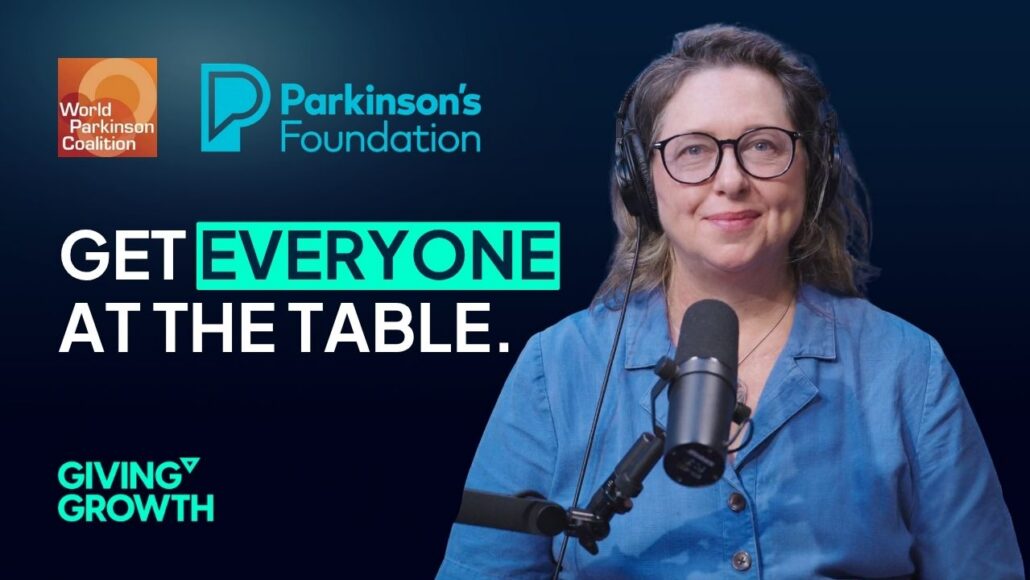
My guest this week is Eli Pollard. She’s the Executive Director of the World Parkinson Coalition and VP Chief Education and Training Officer at the Parkinson’s Foundation.
Eli has been leading the Parkinson’s community since 2004. And in 2006, together with Dr. Stanley Fahn, she launched something the medical world had never seen before. The World Parkinson Congress.
Her vision was simple but radical. Bring people with Parkinson’s into the same room as the researchers and clinicians working to treat them and make them part of the conversation from day one. Since then, the Congress has grown into a global event that connects over 100 organizations, tackles hard-to-talk topics like shame in Parkinson’s and inspires real change in research, care, and patient empowerment.
Eli, welcome to Giving Growth.
Eli Pollard
Thank you. I’m so happy to be here. I love to talk about the work I do.
Greg
How did you end up meeting Dr. Stanley Fahn? And how did the World Parkinson Congress come about?
Eli
I mean, I think about this a lot. I was in the right place at the right time with the right skill set and met an incredible person who gave me a chance, to be honest. I had never run a medical meeting before.
I actually didn’t know anything about Parkinson’s disease. But I had trained and a lot of different training academically as well as professionally. And, you know, we agreed that in our conversation that the skill set I needed, it had never been done before.
So I started out as a teacher. I spent a lot of time teaching and working and traveling internationally. I worked in nonprofit space for a number of years.
I had gone to graduate school and worked on international intercultural management. And all of those experiences led me to this interview with Dr. Fahn as he was looking to identify someone to help launch these World Parkinson Congresses with him. And we still laugh about it when we talk today.
He’s now 92. I’m not sure exactly of his exact birth date, maybe 93. And we still laugh when we talk about that first interview.
And he said to me, I think the time is right to launch this thing called the World Parkinson Congress, where we bring everybody together. It’s never been done before. We’ve never had a space where neuroscientists, clinicians and people with Parkinson’s can all come together to learn and advance our understanding.
And he said, I think it’s, you know, time is right. I think people will come. And we laughed about it.
And I said, well, OK, I agree. I think at the time, let’s give it a try. You don’t know until you try it.
And then he said to me, you know, you know what will happen if nobody comes. This was in my job interview. And I said, no, what will happen?
He said, well, in two years, you just won’t have a job. And we both laughed. And I said, so you’re giving me the job?
And he said, I’m giving you the job. Let’s get to work. So that was sort of day one, really.
And we didn’t know if the community was really ready, but clearly they were. We’ve been very successful in connecting people and really change the conversation around Parkinson’s disease.
Greg
The World Parkinson’s Congress is very unique. And the Coalition is unique because you’re bringing together patients, professionals, you know, charities, everyone who tries to solve this disease. And I don’t know that a similar platform exists in the world of cancer or brain or heart.
Why does this format exist in the context of this disease? Do you think that other mission driven organizations could benefit from a similar format?
Eli
I do think other disease areas could benefit from this format. And I don’t know of anything that’s exactly like what we do. So a little history.
I mean, back in 2004, when we were formed, there were a lot of Parkinson’s organizations around the world. Back in that time, they were not really talking to each other. Or networking or collaborating on projects.
And even though they all have ultimately the same mission, we all want to find a cure for Parkinson’s. And until that happens, we all want to find new treatments for Parkinson’s and support people living with Parkinson’s. It’s pretty much the same, whether you’re in Australia, you know, UK, Chile, US, it doesn’t matter.
We all want this. And so the organizations were not honestly playing well together in the same sandbox. That’s actually one reason why the Coalition was started as an individual organization.
There was some concern that because there wasn’t a really tight community and a collaborative spirit at that time, the leaders who sort of thought up this idea and hired me to help launch it, they said, I mean, they really literally said, we want to start. And I asked them, why are you not just doing this through one of the already existing organizations? Why are you creating a whole new organization to host this World Parkinson’s Congress?
And they said, because not everybody gets along. Not everybody plays well in the same sandbox. And if we start a new organization, there’s no history.
And you’re literally a new person that has no history with anyone in the community. There’s no reason an organization wouldn’t collaborate with you and this idea. And so we want to start fresh and we want people to say, yes, and you’re going to remain sort of neutral.
You’re a Switzerland, you’re neutral in this. You’re just trying to bring us together. And move the community forward.
And that was a really smart idea. I think it worked. And yeah, from there, and it wasn’t just that we had this World Parkinson’s Congress that brought neuroscientists and clinical researchers and people with Parkinson’s.
Patients, we used to say, you know, patients, in our community generally say people with Parkinson’s because they are of course patients when they’re in the clinic, but they’re not a patient when they’re walking down the street or doing their job. They’re just a person living with Parkinson’s. So it wasn’t just that we brought that community together.
We also opened up the doors for the entire clinical team. So, you know, nurses, all the entire rehab team, the physical therapist, occupational therapist, speech language pathologist, social worker, nutritionist, music therapist, all these people, they were also never invited into the room. And yet they’re the ones treating and seeing people with Parkinson’s every day or every week.
And so it was quite groundbreaking. And I think as soon as we just had the first meeting, we got everyone to come and show up. They saw the power of us coming together.
And it really just changed the dialogue in the Parkinson’s community. The first Congress was the first one. No one knew if we were going to have a second one.
They just wanted to see what happened with the first one. And once it was successful, it was a springboard for a lot of change in the Parkinson’s community. A lot of advisory boards built out to bring people with Parkinson’s in to advise all the organizations.
What should we be doing? What do people with Parkinson’s need? How do you identify and support research efforts?
What should we be doing research on? What’s more meaningful to you? It just changed the conversation.
And it wasn’t just because people with Parkinson’s were included. It was also the entire clinical team wasn’t included. So it was very powerful shift.
And I think any disease state could do this. They have to be committed to doing it and they have to have support from their leadership. I mean, Dr. Stanley Fahn honestly was just a grandfather of the movement disorder space and very, very respected and loved for his work and his mentorship of hundreds of movement disorder doctors globally. So that was certainly why people took note and took it seriously. I also think because Parkinson’s is a disease that moves slowly, generally. You are diagnosed, you live with it 10, 20, 30 years.
So it gives people time to come to grips with the disease they’re living with and then make many people make a conscious decision a few years in, okay, now I’m ready to engage. And so it gives us this incredible community of people willing to engage, whereas maybe some disease areas don’t allow for that. They don’t have 30 years to live with it to engage.
And so it is a unique chronic illness for sure.
Greg
I remember a story that you shared with me about the researchers who are trying to cure Parkinson’s and their lack of experience with actual patients. Can you just tell me what happened?
Eli
Yeah.
Greg
Why was it important?
Eli
Amazing. Well, I had heard this from the neuroscientists we were working with as we were designing the first World Parkinson’s Congress. And a lot of them said the most profound impact is going to sit with the neuroscientists because they do not meet people with Parkinson’s.
And so they’re in their labs trying to cure a disease and they don’t know what it looks like day to day. They don’t know what someone with Parkinson’s experiences day to day. They’re not treating them.
So they don’t hear the stories about how hard it is to go to sleep at night or how hard it is to get moving in the morning or how complicated the medications are. And so at that first World Parkinson’s Congress, you know, I was taking stock of how it was going. And I remember interacting with a very well-known neuroscientist who’d flown in from Sweden.
And I said to him, you know, how’s it going? I was like, what are you experiencing? And he said, it’s been amazing.
I brought my entire lab with me to this meeting, all my junior researchers. And I said, well, how’s it going? He said, well, amazing, but I’m stunned.
And I said, why? And he said, well, because I didn’t realize that none of them, none of my junior researchers know anybody with Parkinson’s.
And I said, that’s crazy. How is that possible? And he said, I just kind of assumed that they knew people with Parkinson’s because they were researching Parkinson’s and they worked with me in the lab. And what has been profound is that I realized we’re missing some things here.
And I said, well, what do you want to do when you go back home? And he’s like, well, first of all, I’m going to make sure that I bring people with Parkinson’s into the lab so that my neuroscientists can actually hear from them and see them and talk to them. And I thought what was really interesting at that first World Parkinson’s Congress, what was really evident was that there’s a lot of basic research being done and or clinical research being done at that time where there was no interaction with people with Parkinson’s until they got to the point where they needed people to sign up for the clinical study or to participate in the study.
And so, you know, how do you prioritize your research if you’re not asking people with Parkinson’s what they need to be addressed? And I still remember this young guy that spoke. He gave a great presentation on tremor and Parkinson’s, which is a signature symptom that many people have, but not everyone.
And he gave a great talk and someone stood up in the audience, an older gentleman, and said, you know, thank you so much for your research on Parkinson’s. I’m a gentleman, I live with Parkinson’s. My question to you is when are you going to start doing research on sleep?
Because tremor is not that big of a deal for most of us. The poor researcher on the stage looked like a deer in the headlights and he’s like, he probably had spent years doing this research project on tremor and this gentleman stood up and basically said sleep is really our bigger challenge. Can you do your research on sleep?
And I thought, well, that’s a hard pill to swallow. Like to spend two years doing research on something that the patients in the room are appreciative, but don’t really care that much about. That to me was eye-opening.
And I was like, this is why you bring a person with Parkinson’s in. Is this even, to ask them, is this even an important issue?
If I can study this or this, which should I prioritize right now, which may make the biggest difference in your life? That has changed tremendously since our first Congress. So much more interaction and so much more engagement between the basic science community and the people with Parkinson’s, which has, I think, changed research significantly in the Parkinson’s space.
Greg
This touches on something that’s really dear to me. I’ve been in digital marketing for some 25 years. What I have been experiencing is increasing disconnect from the customer.
And in this case, this is the customer that I am marketing to, or donor that I am marketing to, or my team is marketing to, or that charities are marketing to. Because obviously funding is important and we have to talk to donor about the patient or the disease in a way that is authentic and real and hits home. But it’s hard to do that.
The example you shared, if that neuroscientist hasn’t spoken to a patient, it’s hard if the fundraiser hasn’t spoken to a patient or the marketer hasn’t spoken to a patient. I wonder if your experience with the World Parkinson Coalition and Congress as the platform and your other role, because you’re also the VP Chief Education Training Officer at the Parkinson’s Foundation, do you think that the Coalition and the Congress in the context of Parkinson’s Foundation enables the people at Parkinson’s Foundation to get closer to the patient?
Eli
I mean, I wear, I do wear two hats. Obviously I run the World Parkinson Coalition and I work at the Parkinson’s Foundation. I mean, I think, yeah, both organizations do an extraordinary job working directly with people with Parkinson’s.
And in fact, after the first World Parkinson’s Congress in 2006, the Parkinson’s Foundation was the first organization to create a patient advisory board. It’s called the People with Parkinson’s Advisory Council. And a lot of the other organizations have similar councils now.
So I see it in action at the Parkinson’s Foundation. The People with Parkinson’s Advisory Council drives so much of what the foundation does. It is not just lip service. It is not just joining something and sort of sitting on the side. They’re pivotal to what the foundation does and the decisions the foundation makes and what research they’re going to fund, what programs and projects they’re going to lead.
And I see that at the foundation all the time. They do an extraordinary job, as do many other organizations that we partner with at the WPC. I mean, the Parkinson’s UK, Parkinson’s Canada, Fight Parkinson’s in Australia, the Michael J. Fox Foundation, all these leading organizations, they all are very cognizant of the role and the importance of people with Parkinson’s in the decision-making process.
But I do think that the World Parkinson’s Congress helped lead that change. I don’t think that that change would have happened as quickly. I think eventually every organization would have gotten there, but I think the WPC was the springboard for that and the impetus behind that.
But people with Parkinson’s, we’re very fortunate in that there are many people with Parkinson’s who choose to be very strong advocates for their own wellness. There is no shortage of people with Parkinson’s. I mean, from movie stars like Michael J. Fox down to people that you may or may not even realize you’re walking past on the street, advocating for funding for more research, funding for more treatments, funding for just better resources and awareness.
There’s still a lot of misunderstanding about Parkinson’s and particularly around young onset Parkinson’s. And so fortunately, we have a lot of very vocal people who are not shy and that does help with fundraising.
Although not enough money is coming in for Parkinson’s, we do need more. And I think collectively, we’re starting to realize that and figuring out ways to work collaboratively to raise, you know, raise sort of all boats in this space.
Greg
Is there a specific example of a breakthrough or initiative that happens specifically because of this ability to use Congress and the Coalition to enable these face-to-face connections? And I remember you spoke to me about Professor Paul Krack and Dr. Julio Angulo, I hope I’m saying those names correctly, and their work on shame. Can you just unpack this for us?
Eli
Yeah, it was an incredible opportunity. This was at the World Parkinson’s Congress in 2016. Our Congress only takes place every three years.
So 2016 was in Portland, Oregon. And I had met with Dr. Julio Angulo, who is a clinical psychologist, also a man living with Parkinson’s disease and a lovely person. I’d spent a lot of time talking to him and he was, you know, he was very open about the challenges of living with Parkinson’s, but also as a man who worked with and came from the Latino community, he said, you know, as a clinical psychologist, one of my goals is to work with particularly men, Latino men who have Parkinson’s because there’s a lot of shame and embarrassment around having Parkinson’s. They don’t want to talk about it.
And as a Latino man myself, I can bring them into this conversation. And that was the first time, it was probably 2014, where he mentioned that to me.
And as we were planning the Congress in Portland, I remember saying to him, and I think this is important, I’ve never heard anyone talk, at that time, I had never heard anyone talk about shame and Parkinson’s disease. And I said, I think this is something worth bringing to the Congress. Let’s have a round table discussion.
And at the Congress, we have these spaces, literally it’s 12 people and it’s just a round table discussion with an expert on a topic. We have huge plenaries with 800, 900 people. And then we do these round tables to sort of continue the conversation with these leaders. And they’re really wonderful places to keep the dialogue going and build small connections.
And he agreed that he would host a round table on this topic. And then I kind of unilaterally made the decision that I was going to pair him up with a neuroscientist from Switzerland, Paul Krack, a doctor, a professor, Paul Krack, who was a famous neuroscientist, highly respected, did brain surgery.
And I wanted the two of them to actually work together because one of the things we do at the WPC is we cross-pollinate the community. So I thought how amazing to have a person with Parkinson’s as a clinical psychologist sit down with an actual neurosurgeon and talk about shame, what’s happening in the brain, what this means. And when I paired them up, they were both, I would say, kind of terrified to actually co-host this table together, which I found kind of funny, but I understood.
Professor Krack called me and said, I don’t understand why you’re pairing me up with a person with Parkinson’s to talk about shame. That’s not my world of expertise. And I said, I think this could be a very interesting conversation. I think you should be open to it. Talk to Julio, get to know each other. I think the two of you can work well together.
And Julio basically said the same thing. Why are you teaming me up with a neurosurgeon? This isn’t going to work.
But what happened was not only did it work, this was in 2016, they organized together, they led a conversation around this roundtable, small group discussion, but they also became friends. And after that, Professor Krack introduced Julio to his team in Switzerland. And they started talking about shame.
And they started talking about the implications in the brain, what it means. And they went on to publish the first paper ever on shame and Parkinson’s. They also created a tool, a clinical tool called SPARK [Shame in PARKinson’s].
Excuse me, I’m forgetting the acronym this very moment, but it was basically a tool to assess shame in Parkinson’s. And it’s a self-assessment. So you can, as a doctor or clinician, you can give it to your patient when they come into the clinic and they fill it out.
It’ll help you understand if they’re actually experiencing shame and embarrassment in a way that impacts their daily sort of quality of life and living. That is a tool that is now accessible to clinicians globally that came out of a conversation with two people at the World Parkinson’s Congress. It took seven years to get from conversation to a tool, but that’s really powerful.
And then in 2023 at the World Parkinson’s Congress in Barcelona, we led a whole day long forum with executive directors and leaders from around the world. And we looked at the impact of shame on Parkinson’s and how should we, and could we, be addressing shame? Because it’s a barrier to people getting care.
If they’re feeling shame, they don’t get the things they need because they don’t ask for the things they need because they don’t want to talk about having Parkinson’s. And it’s not just impacting people in one or two countries around the world. Every country is feeling it, from the African continent to European, to US, South America, North America.
Everyone reported shame as a barrier. So that came out of a conversation and a cross-pollinated opportunity to interact and talk about a topic. We see that a lot.
That’s just one example.
Greg
I think that many people talk about patient-centered care. And you’ve obviously created a platform where people with Parkinson’s shape the conversation. How has that changed the culture of the Parkinson’s community?
Eli
Well, I mean, we really just walk the walk, right? And I think people will sometimes use that phrase, it’s like a catchphrase, oh, it’s patient-centered care. I think the way that we’ve changed is we’ve just done it, right?
We’ve just brought people with Parkinson’s in. We’ve included them in the conversations. They not only sit on our board, they help design the program. They help present from the stage. They’re not just there passively learning, they’re also helping to design the conversation and lead the conversation.
So we always have a plenary each morning on a key hot topic around Parkinson’s disease. And we guaranteed in our plenaries, we always commit to having a person with Parkinson’s in all part of the panel discussion.
So let’s say we’re talking about, I’m just saying genetic testing as an example. Do you get genetic testing? Do you not get genetic testing? We would invite a neuroscientist to talk about genetics from the neuroscience perspective, the basic science perspective. We would bring in a clinical researchers doing research that may be around genetics, might bring in a clinician, maybe a genetic counselor or someone, a social worker working in the space. And then we bring in a person with Parkinson’s.
And we ask them to talk about genetic testing from their perspective. Why do it? Why not do it? What they learned when they did it, what their fears are, how they talk to their family about it. We just walk the walk, right?
I mean, we just put people with Parkinson’s in the spaces where they should have a seat and they should always have had a seat. And that, I think, has just given people the freedom to say, oh, the WPC is doing it. We should also be doing it.
And, you know, they always say imitation is flattery, right? I mean, I see a lot of the work that we do gets repeated in other places around the world. And I love that because it is putting people with Parkinson’s at the center of the conversation.
I mean, they are the experts living with this disease. They’re not going to cure the disease because they’re not the researchers and the scientists and clinical researchers, but they know what it’s like to live with Parkinson’s 24-7. They wake up with it. They go to bed with it. They wake up with it. They can’t move. They know what that feels like. They know what all the emotions are. They know the motor and non-motor symptoms.
So they’re experts. And I think by just doing what we’re doing, we’re just modeling the right kind of behavior and people follow suit.
Greg
So another example that I remember you shared with me is the work around My Moves Matter. This is about helping patients with Parkinson’s track their symptoms to better understand how their choices impact how they feel, how they progress. Is this a good example of a spinoff from the work that Congress has enabled?
Eli
I mean, I would say I love watching the work of this group and this leader. So in our Congress in 2019, we had a young woman, she’s living with young onset Parkinson’s. She’s a nutritionist by professional training.
And she came in from Dublin. We scholarshiped her to come in as one of our participants. We do travel grants for people with Parkinson’s as well as early career researchers.
And her name is Rochelle Flanagan. And I remember meeting her and she said, I have two things that I’m interested in. One is nutrition because I’m a nutritionist. And the other thing is gender differences in Parkinson’s because I noticed that when I take my medication certain times of the month, that doesn’t work the right way. It doesn’t work the same if I’m dealing with menses or my menstruation cycle. It just feels different. My meds don’t kick in the same way.
And I remember she said, this is what I’m interested in. And who should I talk to? And I said, oh, I kind of looked around. There were, you know, 180, 200 speakers walking around. I said, I think you should just talk to everybody. Like ask them who’s doing the research. I don’t know where to direct you. And she did.
She just walked up to every researcher she could find. And she said, who’s doing research on gender differences and impact it has on medication efficacy. And she found out that really there wasn’t a lot going on.
And she said how, and a lot of researchers said, I’ve never heard anyone say that before. I’ve never heard anyone say that their medications don’t work the same day to day because of their menstruation cycle. I’ve never even heard anyone tell me that.
So maybe we should be doing research on that. So Rochelle returned back to Dublin, started really looking at, you know, these differences and started pulling people in. She created a mobile app called My Moves Matter.
And initially she was really interested in women because being a young woman she wanted to understand. But she realized it wasn’t just about women. It was about men and women and just gender differences more broadly.
And so now she has this mobile app. She’s doing research with France Parkinson’s. She’s doing other research studies.
And I’m hoping that some of the data from her study will come out at the next World Parkinson’s Congress next year. But that is an absolute spinoff. I mean, she came and this is, this is what we see is that people come to the World Parkinson’s Congress.
They’re leaders. They just need a direction and support in doing what they’re, getting them on their path.
She came. She had a vision. We created the space and she did the hard work. She did the hard work and she continues to do the hard work. But definitely a spinoff from the Congress in supporting her travel grant to get to Kyoto was a hundredfold — the results, the output from getting her there and giving her that opportunity to cross pollinate with the community and meet people has given back to the community a hundred times. It’s been amazing to see what she’s been doing.
Greg
This is an episode about how when we bring together charities and patients and researchers and others who are involved in wanting to cure a disease or deal with a disease, that these amazing things can happen. These amazing connections can happen that one wouldn’t have thought of. Otherwise, like these examples of, you know, work on shame or work on gender differences in Parkinson’s, you know, one could not have predicted this back in 2006.
And I’m sure there are many other examples like this of these really fascinating collaborations that are obviously very valuable. Now, I can’t stop being a little selfish when I hear you speak and thinking about fundraisers and digital, you know, fundraisers and marketers who are online or in person raising money for the diseases. Sometimes, because I feel this way, the work feels a little bit sterile.
It feels a little soulless because, again, if I don’t have a chance to hear these stories, if I don’t have a chance to actually, you know, I can never know what it feels like to be in those shoes. But if I don’t even hear what it feels like to be in those shoes, how can I talk in a way that’s authentic and compelling about what people with Parkinson’s or heart disease and other diseases are experiencing in a way that pulls on those heartstrings that charities always talk about?
That is frankly what resonates with me the most as a marketer, I have to admit. That I wonder if the evolved charities, and I think last year over $500 billion was raised from people, from individuals, from government, from the private sector for a variety of causes. But I wonder how much money is being left on the table because there is lack of connection with the patient.
Eli
I just agree with exactly what you said. I mean, I think bringing a person, in my case, obviously, a person with Parkinson’s into the conversation to tell their story, to tell their challenges. I mean, one of our board members is actually the founder of Parkinson’s Africa.
Her name is Omotola Thomas. And what was amazing is that she told her story on a panel in Kyoto. This is another output of that experience.
And she walked off the stage and she was talking about, you know, the experience of having Parkinson’s disease, what it means to be in Africa. And she’s from Nigeria, but it’s similar in many African countries and how it’s incredibly challenging. Many people in, or live in countries, they can’t even get the basic medication like levodopa, which takes pennies, pennies to produce.
And she told a very moving story, exactly to your point. She walked off the stage and a gentleman walked up to her from a private foundation in Switzerland who also has Parkinson’s. He said, your story moved me. I’d like to give you money to start this charity in Africa to help serve the people in the African community or African continent. It is exactly that story.
And he even has Parkinson’s. So he knows the stories, but he heard her story. It was so moving. He just wrote her check to get this thing going.
And now they’re Parkinson’s Africa is running and helping to serve a number of people on the continent. But it is exactly that. You hear that story and it is so moving and hard to hear someone living with a chronic degenerative disease in a place they can’t even get a proper diagnosis. And if they do, they can’t get the medication.
Nigeria is actually in good shape by African countries. It’s got quite good care and quite good clinicians, but there’s still taboo. There’s all the shame issues of just even getting the diagnosis. Do you want to get the diagnosis? So it’s complicated.
But these stories really resonate. I totally agree with you.
Greg
Storytelling is so important. If I’m standing on the stage or if I’m speaking to my team or if I’m, you know, on a panel, you’re sharing with me stories of examples of the power of the Coalition, the power of Congress. And I think that there are many stories that haven’t been unpacked, that are hidden beneath the surface.
And they’re waiting. They’re desperate to be told. But it’s hard to tell them if I’m not having all the parties at the table.
You have also emphasized the importance of exercise and social connection and mental health for people living with Parkinson’s. Like it’s not just about medicine, right? It’s more complex than that.
How does the Congress reinforce all of these elements in daily life after every Congress kind of closes every three years?
Eli
Well, it’s not even just after they close. It’s actually during the Congress. So the scientific program at each World Parkinson’s Congress is at the heart and core of the Congress.
It has to be exceptional. The speakers are very carefully selected. This program is very carefully designed so that it’s accessible to everyone.
We have high level basic science, clinical science talks, comprehensive care talks. And that is at the heart of the meeting. But what I also think is very important, this goes back to sort of the walk the walk, is that we have a wellness program that runs kind of in parallel to the scientific program or wraps around it in a way that we model for people with Parkinson’s how they can and should be living.
So for example, exercise is such a crucial thing for people with Parkinson’s. Let’s say a person with Parkinson’s, you go to a talk on exercise, sitting is really hard on everybody’s body. You and I both know we need to be getting up all the time, but a person with Parkinson’s really needs to be moving, right?
So they go to a lecture, they hear about exercise, and then we create a space, the wellness space, where then they can go into literally an exercise class with a dance professional, a yoga professional, someone who knows Parkinson’s and teaches this professionally for people with Parkinson’s. Then they can go and do a dance class. Then they can come back and go to the poster session and talk to the early career researchers on neuroplasticity of the brain.
Then they can go back to the mindfulness and meditation room and do a guided mindfulness session. And then they can go back to another session, so they’re learning, but they’re also moving their bodies.
That is the optimal care. You can’t, you know, going to a conference is exhausting. I don’t know how many conferences you’ve been to, but you know, you show up at eight in the morning, you sit all day, you probably don’t eat that well and maybe drink more coffee than you usually do. You leave at the end of the day and then you might go to dinner and have, who knows what you’re having at dinner.
It’s like, you don’t always take care of yourself at a conference. And so we don’t want that to happen. Like we don’t want someone to come to our conference and leave worse off than they arrived.
They’ve got to leave better, right? We want them to feel educated, rejuvenated and well. So we have these classes running, exercise class, mindfulness class.
I mean, when we were in Japan, everyone begged for a ping pong room. So we put table tennis together, ping pong. It was wildly successful. It stays. We still have a room. The International Table Tennis Foundation helps run it for us.
So people can literally move their bodies between sessions. It’s really important and it’s open to everyone. Doctors can come in and play as well. It’s not just for people with Parkinson’s.
But we try to model that, model good living and also give people an opportunity to try something they might not try at home.
So maybe you see a class at your local Y that says, you know, Qigong. And you’re like, what the heck is Qigong? I don’t know what that is. I’m never going to pay for that class. But then you come to the WPC and you see there’s a class and it’s free. You try it and you think, oh, that actually works for me. That made me feel better. I’m going to incorporate that into my weekly living, you know, when I return back home.
So it is, we give them the tool so that when they do return home, they’re better off than when they arrived. And then because we’re an international community between each Congress, we do a lot of online networking and gathering. So we have, you know, research spotlights where we’re constantly introducing new research to the community.
It’s really important for us that people with Parkinson’s stay educated on the research. And it’s really important that they meet researchers directly. You know, most researchers publish their research in journals that not everyone can access. It’s behind a paywall or you just can’t find it. It’s not something your average person would see.
So we really bring the researchers to the virtual table and we’re like, tell us about your research. How is it going to change someone’s life with Parkinson’s? And we let people with Parkinson’s ask them questions directly. And so we’re always keeping that conversation going, that cross-pollination.
And we do a lot of stuff for care partners. You know, we say Parkinson’s is a disease that impacts the family. It’s not just the person living with it.
It’s the whole family around them, deeply impacted. So we really do support for, we have a care partner lounge at the Congress where family members and care partners can stop in and learn for respite and just network. But we continue that conversation as well between Congresses.
And we have a lot of care partners, even after their spouse passes away, they come back to the Congress. It’s their community. So it’s about building this community.
And yeah, I mean, it’s really, I don’t know, it’s a special place. It’s a special place for sure.
Greg
You know, I think the goal is to have these events every three years until the disease is solved. What’s your hope for the long-term legacy of the World Parkinson’s Congress?
Eli
The thing that we always say is, you know, we don’t really want to be here. We’re trying to put ourselves out of business. That would be the legacy, to be honest.
I don’t want to be bigger and better and get more and more money unless it’s specifically to find the cure. Of course, we need more money to do the research for a cure. But we just want to put ourselves out of business. That would be the legacy.
If someone who comes to the Congress is, say, an early career researcher and they meet someone and they may unlock something, right? I want to make sure that the people who are doing really innovative, thoughtful research, carefully designed thinking, really forward-thinking researchers, that they connect at the WPC and they build their research on top of the shoulders of the people who came before them and that we eventually get a cure.
Cure is a tricky word. So in Parkinson’s, what would that look like? I mean, it could be, you know, Parkinson’s is complicated because it means you lose a certain dopamine cell in your brain.
And for one person, a cure could be just to stop the progression of the disease today. They would say, if you can stop it from moving forward, I could live the way I am right now and be perfectly fine. For some person out there, that’s a cure.
For someone else, a cure would be, I want you to reverse it. I want to go back to the way I looked 20 years ago. So cure is a complicated word with Parkinson’s, but nonetheless, that would be our legacy is that someone who came to our Congress, you know, made a connection with someone and they were able to unlock a new treatment that could slow the progression, cure the disease, maybe a vaccine that would prevent it from happening altogether.
So that’s obviously our dream. And that would be the biggest legacy we could leave behind is that they met at our Congress and they built that research out of their connection.
Greg
Final question. What do you know about creating a global movement today that you wish you knew at the start of your career?
Eli
I mean, patient. I mean, I always had been patient, but I think, you know, being patient with the process. It didn’t work as quickly as I thought it should. Like, I feel like we could have moved more quickly, but not everybody’s ready when you’re ready. And you need to just be patient with the process and to be very, very persistent, which I have been.
But, you know, in the beginning, there were people who doubted our vision and I joke, maybe I just outlasted them. Maybe that’s why we’re still here. I’m still here and they’ve retired or not working in this space.
But be patient and persistent. And when people, you know, when people really look down on your idea and don’t think it’s of value, just pivot and find the people who do value your idea and align with you.
Greg
That was a great answer. That could have been an answer for building, frankly, any business too, right? It’s about patience and it’s about outlasting everyone else, actually.
So I can certainly, as a founder of a performance media agency, I can definitely relate to that answer.
Eli Pollard, Executive Director, World Parkinson Coalition and VP Chief Education and Training Officer at Parkinson’s Foundation. Eli, thank you so much and thank you for the work that you’re doing.
You are an intrapreneur and an entrepreneur. I’m impressed that you’ve built something like this. I know Dr. Stanley Fahn was part of this and he served as the inspiration and the catalyst, but it’s forged in the execution and you’ve been executing this for the last 20 years. That’s very impressive. Thank you.
Eli
Thank you. Thank you for having me. I love, obviously, talking about my work, so I appreciate the opportunity. Thank you.