Non-profits Need New Funding Models - Here’s Why

Get one
powerful idea.
Subscribe on:


EPISODE SUMMARY
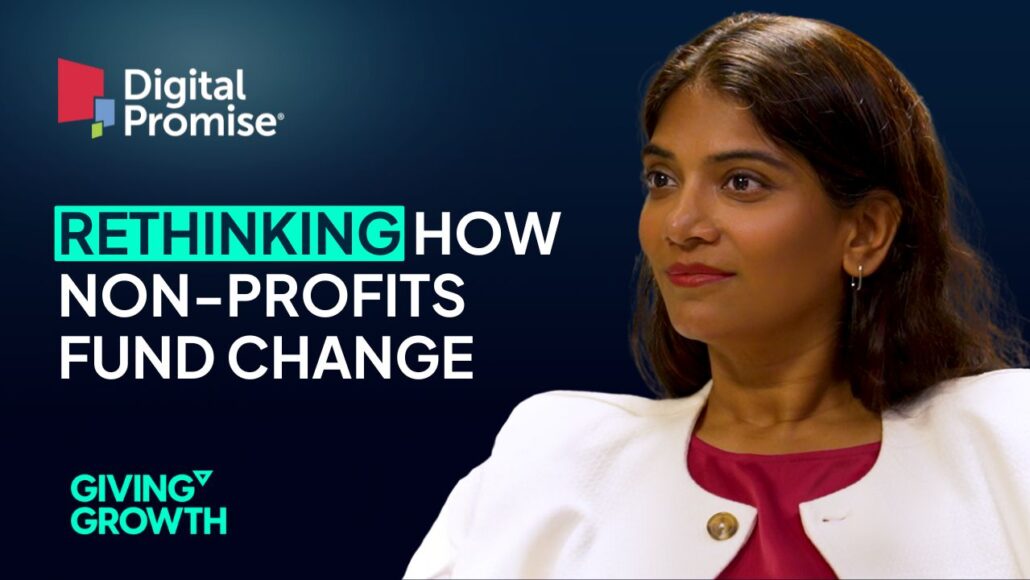
In this episode, Chaula Gupta, Vice President and Chief Program Officer at Digital Promise, joins Greg Sobiech to explain how nonprofits can move beyond short-term projects toward sustainable, scalable impact.
Chaula explores alternative models like fee-for-service, non-profit/corporate partnerships, and venture-style investing, and explains how AI can shift from incremental efficiency gains to truly transformative learning experiences.
Chaula and Greg discuss:
- Why project-based funding fails to deliver systems change
- How nonprofits can balance big, ambitious ideas with long-term execution
- The case for fee-for-service and venture models inside nonprofits
- Why adoption matters more than innovation in education technology
- How AI can deepen learning, not just save time
EPISODE TRANSCRIPT
Giving Growth Podcast – Chaula Gupta (full transcript)
Brought to you by Delve Deeper: https://delvedeeper.com/
Greg Sobiech
There is a problem that non-for-profits can’t ignore, and it looks like the traditional giving pyramid may be cracking. The pyramid is starting to resemble more of an Eiffel Tower with a narrow base and a heavy top. Older donors are aging out, younger generations aren’t filling the gap, and fewer donors are being asked to give more.
And then the volatile economy is squeezing non-profits from all sides. This is Giving Growth, the podcast where we talk to leaders who are reshaping the non-for-profit world and tackling these challenges head-on. Sign up for the Giving Growth newsletter and learn every week about one idea worth sitting with by going to delvedeeper.com slash podcast. This week, my guest is Chaula Gupta, the Vice President and Chief Program Officer at Digital Promise. You have a fascinating background. You started at this intersection of education, innovation, and philanthropy, but you also have lots of data and data science experience and technology experience.
You’ve been in this for two decades now, driving change in public education in the context of social impact. Chaula’s current organization, Digital Promise, is a global non-profit helping educators and communities use research and tech to close learning gaps, spark innovation, and make learning fair. Chaula has helped scale principal leadership programs in Chicago and founded Teach for America’s Social Entrepreneurship and Innovation Initiative.
Chaula, welcome to Giving Growth.
Chaula Gupta
Thank you for having me, Greg.
Greg Sobiech
When we were discussing this podcast, you told me that when you think back at your career, there seems to be a recurring theme that sort of helps explain who you are today.
Chaula Gupta
Yeah, yeah, I think there is. And I put it together as I was preparing for this podcast. I think all of the jobs I’ve had have touched upon some sort of innovative financing for social change.
So my first, I started my career at Ashoka. It’s a global organization. They vet and select social entrepreneurs who are working on game-changing ideas, and they take them through a very rigorous selection process.
Once they accept them into this Ashoka fellowship, they give them a salary for three years, a monthly payment that’s different for each country. But they don’t put any restrictions on how you can use that. They say, we trust you.
We think you have a really strong idea. Go use this money however you need to. You can pay yourself.
You can buy supplies. You can pay for childcare so you can go do work. And that’s very innovative.
This is an organization that started in the 1980s. So I think that’s a very interesting model back then to have that sort of strings-free, no-strings-attached funding.
After Ashoka, I was at Teach for America. I launched the Social Entrepreneurship Initiative. When we started, we decided we were not going to fund any ideas ourselves because we wanted to see if these alum entrepreneurs had a strong enough idea to stand on its own merit and attract external funding. And it worked really well.
We had lots of successes. However, I did notice that our entrepreneurs of color were not as successful because they did not have the angel networks or the seed networks that many others did. So we did end up starting a social innovation award to invest in riskier, more nascent ideas.
From Teach for America, I moved to Chicago and worked for the Chicago Public Education Fund, which has a venture philanthropy model. So every five years or so, we’d raise a fund, and then we’d spend it down. And there was, again, immense flexibility in what we did.
The idea was that every moment we could take those funds and see what’s the best way to reach to our goals. Sometimes that meant funding other organizations or starting new fellowship programs for principals or simply just paying for parking and food so that they can come together and work together. And now I’m at Digital Promise, which is a global organization.
And our financial resources span from grants. We have both public grants and philanthropic grants, fee-for-service revenues, corporate partnerships, contracts, the whole gamut. So I think the idea of how do you resource social change in creative, innovative, and sustaining ways is something that has fascinated me and has been a theme throughout my career.
Greg Sobiech
So when I hear you speak about this leitmotif theme, what I’m seeing is this connection between enabling an individual or an organization to help themselves by taking their idea to market, that results in some positive social change. I’m looking forward to exploring this more with you today. In the context of Digital Promise, what are some big problems that you’re trying to solve?
Chaula Gupta
Yeah, so Digital Promise is a global nonprofit organization. We were launched through a bilateral congressional act in 2011. So I think next year is our 15th anniversary.
But right from the start, we have operated at this intersection of research, practice, and technology. So all of our work is grounded in learning science research. We have a large team of learning scientists who are studying everything from how learners learn, how multilingual learners retain language, how you can build motivation and engagement in ed tech products that are focused on math, all kinds of things like that. So that’s sort of our research base.
On the practice side, we have large networks of educators, superintendents, principals, teachers, both in the US and globally. Actually, my team runs something called the League of Innovative Schools, which I think is a very cool name.
And then we have technology. And we think of technology as a way to enhance. When you have a proven solution, how do you make it more accessible, more personalized, more scalable?
So that’s where technology comes in. So we look at all kinds of issues around learning challenges, and we’re pretty flexible with how we bring together technology, practice, sometimes even policy to solve those challenges. Our reach is pretty broad globally.
I think we reach about over 180,000 educators in 27 countries. Many of our platforms and programs are used around the world. And right now, a lot of what we’re looking at is what is the instructional core?
How does learning happen? What is the relationship between the educator and the learner and the content, and oftentimes the community or the family as well? And how do you set that up for success?
So we don’t take a tech-forward approach. We don’t say, hey, technology will solve all the issues of education. But we look at how can technology help that relationship between learners, educators, and content work better.
Greg Sobiech
You have a deep understanding of the classroom. You can see the classroom through the eyes of the educator, and maybe through the eyes of the children, because it is about enabling students/pupils to absorb what’s being taught to them. And also you operate in a space where there is money to be made.
So if I’m saving the children, I’ll save the children. If I am medical aid for Palestine, if I am leukemia lymphoma, there is lots of pure philanthropy in that, right? It’s giving. There is nothing that I can expect in return except: make the world better.
But in your context, in the space that you operate, and I’m sure you’re the only non-for-profit in the space where, and I’m using those words on purpose, there’s money to be made because there is a whole industry that’s created around the classroom.
And I’m sensing that that creates a really unique opportunity for the kind of change that you can bring to that classroom. But I want to start this by investigating what’s not working right now. You said non-profits need to rethink project-based funding.
And you talked to me earlier about the fact that project-based funding in the context of education of the classroom may be broken. Can you unpack this for me?
Chaula Gupta
Yeah, yeah. I think I’m quoting our CEO, Jean-Claude Brizard, when I say this, but what’s broken is that funders fund projects and expect systems change. And what works with the project you do need, right?
Our education challenges are entrenched, whether it’s teacher shortages or reading and math gaps or the disconnect between graduation and workforce. Those are deep entrenched challenges. And so you need innovative solutions. You need to pilot something new.
But once something works to make it scalable, that’s not just simple replication. You have to rethink how that happens.
And oftentimes projects that are piloted work because they fly under the radar. They’re not disrupting the system. But to actually disrupt the system, you may have to fund very different kinds of things.
You have to fund coalition building. You have to fund collaboration among different organizations that don’t traditionally collaborate. You may have to fund policy work.
You have to fund community buy-in. Those are not things that have easy KPIs. They’re not nice, shiny, wrappable projects.
And so that becomes sometimes hard for nonprofits, I think, to sustain or to get funding beyond projects and to really think long-term in that way.
Greg Sobiech
And you talked to me earlier about this idea of these big, shiny objects.
Chaula Gupta
Yeah.
Greg Sobiech
And I mean, I get it, right? I mean, I get the fact that we want to invest in things that are big and shiny and they seem kind of sexy and attractive. And I think it’s just human nature.
But then again, when I think about education, it’s a multi-year systemic, multi-generational kind of an endeavor. This does seem sort of paradoxical. And I wonder, is there a way to, you think, combine something being shiny and big and yet long-term and systemic?
Like what would have to happen in order to give that donor a sense that this is something that I can not maybe brag about, because I know it’s not like that but I’m being on purpose, a little sort of excessive in my language, but something where I can say, this is a big moonshot, big shiny object, let’s say, but I also know that to go to the moon, right? It takes a decade. It’s a multi-year program.
Is it possible to do both, both ends? Or is it always one or the other?
Chaula Gupta
No, I think it’s possible. I think there are donors out there who see that vision. I think you have to build that vision.
You have to plan beyond the point of success, right? So oftentimes when nonprofits are planning, they’re planning for what happens if something fails. But what happens if something is successful exactly as you wished it to be and someone comes to you and says, all right, this is great, grow it, scale it. What are you going to do next?
That is the vision that you have to build. And that is what you have to build buy-in from funders for. I’ll share an example from Digital Promise.
We built something, I think we started in 2017, 2018, something called the Learn Availability Navigator. It’s almost, I think its original name was a learner positioning system, like a GPS, but for learners. And it’s grounded on this idea that there is no such thing as teaching to the average.
Every student has a jagged learning profile and there are lots of factors, cognitive factors, background factors, social emotional factors that impact how you learn. So we had this idea of building a tool that would help teachers navigate the learn availability of all of their students and deliver that at scale, personalized learning at scale. And we were fortunate to find funders who believed in that vision from the get-go.
So Oak Foundation, I think Chan Zuckerberg may have supported that as well, but Oak Foundation has been our consistent funder for several years on that. And they saw this vision. They knew this isn’t something you can just do a small pilot project.
For it to be successful, it has to be comprehensive from the get-go. So over, I think about six, seven years, they have been funding us and supporting us to build this tool that basically brings research-backed strategies that address those factors directly into the hands of educators. It is a big, shiny object.
But to get to that big, shiny object, just like to get to the moon, you have to do a lot of small, repetitive, unglamorous things and then build a rocket that goes there. And that’s what we’ve been able to do with our navigator.
Greg Sobiech
What’s intriguing about your experience and the last two decades you’ve spent in the space is this leitmotif of enabling individuals, maybe startups, to succeed in a space where there is money to be made. That’s commercially, there’s commercial potential in the space, right? And there are many vendors in the space that sell educators, a school system, different solutions.
And what I’m hearing you say is that maybe donors are looking for quick, shiny objects. And yet, to your point, to get to the moon, right? To create something that will systemically change the classroom, it’s many small steps.
And you were talking to me about ideas that you have now for what the future could look like. Because to your point, maybe the funding model, it can work. And there are these unique situations like the Oak Foundation, where they have the patience and they’re willing to dream big.
But how about everybody else? Do they behave this way? If we can’t rely on philanthropy anymore, or if it’s not enough, it’s good enough, but it’s not allowing us to make transformative change.
What are some other ways to create a win-win between the person with the idea of technology and the educator and the pupils?
Chaula Gupta
There are a few different ways. You know, I’ll start with one very obvious one, which is fee-for-service, paid service products. And that has a negative connotation, just like making money in the nonprofit sector seems to have a little bit of a negative connotation.
Yeah, I’ve had colleagues who have balked at the idea of charging an educator for a product or a research program or something like that.
But if you think about it, when you charge the educator for that, you are now more likely to serve them as a client than to serve the funder, right? So now scaling happens driven by user needs, not by funder timelines. And so I think we have to reframe how we think about fee-for-service as in service of the educators, not of the funder.
So that’s something we’ve been exploring. The Learn Availability Navigator, coming back to that example, great that we have built it, but we want to make sure that we can sustain it and not completely rely on philanthropy to do that. So we’re exploring all kinds of products there.
We’ll keep the main platform free and open to all, but we’re looking at how might we use LVN grounded, AI powered lesson plan builders for teachers. We’re also taking all of that content and saying, how do we feed this content, this research content to edtech products that are out there? Those are both really strong fee-for-service and corporate partnership examples.
I think the second strategy or channel for revenue generation is nonprofit and corporate partnerships. That’s something we do a lot as well. We have a program called Research Practice Industry Partnerships, RPIPs, in that we work with products and help them figure out what does implementing their solution in a classroom actually take.
So when you design an edtech product, you often sometimes do it in a silo. You may do a little bit of feedback, but you don’t really take into account is this someone, is this a product that a teacher is going to simply like, or is this a product that a teacher is going to use? And like doesn’t always translate to usage.
So we help them figure out what does it take to make your product stronger and better. And we train educators and students on how do you give feedback in a holistic way, not just about your preference, but what would it take for this to be successful in a classroom setting? That’s a win-win because teachers and students are now getting products that are better designed to meet their needs.
We’re getting to be the liaison and being sustaining. And the product has more of a chance of working because it is grounded in this kind of feedback. So that’s another channel.
And then the last one that we’re exploring, and actually some nonprofits I do know have explored, are venture funds. You know, there is no such, there is, the nonprofit status is simply a tax structure. Jobs for the Future has a very impressive venture fund that they’ve created, JFF Labs.
We’re exploring that with Digital Promise Ventures as well to say, if we have all this knowledge and all this research about how learning should happen, rather than wait for a product to come to us that’s already been designed and give them that feedback at that point, is there a way that we could go upstream and be part of that design process and say, here’s how you design products so that they are grounded in learner availability, so that they’re free from bias, so that they’re ethical and responsible. To me, that is, again, a win-win relationship.
So there are lots of ways that we’re exploring and I think nonprofits have to be more open to.
Greg Sobiech
I had two formative experiences in the technology space. This was about 20 years ago.
Chaula Gupta
Yeah.
Greg Sobiech
So I was working in Manhattan and I worked for one startup called Community Connect that tried to take on back then Myspace, obviously Facebook won, and then another one that was called Uvoo that tried to take over from Skype. I think it could have been Zoom, but we messed up both companies. One of them spent $40 million and the other one, and I have said wasted $40 million, and the other one $100 million of investors’ money.
And in retrospect, those were really wonderful experiences. Because as the director of marketing, I understood that we were too in love with technology and we did not see the world through the needs of the person who wanted to get on a video call or who wanted to be on social media.
We were very disconnected from the needs of the actual market that we were supposedly serving. I do think this is still happening today. But when I think about Digital Promise, I think about your unique ability to maybe create a bridge.
And yes, the venture fund could be the financial vehicle, but your ability to connect the educator and the students with that maybe startup or technology company that wants to provide the solution, that hits a spot for me, because that seems to address this problem of startups or entrepreneurs being too in love with almost themselves. What are you hearing?
Chaula Gupta
Yeah. You know, when I was at Teach for America and I was launching the Social Entrepreneurship Initiative, you’d think my job would be to help alumni become entrepreneurs. But in fact, my job was to convince them often that their idea was not strong enough, was to take them away from that path because there were a lot of people who were in love with the idea of being an entrepreneur without knowing what is it that they were solving for.
And so I would talk to them and I’d say, yes, you have a program that’s focused on enrichment. Well, what else is out there? How are you different to them?
Can you go work with them and make them better rather than just start another organization? So a lot of times it was really helping people see for themselves that what the world needs is not yet another startup. What it needs is a solution that actually works on a problem.
And a big part of this at Digital Promise for us is centering those that we serve. So we have a model called inclusive innovation where we center the educators, we center the community, the families, the students to make sure that innovation is not something that’s done to them, but innovation is done with them. And that’s a big part of why I think we can be successful and that we can be that bridge because we make sure that those, that’s where we start with.
We say, what is it that you want to solve for before someone comes with a solution and says, is there a problem you have? But I think we will all start moving towards that. I think there is more acceptance of this idea that we have to center the voices of those we’re serving and not just the tech industry.
Greg Sobiech
You know, I was here yesterday. I have another recording this afternoon, just happens to be a week of technology for some reason. And the leaders I’m talking to who work for large charities with hundreds of millions of dollars in funding.
And these individuals are specifically in the technology data space. And everybody’s talking about this idea of working backwards from the end objective, whether that’s a solution for the classroom or it’s a technology CRM system or it’s a data lake with donor data or maybe it’s my AdTech, MarTech infrastructure. Everybody struggles with this idea of working backwards from specific use cases or problems and actually then designing a roadmap that answers specific questions.
It just fascinates me that in 2025, this is something that continues to be a problem. And I think this was a problem 10 years ago and 40 years ago. Your ability to create a venture fund, which isn’t just a financial vehicle, but actually there is like a deep, almost advisory or know-how element, to me just sort of naturally makes sense.
What are some challenges around creating a venture fund in the context of a charity? Because you’re thinking about this. This is something you’re clearly passionate about.
It makes sense to me, but many things make sense to me and it doesn’t mean that it’s easy to do. What are some challenges or obstacles to actually getting something like this for you guys and for others off the ground?
Chaula Gupta
So I don’t think the main challenge is in the launching part or in that state, right? A lot of that is just technical, financial, legal. We have to consider what those implications are.
We have to be able to know how we’re going to raise the funding. We’ve explored with, do we start with a full-on investment model or do we just accelerate existing ventures that are out there? Early stage, do we go to others who have invested in ventures and say, we’ll help you get those ventures you’ve invested and be actually successful in the classroom.
In return, we’ll take some equity. So there’s baby steps we could take.
Greg Sobiech
At the very beginning, you said that the project-based funding model is broken. And you said that what’s needed is a number of small incremental steps. And you spoke about the fact that at the same time, donors want big, shiny objects.
And it seems to me that this idea of a venture fund that wants to drive social change and systemic change, and yet it has a five-year maybe kind of turnover, right? And there is also risk is being spread out because you’re investing in a bunch of different projects like a typical VC would, right? Or PE would.
That does seem both sustainable and sort of working on boring, longer-term, and yet foundationally important problems. And it also sounds a little sexy and shiny to me too. So doesn’t this sort of hit the spot from multiple angles?
Chaula Gupta
I think it could hit the spot. I think the other thing, other consequence that we’re not thinking about right now, right, so Digital Promise, as a non-profit organization, has a very unique credibility with educators.
Because we’re non-profit. Because we can say we are objective. We can say, we won’t tell you which product to use.
We’ll tell you how do you choose the right product for yourself based on your needs. But all of a sudden, if there’s a Digital Promise arm that’s also now investing in products that we truly believe in. But that does change how we’re seen, how we’re perceived by educators.
So again, not a terrible problem to have. I’d be very happy to have that problem to solve. I think our team would be too.
But it is something that we have to consider. What changes for you in your organizational DNA when you take on this other mantle of a venture fund or a for-profit arm?
Greg Sobiech
I mean, I could see how this is a trade-off. Because you’re right. This makes sense if there is this suspicion that you’re actually doing this, or it’s being done to benefit of the school system which clearly doesn’t land well.
And yet, when I talk to people who work with major donors, I had a conversation a couple of weeks ago with someone. And this person told me how he was in the room with 20 billionaires. And I guess these billionaires talked about the fact that, yes, it’s true that not only the general population doesn’t trust charities. If you look at the latest Edelman Trust Barometer, it’s an Edelman large PR firm. They release it every year. Trust in government and NGOs continues to decline.
Trust in the private sector actually is quite steady. And we all know about this. So there’s something about appealing to whether that’s a mass donor who wants to give $20 a month, right?
I mean, you guys focus on mid-major and corporate. But maybe it’s not optimal. And yet, maybe it’s transformative to have a venture fund that a major donor or a corporation would be very excited to work with.
Because it gives you the freedom to call systemic change.
Chaula Gupta
Absolutely. I think that’s the biggest value for us is it gives us the flexibility to take any revenue we realize there and put it back into the research work. So now our researchers are able to focus on the research they want to do.
Again, not dictated by what opportunities, what grand opportunities are out there. I think that is probably the biggest case for us to explore this. It allows us to be much more sustainable, but also flexible and autonomous.
Greg Sobiech
You told me something else, which was that it’s not enough for the educator to like a product. They have to actually, you said, use it. And I remember reading something.
This was years ago. And the argument that was made is the following. In order for a new product, a new service to disrupt an existing market, it can’t be incrementally better.
It has to be order of magnitude better. And it was, I think, quantified to the degree of 10x, that something has to be 10x better in order for me to shift habits from what I’m doing now to something completely different. And again, it strikes me that maybe it’s not enough just to solve a problem.
I have a better solution, but it has to be a much better solution. And is that a role that Digital Promise can fulfill? Really keeping that entrepreneur or technology honest in terms of the impact they can truly make.
Chaula Gupta
Yes, yes. That very much resonates, I think, for us, thinking about the classroom experience. Because teachers and school leaders, there’s a lot of tools right now in our schools.
We don’t even think about all the tools, not just the ones that are facing the students in the classroom, but all the backend tools that collect data. So you may have a classroom with 40, 50 different tools being used at any time. And each one of them with their own idiosyncrasies and their own systems and platforms.
And so for an educator, when they have to switch to something, they’ve spent a lot of time getting their class used to a particular product. To switch to something, it has to be exponentially better. The value has to be exponentially better for them to make that switch.
And we see this all the time, even with our research projects, we have researchers who come to us and say, hey, I have this product. It’s totally free. And we will give the teachers a stipend.
Can you get them to try to use it in their classroom for three months so we can collect data? And teachers tell us no. And superintendents say, I’m not asking my teachers to do that.
Because that shift, that change management that it takes is not worth it unless I know that this is going to change their lives tomorrow.
Greg Sobiech
I want to talk about AI for a second. The big thing I’m hearing over the last several weeks when I talk to C-suite in charities is everyone is frustrated that AI, on one hand, shows such promise and no one can point to a tangible example that actually is making a significant difference.
I didn’t actually even prepare these notes using AI. This is based on actual old school writing things down and thinking. But if I do a speech, we have a monthly all-hands meeting, I will sometimes say something important and I will run it through AI to make sure I position it the right way.
Or I will maybe ideate with ChatGPT. But I can’t tell you that it’s transformed my life. It has been a helper.
Chaula Gupta
Yeah.
Greg Sobiech
And I think everyone in the charity space is a little frustrated and annoyed with the promise AI. And maybe it’s saving us 10 minutes here and there.
Chaula Gupta
Yes.
Greg Sobiech
But it’s not causing huge impact. What is your point of view on the potential of AI in the context of a venture fund and really making a lasting change in the education space? Just what comes to mind?
What do you worry about or what excites you about what AI could do for the space?
Chaula Gupta
I think what you just said about how we’re saving a few minutes here and there is the problem. Everyone’s been looking at AI and saying this is an efficiency tool. In education, it has to be more than an efficiency tool.
And there are lots of products out there right now, AI and education products that use AI to save a few minutes here or to make some data entry easier. But what AI, what its actual power is or its potential is, is in transforming how learning happens. It can make learning way, way deeper.
So we’ve been working at Digital Promise on AI for several years, long before ChatGPT came into the scene. We actually wrote, worked on the executive guidance, the policy that came out on AI in teaching and learning from the Department of Education back in 2022. So we wrote that.
Greg Sobiech
So this was before ChatGPT, right? ChatGPT was November of 2022.
Chaula Gupta
It was right there, yes. And we had it out soon, pretty quickly after that, because we had been working on it for a while. We wrote similar guidance coming again issued from the Department of Education on how AI can be used by developers, how AI should be used by education system leaders.
So we have a lot of experience here and our approach is more on how can AI be used for transformative learning experiences. So I’ve seen some examples of where AI is used to recreate history. Our CEO loves to talk about this example of the Revolutionary War.
If you look at the records of Revolutionary War, it would feel like it was just old white men who fought this war. But the actual war was fought by people from all walks and ages of life, a lot of women as well. I’ve seen examples where AI can take that and make those experiences come alive so that you hear the narrative from a woman in Georgia who, with her 12-year-old, defended their farm against soldiers.
I’ve seen AI being used for doing uber-personalization, the Learn Availability Navigator I mentioned. If I needed to use that as it was, it would take a lot of time for teachers to take the strategies, turn it into a lesson plan. With AI, we can do that right away.
We’re using AI right now to take reading tools, reading tutors, and train them for multilingual learners. So people like me who have accents and intonations that are not native English, AI can serve us much better if we were struggling with reading. So there’s so much potential for AI if we go beyond sort of this efficiency play and really think about transformative, making learning come to life, meaning of learning, making it personalized.
That’s where I think we see the potential.
Greg Sobiech
Maybe a month ago with my team, we went to a two-day leadership training. And this was the senior leadership team. There are nine people and then several people on the executive leadership team.
And one of the things that the facilitator spoke about is that we all learn through storytelling. And his point was that as managers, as leaders, we need to communicate with our team by telling better stories. Look, and I know about this, right?
I get the fact that we supposedly evolved by sitting around a campfire telling stories before we could write. So we’re just wired for storytelling. We want to hear stories that resonate with us.
And yet I will forget when I work with my team to tell them stories to make it relatable. And I think what you’re saying is that education that’s more relatable, that’s more based on storytelling.
It’s just sort of the way that our brains have evolved over the eons.
Chaula Gupta
Yeah.
Greg Sobiech
And as you were speaking, I was thinking how amazing would it be if there was an AI agent that everybody in the classroom is assigned that both follows some standards, but also sort of adjusts to the pupil, to the student. And again, back to what you said earlier, that’s not project-based anymore. And it’s not short-term, right?
And it’s shiny, but it’s long-term. And I wish that there was just more thinking like this that’s being brought to education in other parts of life.
And again, the reality is most of those ideas will fail. So it has to be, I go back to venture fund, it has to be something that can accept as a system a 90% failure rate.
Chaula Gupta
Right. Yes. Yes.
Greg Sobiech
Let’s imagine for a second that we fast forward like five years in the future.
Where would you love us? One path towards the future, right? Digital Promise has many missions.
You guys are very active. But what would be amazing in your mind in the context of this venture fund, five years in the future, like what is something that you would feel really proud of in five years?
Chaula Gupta
Yeah. I think there’d be a few ingredients in that five-year future. One is in terms of the role of educators and education systems.
I’d love to see more of them see themselves as doing R&D, which they do, but they don’t always realize. We actually just started a national R&D advisory of our League of Innovative Schools and other systems. And we’re learning that there is a lot of R&D that happens in classrooms.
It isn’t always called that. It isn’t always seen as R&D. It isn’t always, you know, the lessons aren’t always scaled, but there is potential for that.
So rethinking the role of educators here, rather than as just passive recipients or feedback givers even, but more as these are co-researchers, co-designers. They are doing R&D in their own right. So I would see that as being the norm among educators.
And then I think among the industry, among the ed tech industry, I would see that there would be more of that drive to understand the problem and understand the need and to engage in that co-design with educators, rather than to find the solutions and then, you know, design a technology, fall in love with the technology, like you said, and then go looking for someone, you know, looking, being a hammer looking for a nail. So I would love to see that.
I would just love to also see less stigma around the commercialization or making money or things like FIFA service. I would like people to sort of see that as a win-win solution and not as something that’s taking away from the mission, but something that is, like you said, no margin, no mission. But that would be my ideal, just the change of perception and mindset around the role of each player, I think would be a huge change.
And in five years, that would be an amazing win.
Greg Sobiech
Yeah, you know, when I say no margin, no mission, it feels dirty sometimes. Yeah, it does. And it doesn’t make sense to me, but even I feel a little apprehensive about saying it.
And what I do for a living, half of my business is working with charities. And I absolutely see myself in the business of margin. My job is to help charities be successful in raising money.
And I’m a paid fee. Yeah. It’s a small fee, but there is a fee.
And then it is the charity’s goal to focus on the mission. And I think there’s nothing wrong with this model. And I think it’s sort of liberating, actually, because what’s wonderful is we all win, right?
I win, my firm wins, the charity wins, the donor, the other donors win, because their impact is multiplied. But ultimately, we’re all working for the mission. Yeah.
And the mission wins too. So I just love this idea of wins on multiple fronts. Yeah.
And I think that’s what you’re talking about. Yeah, yeah. I have another question, just in terms of paying it forward to others who are listening to this.
If you were to write the Chaula Gupta playbook for future-proofing nonprofits, what would be some principles that you would think about? What is important in order for us to future-proof this industry, both in the context of digital problems, but in the context of just charitable giving in general? Whatever comes to mind.
Chaula Gupta
Yeah. I think one thing would be rethinking that donor-grantee relationship as not as give and take, but as collective ideating, right? Donors aren’t just giving because they want to feel altruism.
That’s oftentimes a big issue, I think, for older donors. But for younger donors, they see that these issues, these challenges that we’re working on are things that impact them as well. If our education system fails, that has implications for workforce.
It has implications for our democracy. If the environmental issues keep happening unabated, that has impact on all of us. In the world of pandemics, healthcare isn’t just about a population, you know, a subset of the population that’s not getting healthcare.
It’s something that impacts all of us. So I think younger donors see those connections more and they see that this is part of the society that they’re living in. And so they don’t want to be just givers.
I think you have to engage them in the strategy itself. They want participatory giving and strategy building. So I think having that discipline right from the start to say, how are we engaging donors not just to fund something, but as thought leaders and thought partners in this work, I think is a critical thing.
I think from the start, thinking not just about, hey, I have this idea, I’m going to go through philanthropy or donations, but saying what are all the ways that I’m going to monetize this? What’s the subject matter expertise that I’m building that I can give to others and get more flexibility? So I think building more on that idea of flexibility rather than just sustainability and just funding, I think is also important.
Yeah, I think those would be my approach.
Greg Sobiech
That makes sense. Approach. And my final question would be, and it’s very cliche, but I find it to be profound sometimes.
You know, if you went back 20 years ago, right? And there was something that, what was one thing that you basically wish you knew about this journey that you’re on that you think would have made a difference that you know now, but obviously 20 years ago, we could not have known that. So you can go back in time and you can speak to yourself and you give yourself advice because of something that is now true to you.
What would that be?
Chaula Gupta
Yeah, I do think I would, I would have focused more on storytelling as well. I know you don’t believe in it or you were skeptical about it.
Greg Sobiech
I’m not skeptical anymore. I think it’s true.
Chaula Gupta
I think I would have said that all of this work at the end of the day is about being able to weave a story for the future and then do the work that you need to do to get to that reality. And I’d kind of focused more on that. That’s what I think would have kept me going, you know, far into the future.
Greg Sobiech
And do you feel like, like you not knowing that telling stories is important? What’s been the consequence of that?
Chaula Gupta
Yeah, I think, I think that’s something, a lesson that I’ve learned. Like I’ve just been, you know, in my younger days, maybe more focused on what’s my goal? What is my annual outcomes that I have to get?
What are my KPIs? But I think to have that consistent thread of a storytelling that says, this is where this is going. This is the impact it’s going to have in future.
I think would have made me approach my work in a different way, would have made me ask even harder questions than I’ve been able to ask. I wouldn’t have kept, you know, I think something I pride myself on is that I don’t have sacred cows. I think I could say that.
Yeah, you can say that. With a lot of my work. I question my own work that I’ve done in the past and say, how could that have been different?
And I think I would have done that even more. And so just because we did something doesn’t, is not the argument for doing it again. Because that’s when you then just go into project and program and program versus saying, how do you change the narrative?
How do you tell a totally different story than just more of the same?
Greg Sobiech
You know, that really resonates because what I see in the industry is lack of courage for bigger change. And it’s not as charities you look at, you know, credit cards, insurance, you look at every sector. And I think there is this sort of tension between incremental change.
And to be honest, I believe in incremental change. If we exercise, right? If we want to improve our relationships with our partners, children, friends, if we want to get stronger, faster, better.
I mean, it’s sort of boring. At the end of the day, it has to be incremental. That’s what innovation is, right?
Standing on shoulders of giants. Anything I read about innovation, you realize that there were 50 other people before this one person who made this thing really happen. So it’s always incremental, but it also starts to your point with big, hairy, you know, shiny ideas.
I guess it’s both ends. We need to have that story, right, that we tell about something that’s transformative. And we also need to sort of succumb to the incrementality.
And it’s about steps.
Chaula Gupta
Precisely. I think you need bulk. You need that sort of, a lot of the things that we talk about that actually eventually create systemic impact are boring.
You know, it’s data systems, it’s having training materials, doing the same thing again and again, doing slightly better, doing it more. You need that. And then you need to create space to say, where can I take a step back from this work?
Get away from just the continuous improvement mindset, which is what that incremental work is, and think quite differently. You know, a lot of our work at Digital Promise came because it was a byproduct of somebody’s research or some other project where we said, hey, there’s this one little thread here that wasn’t what we were trying to do. And yes, we submitted our report and we did this project, but what if we pull this thread all the way out?
And then five years later, that’s become a whole new body of work. So we’re trying to figure out, as we grow as an organization, how do we create that space to go back to some of the work we have done in the past and say, is there a way to think about this differently? Can technology, can AI now make this possible what was unthinkable five years ago?
So I think organizations have to have the mindset of doing both and striking a good balance.
Greg Sobiech
Sreelagupta, vice president and chief program officer at Digital Promise. I would love to see that venture fund come to life. I think it’s a wonderful idea.
I think it would be an amazing legacy. So that’s my wish for you, that this is something that you can stand up. And I love that the win-win-win mentality, that everybody wins in that context.
I think it’s very special. And I love how you said earlier that it’s not give and take, right? We all win in the process.
I just feel that we’re ready, that the space is ready for this idea.
Chaula Gupta
Well, now that I’ve said it publicly, I guess I have no choice.
Greg Sobiech
I would like to believe that if this conversation is one more sort of little push towards that being coming to light, that would make me feel good.
Chaula Gupta
Yeah, I think my CEO is going to hold me accountable to it because it’s on video.
Greg Sobiech
Sure. Well, thank you so much.
Chaula Gupta
Thank you. Thank you, Greg. This is great.
Thank you.