How Microsoft’s AI Team Is Helping Non-profits Transform

Get one
powerful idea.
Subscribe on:


EPISODE SUMMARY
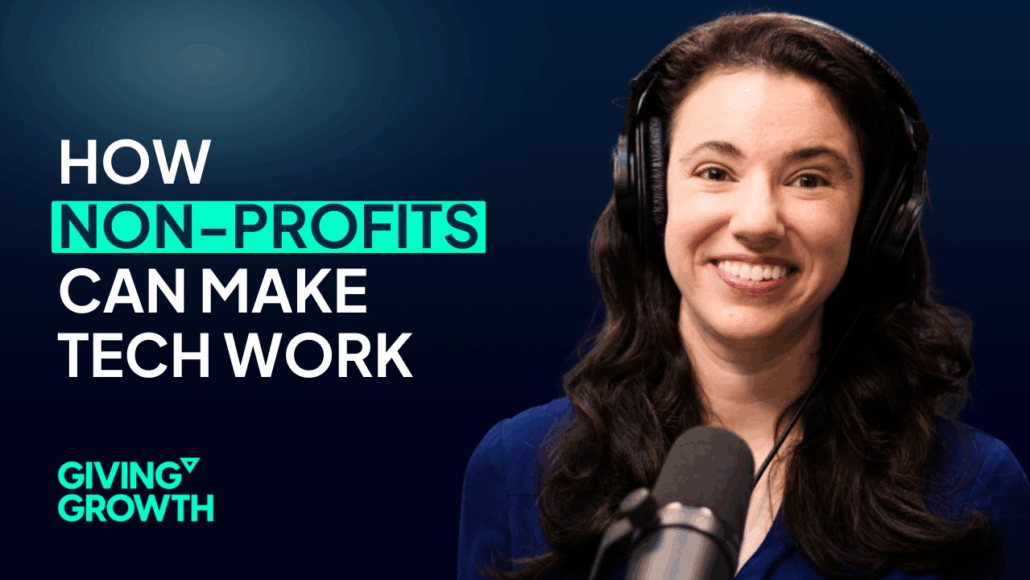
In this episode, Christina Macchiarola, Global Experiences and Events Lead at Microsoft Elevate, joins Greg Sobiech to unpack how charities can turn technology, data, and AI into tools that actually advance their mission.
Drawing on her experience helping organizations modernize through Microsoft Elevate, Christina shares why successful tech adoption starts with people and storytelling, not software.
Greg and Christina discuss:
- Why people, process, and technology must align for real transformation
- How better questions lead to smarter tech investments
- What non-profits can learn from political campaigns about engagement
- How storytelling connects fundraisers, technologists, and donors
- Why investing in infrastructure is essential to keeping missions strong
EPISODE TRANSCRIPT
Giving Growth Podcast – Christina Macchiarola (full transcript)
Brought to you by Delve Deeper: https://delvedeeper.com/
Greg Sobiech
There is a problem that non-for-profits can’t ignore. The traditional giving permit is collapsing. Older donors are aging out, younger generations aren’t filling the gap, and a volatile economy is squeezing non-profits from all sides.
This is Giving Growth, the podcast where we talk to leaders who are reshaping the non-for-profit world and tackling these challenges head-on. Sign up for the Giving Growth weekly newsletter and learn about one idea worth sitting with every week at delvedeeper.com slash podcast. My guest this week is Christina Macchiarola.
She is the Global Experiences and Events Lead with Microsoft Elevate. Microsoft Elevate empowers schools, community colleges, non-profits, and individuals with AI skills, tools, and resources. With Elevate Academy, it aims to train 20 million people in AI through accessible learning paths and global partnerships.
Christina is helping NGOs adapt technology responsibly, leading conversations around AI and, and this is very important for charities, AI ethics, or designing experiences that actually move the needle. Christina’s work is really about non-profit transformation. Christina Macchiarola, welcome to Giving Growth.
Christina Macchiarola
Oh my gosh, Greg, I am so overjoyed to be here. Thank you so much for having me.
Greg Sobiech
Well, thank you. And you told me that you often are actually on the other side, helping others prepare for these kinds of get-togethers. I’m really happy that you and I have a chance to do this together today.
Thank you so much. You’re my first podcast and I couldn’t be more thrilled. Well, and it’s, it’s funny how, you know, we met last November in the Netherlands at another industry conference.
So I, I remember meeting you and I was really impressed with you and I was impressed with the work that Microsoft Elevate is doing. And, you know, it took us a while to set this up. So I am looking forward to this conversation today.
Me too. Thank you so much for having me. So first, do me a favor and give me and give us a bit of a background around your journey.
How did you end up in your current role? Like what happened over the years? What made you get to where you are today?
Christina Macchiarola
I would love to talk about that. I have this conversation with girls that I mentor and other people who think, I don’t know if tech is right for me, because that was something that I never imagined for myself when I was younger. I’m recording right now on 28th Street in New York City.
I grew up in a commuter town to New York, which was amazing. I moved to New York for real, for college, and then just never left. And when I moved here, I thought, I’m going to have a career in theater.
I wanted to be an actress. I thought that was going to be the end goal. And part of that was because I had the experience of going to a nonprofit theater company that catered to children and families growing up.
It was called the New 42nd Street, the New Victory Theater. The reason I bring that up is because that nonprofit that I benefited from as a child gave me my first internship in New York City, and then gave me my first job after graduate school. And initially, when I took that job, I thought, this is my inroad to theater.
This is my way to be on 42nd Street, be in the community. And while that was great, and while I loved that part of the job, the mission-oriented nature of that place ended up being what was most important. I worked on the marketing team.
And our job was to ensure that children and families had access to quality, affordable theater that could open their minds. And so for me, it became less about what was happening on stage, and more about getting the audience a really wonderful, incredible experience. And from there, I moved.
I bopped around between nonprofits ranging from 17 people in size to 1,500 people in size, all based in New York City, largely working in marketing roles. And I loved the work. I loved being so close to mission acceleration.
And Greg, I’d be curious if you’ve encountered this with the nonprofits that you’ve worked with. It became Groundhog’s Day after a little while, like year on year. I was like, oh, we’re gearing up for the end-of-year appeal again.
Oh, we’re working on invitations for the spring gala again. And it felt cyclical. And simultaneously, as a marketer, you’re exposed to a lot of technology and other industries that are moving really quickly.
And I thought, well, why do we never get to have our hands on this? Why can’t we do any of that? And so while I was working for a nonprofit, I was actually going to business school part-time studying international strategy.
And ultimately, it’s those two things together that led me to Microsoft. My first job was on a marketing team at Microsoft that supported higher education institutions. And then I pivoted to a group that was formally called Tech for Social Impact.
We’re now Microsoft Elevate. And our mission is to deliver the power of AI technology to institutions that are doing the most good in the world. Nonprofit organizations, IGOs, K-12 schools, community colleges, making sure that, you know, the Microsoft mission is to empower every person and every organization on the planet to achieve more.
Well, you can’t do that unless you’re making sure that the organizations and people who are doing the most good in the world have access to all of those great tools and services. So that’s what brought me here today. And my favorite part of the job is getting to speak to people in the nonprofit space who are ready to take that leap, who are like, yes, I know that we can do more for our mission if we empower our people.
And so I can’t believe that I get to do that every day. And it’s my joy to be here and share that with all of you.
Greg Sobiech
You know, New Victory Theater is at 42nd. That’s right. Is this southwest of the Times Square?
Christina Macchiarola
Yes, yes. I can walk to where I had my first job.
Greg Sobiech
No, I know exactly where this is. I think the, if I remember correctly, because I used to take my kids there when I lived in the city.
Christina Macchiarola
I bet you did. I bet you did. It is also, ironically, directly across the street from the New York Microsoft office.
Oh, Microsoft office.
Greg Sobiech
But I think the Aladdin Broadway show, if I’m not mistaken.
Christina Macchiarola
Yes, it is directly across the street.
Greg Sobiech
Because I’ve seen that show with my kids and my wife. And really, it’s mostly my wife has gone to the theater and I’ve gone a couple of times. But this was maybe, you know, about 10 years ago where we’re still in New York City.
So I’m actually very familiar. And then your point about Groundhog Day and marketing work being cyclical, right? As you, I was on the brand side and on the agency side and worked for startups.
And I know that marketing can feel cyclical. And it’s also exciting because to your point, there is this mix of technology and creativity. It’s always evolving.
And it’s never, you’re never done and you never know everything. I personally enjoy the fact that it is a, like digital fundraising, digital marketing is a journey. And there’s always surprises.
Christina Macchiarola
Yes, I agree. That’s what makes it exciting. Like if you’re like, I’m willing to have a learner’s mindset and evolve with where the technology is taking me, you’re primed to succeed.
Greg Sobiech
A hundred percent. But to your point, you have to have that curiosity and you have to be okay not knowing. When I talk to charities and typically these are larger charities that have several hundred million in funds that they raise every year, up to a couple billion a year.
Sometimes it does surprise me that many blind spots exist when it comes to technology adoption. And I think it’s partially rooted in the fact that charities traditionally have been so fundraising driven. It’s been so much about mid and really major donors.
That just technology, frankly, hasn’t been that important to growth that charities had experienced in the past. What are some blind spots that charities should be thinking about when it comes to technology adoption?
Christina Macchiarola
When I talk to organizations, I love thinking about tech adoption under three pillars. You have your people, you have your processes, you have your technology. And something that I’ve observed is that people have a way of over-indexing on the technology part.
They’re like, oh, technology is hard. I would argue technology is complicated and that’s what makes it work. People are hard.
Convincing others in an organization that technology is important is the challenge. Being willing to change your day-to-day processes and how you think about the way of working. Is the challenge.
And so to me, one of the biggest blind spots, I think, is this write-off where you’ll hear buzzwords, you know, in the zeitgeist, AI, cloud computing. It just, it sounds so difficult. And I’m not saying that technology implementation isn’t complicated.
You need people who are really smart, who know what they’re doing. You need the right partners in the room. You need to understand what your end goal is for the purposes of technology implementation.
But I think that write-off can be the first biggest hurdle. Because once you get past that, and once you say, I, one, have been able to identify the problem that I’m trying to solve. Well, then you’re thinking in a solution-oriented manner rather than, oh, well, we just can’t adopt technology because we don’t have enough time.
We don’t have the space to think about it. I have a similar reflection. I would love to hear about it.
Greg Sobiech
No, no, I have a similar reflection. And I agree with you because I find, and I’ve been in the industry since 1999, so quite a bit of time. And in digital, it’s really hard, not just for mission-driven organizations, but for anyone who is in a revenue role to know what questions to ask.
And it’s hard to ask good questions. And I think that that kind of speaks to your point about process. What is your perspective on asking better questions and not focusing on technology, but focusing more on what it is that technology is meant to enable?
Christina Macchiarola
Oh, that resonates 100%. I think, I know we’re speaking mostly about data during our conversation today. I’m going to bring in AI just because that is the hot thing in the news right now.
I get a lot of, you and I feel like are on the same conference circuit. And I get a lot of questions that is mostly, well, how do I start with AI? To which I say, we need to rethink the question that you are asking me because we shouldn’t be talking about technology for technology’s sake.
We should be saying, what is the thing that is causing the biggest pain point for the community that you’re serving? What’s the biggest pain point for your internal staff that doesn’t allow them to solve that community problem? And that’s when technology enters the conversation.
And if AI is a tool as part of that, fantastic. Sometimes I like to think about my job as how do I frame certain technology concepts as if I were talking to a group of eighth graders. I’m not trying to diminish intelligence by saying that.
Greg Sobiech
I just think- I agree with you. I’m there with you.
Christina Macchiarola
When I speak to tech people internal to the company, I ask them to explain it to me as if I were an eighth grader because those concepts are tangible. One of my favorite analogies is that when I wake up in the morning, I think, what do I want to eat for breakfast? I don’t think, how am I going to use the stand mixer today?
Maybe if I want to make a frittata, the stand mixer will come out just so that I’m not standing there whisking for hours. It will go faster if I use that particular piece of technology in the kitchen. But I’m not starting with the end result.
Greg Sobiech
I understand and I agree completely. I actually use the same exact phrase internally when I talk to brands or with my team. And I always say, can we just think as an eighth grader?
Because that’s also the reference point around just like basic communication skills should be eighth grade level. And I think that as an industry, we’re often guilty of using acronyms. And we love acronyms.
I know. And I like, I love, I’m in digital, right? I like CPC, CTR, right?
And ROAS and other acronyms and acronyms that describe technology stacks. But it’s not helpful when helping someone, or when trying to enable someone who has huge revenue responsibilities, a large team, and who deals with a complex set of stakeholders. That doesn’t help them get their job done.
Christina Macchiarola
It doesn’t. And I think that’s the same if you’re in a nonprofit and you’re talking to your board. You have a group of people who are meeting for a fixed amount of time.
Your nonprofit is not their primary responsibility. It’s on the list of their responsibilities. And in that hour, maybe if you’re lucky, you have two with this group of people who are critical decision makers, you have to be able to synthesize what you need really, really quickly.
And so if you’re providing layers and layers of complexity, you’re going to lose people in the room. It’s what do you need to achieve? Here’s the tool that I need to achieve it.
Here’s how long that I think it’s going to take. And here’s the desired outcome. And breaking it down.
Greg Sobiech
And you said at the very beginning, it’s about people, process, and technology, almost in that order. I think what we are talking about is telling better stories and maybe working backwards from the kinds of like- 100%.
Christina Macchiarola
I have a giant note. I realize the camera can’t see it. I have storytelling in giant letters on the back.
And I think internal storytelling is just as important as the external storytelling. People are constantly selling within an organization, whether it’s a huge organization like Microsoft, where you’re trying to get a project pushed ahead, or within a nonprofit. Maybe you only have a team of, like I said, I was on a team of 17 people at one point.
You’re trying to coalesce around an agenda. And sometimes it’s the people who can articulate that vision who are going to get other people to come on board.
Greg Sobiech
Thinking about storytelling, back to Buzzwords, Christina. I like the word storytelling. I like the word the journey of a donor with an experience in different environments.
In the for-profit world, we call it personalization, which I think can be a little overwhelming because it sounds complicated, and it can be complicated. But what is your perspective on what role technology, particularly better data and personalization, can play in really elevating how potential donors feel about a mission? Can data be an enabler of actually deeper connection that a donor has with a charity’s mission?
Christina Macchiarola
Absolutely. And so something that I want to connect to this conversation is the concept of restricted giving versus unrestricted giving. So I’m sure your listeners know restricted giving is when a donor is saying, I want my money to be used for X, Y, Z.
Unrestricted giving is when somebody is providing a donation and they’re not limiting how the donation should be used. For a lot of nonprofits that I talk to, restricted giving is sometimes a pain point because the funds are limited. You know, if you’re working for a museum and somebody only wants to contribute to your armor collection, then that money can’t be used elsewhere.
But here’s why I think looking at that model is important. When a donor is restricting a gift, they are saying, this is what matters to me. They’re saying it with their money.
This is the thing that is important to me. And I think historically, a lot of nonprofits are using that restricted mechanism as a way to understand what the donor wants. That works really well at the top of the pyramid when you have really big gifts, when you know people individually, one-on-one.
Something that I like to think about is what is that mode of understanding for people who you are trying to attract and mass? When I think about reporting that a lot of marketers do, go to any retail site, you place an order online. At the end of the transaction, I would bet you see a pop-up that says, how did you get here today?
Was it on this social platform? Did you search? I have rarely seen a question, why did you come here today?
I think there’s an opportunity there, especially with AI now and the way that natural language can be parsed. If we start asking people who are coming to our sites, whether it’s retail, whether it’s nonprofit, of their own volition, why they are here, we can start to have a better understanding of what is attracting people to whatever entity you may be in the first place. Well, then that Greg, like we were saying, that’s data that you can mine.
You can look at ratios of people who are responding a certain way. You can look at key things that are driving people to a place. And then that’s when your data modeling can come in.
I know this information about this person. What other demographics can I tie to this individual and start noticing patterns and mass? And then once those patterns have been identified, how can I use predictive modeling to try to figure out who knew I should be targeting?
And if these are the key messages that are important to them, I can construct a story to our earlier point that may draw them in, especially in the midst of all the noise. Like sometimes I try, I have those timers on my phone that limit how much I’m allowed to be on certain websites because the noise is overwhelming. But the things that cut through algorithmically or otherwise are the ones where I feel like they’ve read my mind before I’ve even started engaging.
Whether we like it or not, that’s what’s drawing people in in a digital landscape. We have to sort of anticipate those needs, but we can’t anticipate those needs if we’re not even asking what those needs are.
Greg Sobiech
I really appreciate what you’re saying because it is so simple. You would think that everybody does this, especially for mission-driven organizations. I think this is complicated because if I’m, for example, raising money for cancer, to cure cancer, and I am the Leukemia and Lymphoma Society or cancer.org, there are different reasons why I would give. In my case, for example, my father died of leukemia when I was six. Frankly, I am less interested in R&D around cancer. I am way more interested in providing mental health support for kids who lost a parent.
So why not ask me, Greg, why do you care to give to cancer? And here’s a bunch of options. And again, it’s so simple, and yet it’s so rarely done.
Christina Macchiarola
I was on LinkedIn the other day. And so LinkedIn, you know who you work for. I had an ad targeted at me from an organization that said, hey, I know you work at Microsoft.
Did you know that Microsoft matches your donation and you can actually double your impact with my organization if you reach out? And I thought, what a great use of personalization. One, to remind me of a benefit that I take advantage of regularly.
Two, you showed up in a place where you know I normally am. And three, you used compelling imagery and language to, this was a nonprofit that I never heard about. You piqued my interest and I wanted to learn more about you.
And so there is power in that personalization and finding the right people.
Greg Sobiech
And this example, I would imagine, starts with someone, a marketer, having just a simple realization or simple idea that there are many, Microsoft has many employees. It’s enough of a population to go after. And maybe that ad was created by a human or some sort of algorithm, but either way, it’s a simple idea that’s powerful and you’re remembered about it.
And I think this goes back to process and people and just kind of, you know, asking better questions. What if we did that? And what would it do to increasing our donor engagement?
And we so often just jump to AI being that kind of solution. But again, it starts with human intelligence and only then can it go to artificial intelligence. A hundred percent.
Now, last time we spoke, when we were preparing for this recording, you said that no one wants to fund keeping the lights on. The overhead myth. Yeah, exactly.
And because everybody, even I was talking to someone yesterday and to another charity and this person said that, you know, donors love to fund new, exciting projects, but keeping the lights on just seems kind of boring and run of the mill. And I think this is a real problem that the charities have. Is there a way to reframe this essential operational work, especially in the context of data and technology, data security, you know, AI integration, as something that’s actually mission critical?
Christina Macchiarola
I think so, 100%. So I’m of the generation that I grew up watching Mr. Rogers’ Neighborhood on TV. Yes.
This will be relevant, I promise. Mr. Rogers always had a segment on his show where you got to learn how things were made. You got a tour of the crayon factory.
And I was a kid and I loved crayons, but oh my gosh, how cool was it to see those crayons being made? If you go on YouTube, the number of how-to behind-the-scenes videos that just swarm algorithms, it’s almost overwhelming. As people, I think we’re fundamentally curious and we like knowing how things are made.
We like getting under the hood. I feel like storytelling is going to be like the big word of this episode, Greg. But those stories exist in nonprofits every day to create that through line.
So I’ll give you an example. Let’s say that you work for a museum and you have the opportunity to do a hard hat tour of your art storage with a donor. Well, suddenly the donors are saying, oh my gosh, look at how much work goes into storing and saving this art.
And temperature control is critical to making sure that this art stays alive. And you know what is making sure? And constantly monitoring temperature control in this room.
Well, you have a lot of computers and a lot of people in the back using technology to ensure that this art stays safe. And that’s the same technology, by the way, that is going to be the underlying backbone of your internal operations. Suddenly that’s a way to make that really, really cool.
If you’re an organization that requires a lot of field work and you have people on the ground who are not always in networked environments who have to work offline, is there a way that you could use, put a GoPro on somebody in the field, walk them through their day and then make sure that their tablet, whatever they’re using to respond faster in emergency situations. Is part of the narrative so that you are actually seeing the technology in use. I don’t think it’s about, you know, again, walking into a boardroom and saying, you know, here’s the map of our networked environment.
There are some people who are going to think that’s the coolest thing in the entire world. But you can show, well, you’re right, Greg, I know you’re one of them. But, you know, if that’s not you, the technology is in the mission work every day.
You just have to, I think there are just opportunities to step back and say, well, how do we show where technology comes into play? And suddenly then you’re in the narrative.
Greg Sobiech
I agree. And this is a classic sort of business versus technology friction and a classic example of silos and gaps in communication. So Dan, if you’re talking to a nonprofit leader who has revenue responsibilities, because maybe they don’t appreciate the need to invest in data infrastructure because they see technology as a schematic or a system versus an enabler of the mission, what is your message to them to make sure that they do think of changing their approach to investments in technical infrastructure?
Christina Macchiarola
So I would approach it a few different ways. One, I think there’s often a fear of not wanting to be first. Again, going back to storytelling, sharing stories of nonprofits of a similar size, of a similar budget who have made that investment and showcasing the output of that investment grounds it in reality rather than the theory of, I can say all day and I believe it, investing in a solid infrastructure now rather than continuing to put band-aids on whatever problems you’re dealing with is the sustainable model in the long term.
Now, more so than ever, nonprofits are under tremendous pressure and frankly are in an environment where they have to be reactive in order to serve the communities that need them the most. And so it can be really hard to take a step back and say, well, you now actually, you have to think about this. It’s not just your five-year plan.
It’s your 10-year plan. It’s your 15-year plan. It’s building the foundation of your house, which is a scary thing to talk about when you’re like the house is already built and I’ve added three extensions to the house and what else am I supposed to do?
So providing stories of nonprofits who are in similar situations, I think helps. A question that sometimes makes leaders uncomfortable, but I ask anyway, is I’ll say, how often do you bring IT to your board meetings? I met with the answer no a lot of the time or not often or rarely.
And I would say, I think that’s something that you need to make space for. Chances are your board are working in organizations where a lot of this IT infrastructure isn’t even a question. That’s somebody who your board probably wants to hear from and you can work with them to create a cohesive narrative for your board.
So invite your experts to the party.
Greg Sobiech
Yeah, you and I have had very similar, I think, backgrounds because we’ve both have been sort of on the brand side doing marketing and almost through that we have learned to embrace technology. And I look at user experience, process, teams, technology it’s part of the same endeavor. It’s part of the same journey.
When I talk to technology leaders at charities, they’re kind of desperate actually for that seat at the table in the boardroom. They’re desperate for a deeper relationship with fundraising. But there is this just lack of understanding between the silos, between the business and between IT which is seen as a cost center.
And I have a problem with that statement that it’s a cost center. IT desperately wants to be a revenue center. But to your point, is storytelling the connective tissue between these teams?
I think it is. And yet I don’t see that happen a lot.
Christina Macchiarola
I agree with that completely. And going back to the people, process, technology framing that we started with. Something that I like to remind non-IT people who work in nonprofits is this.
A lot of this is anecdotal and it was something that was true for me. I worked in the nonprofits that I worked in because I truly believed in those missions. That work mattered to me on a really deep level.
That mindset isn’t just for the people who are working in your programs. It’s not just for the people who are dealing with donors. It’s not just the creative marketers.
Your IT team has really valuable skills. They could take those skills to the corporate sector probably any time that they want. And they are choosing to apply those skills to further your mission.
You’re all there for the same reason. You’re one team. And so I think reminding folks that it’s, well, it’s just IT.
Same thing with finance, NHR, by the way. Well, it’s just that department. It’s like, no, they are making the choice to work for your organization, probably for less pay than they would if they were in the private sector.
There’s something incredibly beautiful and sacrificial and worthy in that no matter what department that you’re in in a nonprofit organization. And I think if that mindset was shared and it was viewed as one team, there’s a way to maybe break down some of that siloing when you get past the, oh, well, they just do that. They’re separate from the mission.
No, you’re all working towards one mission. I’ll get off my soapbox on that one.
Greg Sobiech
No, I’m there with you. And by the way, if you’re enjoying what we’re discussing, we have regular conversations on giving growth with people like Christina and other leaders from US-based and global charities, including UNICEF USA and United Way worldwide. And if you would like to get this podcast on a regular basis, go to delvedeeper.com slash podcast, sign up, and you’ll get your one idea worth sitting with every week. Back to the conversation, Christina, something else that for me this spills into is this fact that there seems to be a disconnect, especially at the base of the giving pyramid. So when we think about the typical giving pyramid, mass, mid, major donors, I do think that the pyramid is in some ways shrinking or collapsing. And I think that reflects changes in society, kind of richer, getting richer.
And we’re asking people who have less disposable income to give. And they’re the future of giving. And yet we’re focusing on people who are of means because that’s where the money is.
And I worry about this dynamic. Do you think that there is a disconnect between how donors want to experience impact and how organizations are actually communicating impact?
Christina Macchiarola
I do. That goes back to that, to our restricted versus unrestricted conversation a little earlier, where I think people are telling institutions what they want. And I’m not gonna say this is true for every single organization, but I do think there is this flywheel of donor treatment.
Again, I live in New York. The cultural vibrancy is why I absolutely love this city. And I wanna support as many cultural institutions as I can, right?
The only mail that I get is membership and donor requests from, name the cultural institution, like physical, hard copy mail. All of it goes into the recycling. And I, cause I’m a little bit of a nerd about this.
I do read everything. Sometimes I compare donor letters just to get a sense of like, oh, like what are they changing in the language? And nobody’s talking to me.
You know, now when you’re choosing that medium and it’s not to say that there isn’t value in that, you know, direct mail still works for, you know, a portion of donors that are critical. If you did a little bit of demographic digging, you’d probably realize pretty quickly that I’m not one of them. And maybe I could be eliminated from that list.
I think, again, to the beginning of your question, we’re not necessarily indexing on the channels where people are. And we’re not talking to them about what matters most. I actually think political campaigns are a very interesting model that nonprofits can actually take, you know, a closer look at.
Like a lot of the groundswell that, you know, we’re seeing around small donors are because people are capturing a message that is important to others. And even if it’s, you know, $5 once a month, that’s significant. So I would just say, I invite, you know, as we’re thinking about, well, how can we adjust to that pyramid?
Sometimes I think there’s this desire to only look within the industry for lessons. Outside of the industry, it seems to be communicating really well. And maybe we can learn something.
Greg Sobiech
So we spoke about people, process, technology. We spoke about the fact that storytelling is really probably one way to connect, not just with donors, but to also connect people internally at my charity to make sure that fundraising and marketing and communications and just the business is properly partnering with IT or the technology group. Can you share examples, like real life examples of how you’ve seen technology really be an enabler of deeper donor engagement?
Sure.
Christina Macchiarola
So I did not work with this organization directly, but a few of my colleagues did. And I think what they did is just a really beautiful encapsulation of an end-to-end vision. So Make-A-Wish Foundation, which, you know, your listeners are familiar with, they are a national and regional chapter-based organization that’s dedicated to supporting children in critical condition during some of the most difficult parts of their lives by granting them a wish, whether that’s a vacation or an opportunity to meet someone that’s really important to them.
The volume of children whose lives they make brighter is really incredible. And this is true for any organization that has a federated or affiliate model. You have a national chapter, and then you have regional chapters around the country, maybe even around the world.
And sometimes you’re not always singing the same song. And so something that the Make-A-Wish Foundation did on a grand scale is they unified all of their data, leveraging Microsoft Azure, which, for those who aren’t familiar, it’s a platform as a service. And then they leveraged Microsoft Fabric, which is a software as a service.
Sometimes, again, going back to analogies, I like to think of the platform of a service as like the muscle of the human body, the big thing that’s getting things to move. And software as a service is sort of like the fascia tissue that sits on top of the muscle. It’s making sure that everything is connected and working.
I’m a Pilates teacher on the side, so that one is always coming to mind, but I’m digressing. The point is, by connecting this data across chapters, well, suddenly you’re able to see trends. Suddenly you’re able to notice things that are actually running in parallel across your organization versus things that are different.
So for example, when it comes to donors specifically, rather than just having one chapter’s data, they were able to look holistically and apply some predictive modeling to get a sense of who are the kinds of people who donate to a particular cause. That’s on the one side. The other thing that I think is so interesting about what Make-A-Wish did, and I would encourage other organizations to think this way also.
And to your earlier point, Greg, on silos, sometimes people are like, well, fundraising data lives over here. And program data lives over here. Well, chances are your donors, they care about what is happening with respect to your program data.
And so if you are giving funders the ability to look at a program dashboard in real time to see the kind of impact that’s happening, and that’s something that Make-A-Wish did. They leveraged Power BI, which is a data visualization tool, so that people across the organization could see, what’s the speed of wish fulfillment that’s happening? How many wishes are coming in from children?
Where are areas where we’re in need of support? Well, suddenly your fundraising team, your development department, has the ability to say, oh, here are things that are happening on the program side. Maybe we can be responsive to that versus, again, going back to the beginning of the conversation, it’s gala season.
The end of the year is coming up and everybody wants to make sure that they have that one last donation before taxes come in. Something I love that they said, no, data is a holistic environment. And what we’re learning in the field is going to be critical for fundraisers to communicate to prospective donors so that they’re responding in real time.
I think, and I’m going to step out of the Make-A-Wish example. Greg, I feel like, I can’t remember if you and I were the ones were talking about this, but there are trends now, they call it rage giving, where something terrible happens and you have an upswell of donations in response to the terrible thing that happened, whether it’s a sudden loss of funding, whether it’s a natural disaster. And that’s just our new cycle now.
And a question that I get from organizations who are not in the business of being responsive in that way, if you’re a ballet company, you’re not reacting to something that’s happening on a macroeconomic scale, but there are things that are happening and responsive in your programs every single day. And so, how can you feed into that upswell mentality by looking at your program data in order to make your donor outreach more effective?
Greg Sobiech
What I love about your example with using Azure Fabric, Power BI, is that it didn’t feel like it was outlandish. It didn’t feel terribly sophisticated. It didn’t feel terribly complex.
You’re talking about simply sharing data real time about programs and what’s working and who’s giving and actually feeding it or exposing it to donors, not even exposing it kind of internally, which I’m sure is of course part of this process too. And to me, that’s a wonderful example of a very basic story that one can tell donors. I do think this goes back to keeping the lights on.
I think this goes back to investing money in infrastructure, but it’s all done through the lens of imagine if this happened and what would that feel like? And this to me encapsulates everything that we’ve been discussing over the last about 45 minutes, which is if we work backwards from better stories, and if we think of those stories, we can really connect everyone and we can justify investments in technology. Yeah, absolutely, absolutely.
Now, something I always ask everyone who comes on the show is the following. You know, we spoke about the cracks in the giving pyramid and today’s conversation has really been about storytelling and how I can use storytelling to really inspire my organization to go heavy on technology investments and data investments. And we didn’t really talk much about the fact that charities do struggle attracting younger donors.
There are these cracks in the giving pyramid that are appearing and I’m personally worried about this because I want charities to be here, not just tomorrow, but in 20 and 50 years. But what do you know about these cracks in the giving pyramid today that you wish you knew at the start of your career?
Christina Macchiarola
Ooh, that is a really good question. So it’s funny when I go back to the, when I started my career in marketing, Facebook had only just come on the scene. One of my first jobs, I was an intern in my, I was still in college and I was interning for an organization and because I was the young person on staff, it was my job to monitor Facebook and see what people were saying just because I was considered native in that language.
And I think about that all the time because there were people in leadership who were looking to me as someone who, let’s face it, I had no experience other than my lived experience at that point. But I was being treated as an expert and something that was new and up and coming. And that kind of trust was perhaps, and this was an internship, not for a nonprofit at the time.
That was kind of unusual now that I think about it. I don’t know if we are placing that amount of trust in people who are digitally native. And so it’s not necessarily a crack at the beginning of my career, more of a lesson for us to apply to the cracks now where are we bringing the voices of the people that we want to reach in the rooms where decisions are being made to think about how to reach them rather than, look, I love my data too.
I love looking at things in an aggregate, but that lived experience is valuable. And so what I would say is, I think a crack is not bringing the people you wanna reach to the table. Even within your staff.
Greg Sobiech
I really like this and here’s why. I have the benefit of having probably eight to 10 conversations like this per month, whether that’s recordings or kind of preparational pre-interviews. And when I talk to fundraisers who are often in their 30s, they see themselves as being kind of the young kids on the block, right?
And they are facing real resistance internally from leadership who is often simply older, probably my age, I’m 51. So I think that what you’re sensing is real. I think that there could be more openness and curiosity with leadership to bring people into organizations that are to your point, let’s call it bottom of the pyramid native, who are digital native, who understand personalization, who really appreciate the fact that you can create a deep emotional connection with a podcast host, with a brand, with a cause online, having never met that person organization.
And I think charities are simply, you know, they’re a bit addicted to major donors and I get it. And we should never forget about major donors. But the mass donors of today will be the major donors of tomorrow.
And the black of the seat at the table is one reason why there are cracks in the pyramid.
Christina Macchiarola
Absolutely.
Greg Sobiech
So thank you for your time today. Again. Thank you, Greg.
Christina Macchiarola
This was so much fun.
Greg Sobiech
Same here. And Christina Macchiarola, Global Experiences and Events Lead for Microsoft Elevate. You know, we spoke about Microsoft Elevate.
We spoke about Azure Fabric, you know, Power BI. I have been a user of GCP, AWS and Azure. I think it’s a great stock to consider.
And like you were saying, Christina, it’s less about these terms and acronyms and whether it’s a, you know, the muscle or the connective tissue. It’s really more about using better stories to inspire our organizations to embrace technology and data, including Microsoft Stack, to create deeper engagement. Absolutely.
Thank you so much.
Christina Macchiarola
Thank you, Greg. It was such a joy to be here.