Beyond Segmentation: Rethinking Donor Relationships

Get one
powerful idea.
Subscribe on:


EPISODE SUMMARY
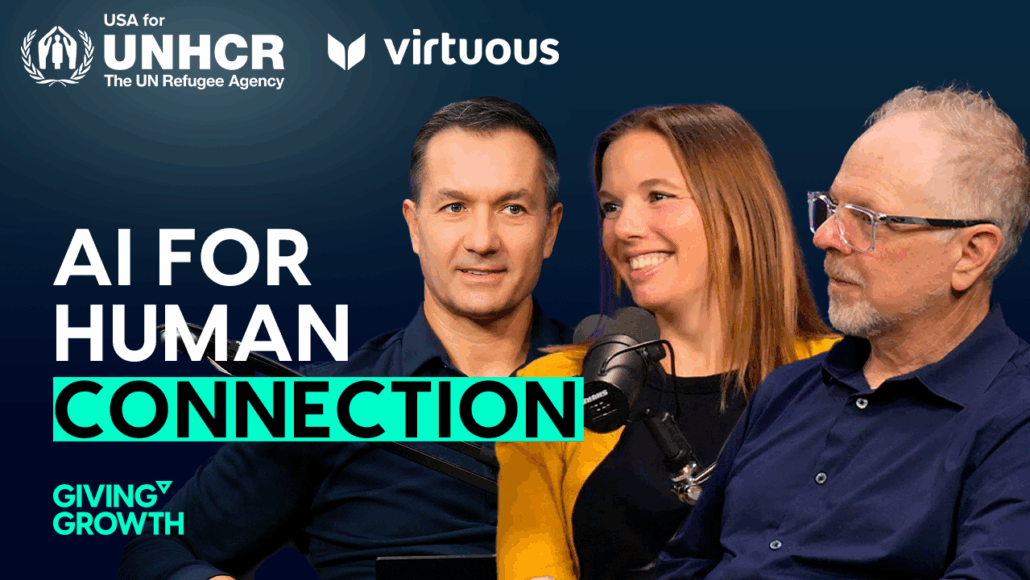
In this episode of the Giving Growth Podcast, Greg Sobiech sits down with Lacey Stone, Chief Development Officer at USA for UNHCR, and Nathan Chappell, Chief AI Officer at Virtuous and co-founder of Fundraising.AI, to explore how non-profits can move beyond segmentation and embrace an AI-first approach to donor engagement.
Lacey shares how USA for UNHCR responded to the Ukraine crisis by welcoming 100,000 new donors and rethinking donor journeys — treating even small-dollar donors with the same care as major givers. She explains how listening, trust, and authentic stewardship are at the heart of retention and long-term loyalty.
Nathan brings his expertise in AI for social good, unpacking how predictive modeling and personalization can help charities build deeper donor relationships. He emphasizes why listening at scale, starting small, and creating a culture of curiosity are essential for successful AI adoption.
Together, they explore:
- What it really means to go “beyond segmentation” in fundraising
- How USA for UNHCR transformed an influx of emergency donors into long-term supporters
- Why listening to donors is often more powerful than traditional segmentation
- How nonprofits can use AI to prioritize limited staff time and deepen relationships
- Why 70% of AI initiatives fail and the cultural shifts needed to prevent it
- The small, consistent steps nonprofits can take today to move toward true personalization
EPISODE TRANSCRIPT
Giving Growth Podcast – Webinar with Lacey Stone and Nathan Chappell, hosted by Greg Sobiech (full transcript)
Brought to you by Delve Deeper: https://delvedeeper.com/
Greg Sobiech
Well, here we are, thank you for joining me, guys. So we’re talking today about beyond segmentation and how we can be AI-first when it comes to really maximizing donor engagement, but maybe do me a favor and share a bit about yourself.
I mean, Lacey, you’re with USA for UNHCR, you’re the chief development officer, and I’m really impressed by how you and your organization is truly on the forefront of reimagining what it is to do donor engagement. Can you just share a couple words about yourself?
Lacey Stone
Yeah, absolutely. So thanks again for having me. My name is Lacey and I serve as our chief development officer at USA for UNHCR, the UN Refugee Agency. I’m based here in Seattle, but we are a global organization working in over 136 countries around the world.
And I lead our fundraising division here in the United States, working with the private sector to mobilize resources, raise awareness, and promote refugee causes for the UN Refugee Agency.
Greg Sobiech
And I also have Nathan Chappell. Nathan, you are the author of Nonprofit AI, co-founder of Fundraising AI.
You are the chief AI officer at Virtuous. I look at you as an expert in how organizations can harness AI for social good.
Couple words about yourself.
Nathan Chappell
Yeah. I wonder where you got that idea.
I think I have the letters AI in a lot of things I do. You know, to be honest, though, I actually consider myself, you know, a 20-year accidental fundraiser. So while I’ve been focused on AI since 2017, I spent 20 years leading nonprofit organizations and, you know, wearing all the hats, doing all the things.
And really me, my work in AI only started because my 20 years of fundraising, my job never got easier. And I kind of wrestled with that. Yeah.
It’s been an amazing path. And now I get to hang out with cool people like you. And I mean, I think Lacey has the coolest name, by the way.
Like if I think about like anyone like is going to save the world, Lacey Stone saves the world. So.
Lacey Stone
Well, let me tell you, my middle name is Chanel. So Lacey Chanel Stone only
Nathan Chappell
Saves the world. Yeah. So yeah. No, it’s really fun to be here, Greg.
And I, you know, thanks for bringing us in person. I mean, we flew from, you know, you were here, but like we flew to see you.
But to be in person, I think just we’ve we’ve been able to have lots of conversations and talk about our experiences and how they come together. And I just thank you for bringing us together.
Greg Sobiech
Well, thank you for being here. And my name is Greg Sobiech. I’m the founder and CEO of Delve Deeper.
Also host of a charity focused podcast called Giving Growth. And I love talking to people in the industry. These conversations, what I do on the podcast really helps me understand how I need to view the world through the eyes of the people who are actually in charities, actually doing the work.
And that way we can create more value together. We can actually create more impact together. So that’s really why I’m here.
I’m here to both understand what you both are seeing. And then I hope that the audience will walk away with one thing. If whoever is online right now, if you walk away with one thing that you can take to your organization tomorrow and actually implement, in some way that would make me really happy.
That would give me some joy. Now, we are going to talk about really two topics. One is this idea of small, consistent steps.
What can we do that doesn’t require any money, doesn’t require any technology, but what steps can get us closer to actually understanding donors’ needs? What really matters to them the most? And that’s where I’m going to plug in you, Lacey.
And we’ll also talk about AI and how AI is used at USA for UNHCR. And also what you’ve seen, Nathan. And that obviously requires a little bit more technology and maybe there’s a bit of an investment needed.
But you’ve made really compelling arguments over breakfast this morning that it starts with creativity. But I do want to start with how do we even come together? Why are we even here?
So I remember early in the summer, I interviewed both of you on Giving Growth and I really liked just the interaction. I felt like we had a really good time together. It felt very natural.
And I realized that what you were doing, Lacey, at USA for UNHCR was very special. I haven’t heard many charity leaders speak about the work they do this way. And I’ve spoken to maybe 50 people so far over the last year.
And then, Nathan, you were just so and you are so full of energy and just clear ideas about how segmentation can be done and how AI can be used. So what makes this industry very special is the great people that have really awesome intentions. But we do struggle translating that willingness into impact and deeper relationships because, again, we’re under such pressure to deliver, to meet numbers that sometimes that kind of stands in the way of just having like real deep conversations.
Nathan Chappell
You know, and honestly, like our sector is at an inflection point right now where these conversations are not just nice to have, they’re needed. I mean, we’re facing a tectonic shift in how work gets done. The issues that we’re facing are not becoming less, right?
The world’s becoming more complex. The pace of everything is faster. So I think pausing for a few minutes, comparing notes, sharing best cases, sharing examples of things that we’ve mostly learned the hard way, I think is invaluable.
Greg Sobiech
Let’s try to use today as an opportunity to pause and to create value for the audience and the industry by sharing our perspectives and just tangible examples of what people who are listening to this and viewing this can do again tomorrow. I mean, we are in late August, right? Everyone’s gearing up for Giving Tuesday, for having a great December.
And I know that if I think about AI first and AI, that may feel like a 2026, 2027 initiative, right? Budgeting cycle. And actually, I think you both would argue, and you have, that it’s something that we can implement even by November and December.
Nathan Chappell
Yeah, that hurts my heart when you said that. I’m like, wait a minute.
Greg Sobiech
I really, well, many, look, many RFPs will be launched in March with a date of July 1st because of fiscal cycles, right? And it’s just kind of the way, like, I’m sure that those RFPs will have AI elements, right? And charities will be looking to do more with technology data, right? Media creative.
I would love for us to also argue that there are things we can do now, tomorrow, in three months. For sure.
We have five major segments we’ll go through. We’ll start by tailored donor journeys. And I, when I hear the word tailored donor journeys, by the way, I think of how addicted I am to consultees, big words, fancy, fancy language, which for someone who, whom English clearly is a second language is almost like a paradoxical thing to say.
But when I think about tailored donor journeys, I think about the work Lacey that you’ve done and your team and how you guys raised money when Ukraine happened. You had a hundred thousand new donors come in and you did something very pivotal. You decided to treat people who gave maybe 10, $20 a month as if they gave $10,000.
Sure. So can you walk us through what happened at that point three years ago? What challenge did this influx of donors cause for you guys?
Because it was good, but there was also, there was something challenging about the situation. And then how did you decide to lean into understanding these donors’ needs?
Lacey Stone
Absolutely.
So just to kind of set some context, right, in 2022, when Russia’s full-scale invasion of Ukraine started, in just those first two weeks, the context on the ground was unprecedented. And I know we use that word quite often, but to put some numbers behind it, right, in the first two weeks alone, you had 2 million people who had fled Ukraine to other countries. You had another 2 plus million people within the country who had been internally displaced.
And this is a country of about 44 million. So we’re talking about a tenth of the population in two weeks who was forced to flee. That is quite unprecedented.
And in those two weeks, UNHCR globally raised $200 million from the private sector. So this unprecedented emergency resulted in an unprecedented private sector response. And part of that unprecedented private sector response, I think, showed that there was such solidarity with refugees.
It showed the generosity that was behind, when I say private sector, I’m talking about individual philanthropists, corporations, foundations, individuals giving $5, $10, $100. And that support only grew as the months go on. So if you fast forward a few months, you’re right.
We reached 100,000 new donors, mostly one-off, one-time donors. So these are not recurring donors. These are not people who are even familiar with USA for UNHCR in the past.
And so what an amazing opportunity for us to be able to bring them into the fold, to learn more about the work that UNHCR does beyond emergency response, which is historically how we would have treated all of those new donors, right? You have an emergency response. And the goal typically is that you then convert those emergency donors into long time, long standing partners by introducing them to the other parts of the work.
And when we brought these 100,000 new donors in, one of the biggest challenges is that we did not have the staffing structure, the infrastructure internally, the systems to appropriately steward and provide meaningful engagement opportunities for these donors to be able to get excited about the work that UNHCR does, to learn more. We were in emergency response mode for quite some time. And so with those 100,000 new donors, you have 100,000 new opportunities for retention.
You have 100,000 new opportunities to learn about what motivates this donor. What was compelling for this supporter to choose UNHCR above all other organizations? And why would they want to stay with us?
And so one of the first things we realized is we don’t have the right systems. We don’t have the right infrastructure. And if we really want to retain these donors, we need to provide them with reasons to want to stay with us.
We need to provide them with reasons to trust us, to build loyalty. And that will take time. What we did is we looked at our internal fundraising program.
And what was nice is that because of this unprecedented response, and we were lacking in the systems, that kind of gave us the freedom and flexibility to say, well, what do we want this to look like? What could this look like in the future? And what’s the best system to be set up for success?
Not how it’s been done in the past, but what do we want to be in the future? And we built our fundraising team on that vision for what we wanted to be in the future. And part of that building included establishing and aligning and committing to shared goals for the entire development division.
So we have four total shared goals that everybody in the division can see their own work reflected in that. And then under our shared goals, we also have shared strategic priorities. So rather than what we had done previously, and when the donors came to us through the emergency response, rather than segmenting donors by the channel in which they came as a donor to USA for UNHCR, we thought instead, and I’ll say as an example, I might give digitally, right?
That does not mean that I’m not also receiving mail. It doesn’t mean that I’m not also going to meetings and webinars and interacting in different ways with charities that I support. And so why are we treating donors as though the channel in which they donate is the only channel in which we should communicate with them?
We thought that was a real opportunity for us to shift. And so under our strategic priorities, one of them is donor development. And that means that regardless of how a supporter comes to USA for UNHCR, one of our shared goals across the development division is to develop that donor along the entire journey with USA for UNHCR to understand what motivates them.
How do they think about UNHCR? What do they value? What compels them to give?
And then to build out through authentic stewardship, which is another of our strategic priorities, meaningful engagement opportunities, including, by the way, non-financial engagement opportunities to encourage those donors to build more loyalty, to learn more about our organization and ultimately to think about USA for UNHCR as their top charity of choice when they give. I know that doesn’t seem super radical, but to us, it was quite different to develop these strategic priorities and treat donors as human beings that are reached in an omni-channel way. They interact with the world in an omni-channel way.
So why should we only be engaging them through the modality in which they decided to make that donation that day?
Greg Sobiech
You know, I have a, you know, business coach and I’ve learned a lot from him and just from reading. And there is this phrase to know and not to do is not to know.
And it applies to all areas of our life. So I totally agree with you that just because moving away from channels and towards audiences, and that’s a thing in the industry right now. It’s been for a while.
We all talk about moving away from, I belong to this program or I belong to this channel. And we know all intuitively know that we should be looking at donors as segments. And yet, honestly, that’s not often done.
I think you’re here today because you are doing this. This is a testament that this is possible. But I love how the way that you lean into understanding donors needs.
It wasn’t expensive. No, you put these donors into logical segments. There were three segments and this was this happened about three years ago.
What were those segments and what did that focus on understanding donors needs imply for where you are today? How is this translating to your go to market strategy in terms of communication today?
Lacey Stone
Yeah.
So as we looked at, and we were very fortunate because we have an in-house innovation lab within USA for UNHCR that is in the data every single day. And it’s not just using data models, but it’s also doing donor sentiment surveys to specifically ask what compels you to give to USA for UNHCR. What’s the most important part of UNHCR’s work to you?
And we were able to distill three big themes from donor sentiment surveys and from the data that we had and the three segments that we were able to broadly identify that led to donor journeys and now initiatives or campaigns within our work. One was women in philanthropy, and that’s not just women, people who identify as women who are giving, rather it’s a program. And so the program is empowering and enabling female refugee scholars to continue their education.
So it’s a higher education program. It started as a few women giving very generously and it has expanded and continues to expand. So we have this women in philanthropy segment and then we also have faith based donors.
And that includes both organizational and individual. And again, this was identified based on those donor sentiment surveys. We ask every donor when they make a donation online at the end, what are the values that you align with?
What made you decide to donate? And so many of our supporters cited in the free form text something about their faith has compelled them to give to UNHCR. So that was the second segment.
And then third was emergency. And I know what I said at the beginning, which is, you know, you have these emergency donors. How do you then make sure that you’re bringing them into the full fold of UNHCR’s work and not just keeping them in that one emergency?
But instead, we thought, well, what if we embrace the fact that these individuals are wanting to support an emergency situation rather than saying you came through an emergency. Now I have to move you through a specific predefined journey where I now need you to really be motivated and compelled about education or livelihoods or whatever it may be. Why don’t we really lean into the fact that because this is an emergency situation, because you are compelled that UNHCR activates within 72 hours of an emergency, because you are compelled that we are leading the charge when it comes to camp coordination, management, protection, shelter.
Let’s lean into that, embrace it and allow donors to have the opportunity to learn more about how we work in emergency situations rather than trying to fit you into a box that you weren’t necessarily interested in in the first place.
Greg Sobiech
So what I find fascinating about this example is how beautifully basic it is. I think the word survey, right, stands out.
And I really want to like double click into this word because obviously there’s pressure to raise money. I think there is lack of permission in the industry to waste the communication. I think it’s often positioned as why would I waste the communication and email or, you know, interaction online to ask about what the donor needs?
I think that’s real personally. I think what’s also real is that this reflects lack of passion to understand donors needs. And I want to bring you, Nathan, and talk about why that’s happening.
But before we just do that, the fact that USA for UNHCR has a culture and we’ll talk about this in a second, where your team has the permission, but also like the level of awareness to ask donors about why do you actually donate? What does it do for you? We talk about pulling heartstrings.
I think it’s a little aspirational as a term. Like, I get it. And my father died of leukemia, right?
I donate to Leukemia and Lymphoma Society. My heartstring is boys and girls who don’t have parents. I don’t know that I care about, honestly, research as much as I care.
And I do, of course I do. But I care about a boy and a girl who lost their parents when they were six years old, like I was. Yeah.
So that’s my heartstring. But there’s a deeper need behind that, that one can express as a charity to their donor. And I think you guys are doing that.
Lacey Stone
Thank you. I happen to agree. And I think it goes beyond the survey of, you know, why did you give to UNHCR? Yes, that is one of the questions. But also we talk about the values alignment. And so trust continually comes up.
Greg Sobiech
Can you give me an example of a question? Do you remember a question that you guys ask?
Lacey Stone
Yeah. And so we do send a targeted survey in addition to the survey after each donation. And so in the targeted survey, it’s a longer form of questions. And one of the questions is around which of these, and you choose, drop down, which of these is most important to you when you decide which charitable organizations you support.
And overwhelmingly, whether it’s institutions, organizational institutions or individuals, we learned that the majority of our donors who responded choose to support us because they find us to be trustworthy. They trust us. And so knowing that, knowing that they choose us because they trust us, how do we lean into that and make sure we can build that?
Greg Sobiech
I mean, that impacts how you communicate.
Lacey Stone
Exactly.
Greg Sobiech
So Nathan, question for you.
20 years ago, even 10 years ago, even five years ago, if I wanted to do what Lacey is speaking about, I would probably spend X thousand dollars and I would go and hire a research company to make sure that I am, you know, coming up with unbiased questions that don’t ask leading questions. And I feel like that’s no longer needed. Why do organizations struggle with change management?
In your book, you talk a lot about the fact that there are many things that organizations get right and many things that they get wrong. Can you share some examples of what you discovered? We have your book right here.
What are you hearing in the industry?
Nathan Chappell
I mean, there’s just so much to unpack there. You know, when I think about Lacey’s story of, you know, first listening and then responding, I mean, I think that at the fundamental level, that’s what our sector has really been challenged to do. And it’s largely, and to pass to your point, that type of experience is very expensive.
Right. And, you know, the area of persona development, you know, where back when I was at a cancer hospital, we’d hired a very large consulting firm to charge us, you know, several hundred thousand dollars to come up with personas. And at the end of the day, I felt it was kind of like witchcraft.
It was like, there was no real basis for it and there was no way for me to actually put it into action. And so it was like, yeah, I understood that we had different categories of people that approached us or oriented with us in different ways, but it wasn’t really actionable. And, you know, fast forward from 2017 to now, like we’re talking like this like massive shift in our ability to understand donors at an individual level.
Right. And not something where, yes, I mean, having, you know, you have the lab and you can, you have people that are looking at this data and they’re actually, you know, doing surveys and then responding to the surveys. But, you know, what AI and more modern AI has really allowed organizations to do is, you know, those that can afford to do that can do this now at scale.
I think, though, it has to start with a desire to want to know, right? Because I think fundraising for so long, you know, I got into fundraising in 2000 where it was highly related, almost entirely relational. I didn’t have a CRM.
I had a Rolodex. And the value of my contribution to our organization was how many people would say yes to having lunch with me in my Rolodex. And somehow throughout 20 years of me fundraising, we moved into just this like complete numbers game and it was just like winning, winning the game, you know, just like, you know, but not listening.
It was very, you know, just throwing things out there. I think the desire to listen, because there’s so much data. I mean, you already shared examples, the desire to like understand what’s your orientation around nonprofits at all.
And then how do you make a decision on why you would come? But then you also mentioned like donor surveys. So like how few organizations actually, when you make a gift, you know, actually want to know, like, did this satisfy your need to partner with us or like what could we have done better?
And so I think one is the desire to like want to know. And then the second is to really understand that we have technology today that lets us not look at donors and prospects, but as individuals that have a varying degree of connection to you. And that degree of connection will change continuously.
And so we started modeling this in 2017 with Predictive AI, realizing that, you know, when we started building our first model with AI, we realized like, oh my gosh, like we’ll never be done. Like this model will continue to get better and better and better. And we moved away from this idea of donors and prospects to what we stole from healthcare, which is the idea of N of 1.
Like the N of 1 in a clinical trial would be that every single person is treated individually based on their own DNA and their genotype. And so in cancer treatment, we wouldn’t just prescribe you a general type of disease. We’d just prescribe a certain drug to you because it may help you and it may hurt someone else, the exact same drug.
And so we started thinking about this idea of precision philanthropy and this idea of like every person’s an N of 1. You can only do that if you listen, right? And so if you’re listening and you’re setting these mechanisms up to like survey people in advance, communicate, listen for those signals, get back, and then respond in ways that feel intimate, right?
That feel like, okay, this is satisfying my primal desire to be engaged with you. Because I care about emergencies or I care about, you know, people separated from their children, or I care about whatever, because it aligns with my faith. Only then I think nonprofit can break through the barrier of treating people transactionally.
So we have a lot to figure out in the new world of fundraising and AI. I’m super bullish on the idea that we can move away from this like broad swath of like just treat people as one or two types of cohorts and getting to a point very soon where, you know, every fundraising strategy is segmented, like micro-segmented to the N of 1.
Lacey Stone
Can I chime in on that?
Greg Sobiech
I saw you take notes and I was going to ask you to chime in. So yes, you may.
Lacey Stone
So I love what you just said, and it’s the word listen, because one of the strategic priorities that we identified when we were saying these are our shared goals, these are our shared priorities, one is transformational relational fundraising, which is very different from transactional. And the reason I wrote listen down and underlined it is because when I think about transformational relational fundraising, the word is relational. It’s a relationship.
And in any relationship, you want that relationship to be nourished. You want that relationship to be nurtured, to be cared for. You want to put your best foot forward and you want to make sure in a successful relationship, you want that person to do the same and to listen and to understand one another.
And it’s not to say that it’s always perfect. It’s not to say there aren’t things that we could all improve and do better. Those are the things we should be sharing with one another, including in the nonprofit industry.
And it’s something we talked about earlier. But when something is working, we should be sharing that as great impact. We want you to know that your donation was able to help us make this outstanding impact.
And when we don’t get it right, we should also be sharing that because in a true relationship, we should be able to have that transparency, which should help to then build trust.
Nathan Chappell
Yeah, I think to the change management portion of all that is actually the desire for change, right? Moving from transactional to relational fundraising is where our sector, I think the pendulum has swung super far, super far to transactional. And it’s because we got enamored with technology and the ability of, you know, kind of winning the game.
And donors have spoken. I mean, donors like, I mean, trends in charitable giving are not favorable in terms of total dollars, which, you know, we shouldn’t really only look at. We should look at the number of people participating in any civic engagement.
Those numbers have been dwindling. And it’s because we’ve treated donors like ATMs. But I do think that pendulum has swung so far that it’s moving back. Reality is the data is there.
Like the data is there. And the great part is that if it’s not there, you can create it. Like you can curate data by listening and then responding.
And I mean, that’s at the core of what, you know, where I work at Virtuous is like, it’s literally considered a responsive network. So it’s like listening and then responding. And it’s just like end of one kind of idea.
Greg Sobiech
I remember in your book, and we spoke about this on the Giving Girl podcast, I think you had a statistic, I hope I don’t butcher it, that back in the year 2000, I want to say 68 percent or 70 percent of all the households donated.
[Speaker 2]
Yeah.
Greg Sobiech
By 2018, this went down to 50 percent.
[Speaker 2]
Yeah.
Greg Sobiech
Did I get those numbers right, more or less?
Nathan Chappell
Yeah. 66 percent in 2000, 46.8 percent now.
Greg Sobiech
There we go.
Nathan Chappell
Yeah. So givers are the minority.
Greg Sobiech
And the latest Giving USA report, I think this is the fourth year in a row where count of donors is going down.
Nathan Chappell
Yeah.
Greg Sobiech
You know, giving is going up. I think it’s because more people, there’s a generational wealth transfer happening right now. They’re in the midst of, and this is just boomers, it’s also Gen X increasingly.
So we are relying on a smaller count of donors to give more.
Nathan Chappell
Right.
Greg Sobiech
Which also means we are pushed to care about mid and major more than mass donors. Right. But, but the thing that really stands out for me is that there are things that we can control in life and there are things that we can’t control.
And I know that I’m not saying anything that we, none of us has, hasn’t heard before, but what we, I believe can control is to listen better, to lean into those needs better. And yet Nathan, again, that sounds great. But from a change management perspective, you wrote in the book, which is right here, 70% of AI transformation efforts fail primarily due to poor change management practices.
Like what does this mean in reality? Why, why does 70% of these kinds of projects fail? Obviously what Lacey is talking about isn’t, you don’t need AI to do a survey.
Nathan Chappell
Right.
Greg Sobiech
And yet it’s a foundation to train the model that will be AI first. Why, why, why aren’t more organizations doing what Lacey is doing and actually leaning into AI projects?
Nathan Chappell
Yeah, it really comes, you know, it’s a cultural issue, right? I mean, at the end of the day, when we talk about success or failure of, of AI, 70% has nothing to do with data or models. It has to do with people and culture.
And so, you know, I was able to, you know, the last number of years implement, you know, custom predictive AI solutions for lots of large, you know, nonprofits throughout the country. And, you know, when I stepped back and, and really dissected like why some were like thriving in this and some were not, they all had the same treatment. Like they all the same, you know, relatively like the same, the way you set up a predictive model is like identify a target, you use first party data and third party data, you aggregate it, you all the thing.
The process is exactly the same for every single one, even though their data is unique. And then when I really stepped back, I mean, like, why are some just super challenged and some are thriving? And it was, it wasn’t because of the data or models because they, those that changed the way they worked or the way they thought.
And so I think that’s where we have to break free from like what we’ve tried in the past. Like my, one of my least favorite sentiments are like, well, we’ve always done it that way. It’s like the worst, like in the age of AI, right?
It’s like the worst, if that’s just like, you know, just go take the rest of the day off and like come back. And when you rethink that, that phrase, I mean, the reality is like, like just because we tried it that way and it didn’t work or that’s the way we’ve always done it, no longer apply. And I, you know, and I think about like the idea of best practices, also not my favorite word, because I don’t think there really are best practices.
I think there are just better practices, but we should always be striving. But any quote unquote best practice that a nonprofit had before November 30th, 2022 was the day that Chat GPT came out is outdated, like entirely straight up. No, you know, it’s outdated.
And now we live in this opportunity to rethink everything. And so I see some organizations like UNHCR is like, like really taking some really bold steps to just imagine the possible. And that’s what our sector needs desperately.
I think it’s why UNHCR is kind of like this lighthouse, you know, on the hill and be like, hey, you know, there’s another way. And I get so excited about that. I feel like a lot of organizations are just, they’re fearful of change.
They have not built a culture of change. They either have leaders that are just trying to punch the clock until they retire and they don’t want to learn quote unquote something new. And I think the challenge is they think that they have to learn something technical.
And we think about change management around AI, very little of it has anything to do with, you know, technical ability. A few key words, like you can impress your friends at a dinner party and talk about predictive AI or generative AI or agentic AI. But I mean, you can learn those words in 15 minutes.
It really has to do with how we hire, how we reward and how we incentivize curiosity within organizations. And so I see why, you know, in the Hive, you know, creating a space to showcase like how we think, you know, in a more curious way where it’s not about ROI immediately, but it’s about changing the way we think. And that’s, that’s what our sector needs desperately.
Greg Sobiech
So Lacey, why is it that Nathan is describing USA for UNHCR very nicely as a lighthouse, and you’re talking about Nathan, these cultural changes, they’re like a mindset. There’s some really wonderful things that are happening at the organization that I wish I heard more of from others. What makes you guys, I don’t want to say different, but unique?
Lacey Stone
I’ll answer in kind of two ways, because two things come to mind. I would answer it one way. But as I’m hearing you speak, something else comes to mind.
So, so first I’ll say I mentioned earlier, we do have our in-house innovation lab, the Hive. So having that in-house means that we have, you know, we have data scientists on staff, people who can visualize data, people who are experts in this area who know much more than I do about user research and donor sentiment surveys and data and analytics and how to do predictive modeling to help us as fundraisers to understand who is likely to give, when they are likely to give, how much they are likely to give, so we can put forward our best effort and essentially to make our fundraising efforts more effective, more strategic and more efficient. And we partner with them.
I mean, they’re our colleagues, but we partner with them in meaningful ways, constantly. We go to the Hive and say, this is the challenge we would like to solve. We would love your expertise.
And they say, OK, this is how long it’s going to take. We’re going to scope this out. And then they help us to solve it.
So that’s that’s one. And I do think that makes it unique. But I think something else that you mentioned, I think it’s important that we don’t conflate AI and innovation, because what we’re talking about is is specifically AI and how AI is something that organizations should be embracing and using and how can they use it most effectively.
I don’t think it’s necessarily that unique that USA for UNHCR is using AI or machine learning. Maybe it is, but I don’t think it’s that unique. What I think is more unique is that culturally we not only embrace innovation as a concept, it’s part of our strategic plan.
It’s part of the strategic plan in our expense budget that there is a portion of our budget that is used for innovation. And that means that culturally we have the freedom and the flexibility to try new things, to experiment and to learn. And that gives kind of permission at all levels of the organization that it’s not innovation is not just for the hive.
Innovation is not just for the team of data scientists. Innovation is for all of us. Innovation means thinking of a creative solution to a problem.
It means trying something new. And every person in every organization has the ability to be innovative, even if you’re not using AI and even if you’re not a data expert.
Nathan Chappell
I love that distinction. I think that’s so powerful. And, and, you know, I’m curious how that came about.
Like, is that always been the case or is it come from the very top and work down? Or is it just because you’ve hired a lot of curious people and that bubbled up organically?
Lacey Stone
Great question. So our strategic plan right now runs 2025 through 2030, and it’s part of that strategic plan. And it’s really been ingrained, I think, and embraced at all levels within our executive leadership group, including with our CEO.
But then it’s also from the ground up. There’s a hunger for it. There’s an appetite from staff who come with ideas and say, what if we tried this?
What if we tried this? And the response is typically, let’s make the case for support. Let’s weigh the pros and cons.
Let’s talk about what the value proposition is and what the ROI is. And my philosophy is if we if we can make a good enough case for support to prioritize this work, let’s try it. Let’s try it.
Nathan Chappell
It’s amazing.
Greg Sobiech
So if I just zoom out for a second, we spoke about first tailored journeys, and I really don’t maybe like that word because it sounds sounds very smart. What I’m hearing there is we need to have more permission to collect signals about the things that donors need most from us to do for them.
What motivates them, what their values are, what they value in their relationship with a charity. There is a famous study about jobs that we are hiring things for. So what is a job that that donor is hiring a charity for?
That may be to honor someone who is sick. It may be to, for me to have more meaning in my life. Again, my personal example is what would motivate me to donate to cancer organization is to help a little boy and little girl probably with mental health after losing a parent.
These are all very deep motivations that we can get at if we simply listen better. Like you guys said, if we ask more questions. So that was one.
And this is something very tangible that charities can implement tomorrow to learn about their donors in prep for Giving Tuesday, for example. Literally in two days, I can launch a survey and I can use ChatGPT to help me design that survey and probably will not be wrong. And there are many ways, right?
This can be text. This can be email. Other mechanisms can be thank you message.
I’m sure if I went to ChatGPT and asked, how can I do this? It will give me lots of great ideas or Gemini or any other platform. That’s number one.
Number two, we spoke about change management. Just the fact that it’s not about being super technical. It’s really about maybe curiosity.
It’s about permission to fail. I mean, I loved Lacey, your example. Again, I wish we could just spread the religion of USA for UNHCR.
And I’m using the word religion as faith, right? As an operating model with more organizations. Like you said, Nathan, 70% of projects that are transformational, including AI fail.
And it’s not about technology or data. It’s about people. And culture that we operate within.
This is a webinar about beyond segmentation and using AI in personalization. So I do want to shift gears to talking about specific examples. What are some, Nathan, maybe I can start with you, examples of initiatives or things that you would do if you wanted to lean on an AI more in a charity?
What, what would you recommend? We’re actually using AI besides just helping me write an email.
Nathan Chappell
Yeah, you know, I mean, it’s such a good question and I get the question a lot. And it’s also a really hard question because AI has now become everything and nothing. Right.
And so, you know, in the beginning, AI largely from 1955 until really about 2017, AI represented mostly, you know, this idea of taking lots of data and understanding it. So predictive AI. And it came to me, you know, Lacey, you actually talked about this, but the, there’s this, a quote from Aristotle who basically said, you know, the idea of giving away money is easy, but decide who to give it to, when, for what purpose, what way and how is really difficult.
And if any of those things get in the way, we just don’t get, right. Those are barriers that overcome. And it made me realize this in 2017, where we were starting to use predictive AI.
So predictive modeling to decide, it didn’t matter how much we asked for or when we asked or in what way, if it wasn’t the right person to begin with. So starting there, peeling back the onion, what I find for a lot of organizations is they try to quote unquote, boil the ocean with AI. It’s like, oh my gosh, like the board said we need to use AI or my boss said we need to use AI.
Let’s, everybody use AI. The reality is that it’s not a thoughtful and targeted approach. But I really encourage organizations, especially if they’re just starting in their AI journey, is to start small.
And to be honest, like really small, like start with like the highest yield, but low risk problem that you can find. The thing that’s just annoying, labor intensive, mundane, nobody wants to do it. You don’t have the staff to do it.
Start with that like single isolated case that’s like high yield, but low risk. And then when you’ve proven that, then take another step and another step and another step. When I see organizations do that, they’re beginning to build this like culture of innovation, if you will.
And like the acceptance of like, oh, we can try things differently. And then they’re starting to just expand their horizons on what’s possible. And so, in fact, there’s a study that came out two weeks ago by MIT showed that 95% of AI initiatives are failing and they’re not measuring them in the same ways.
But the reality is the 5% that were thriving, it’s because they actually, they didn’t try to do too many things. Like the organizations that just said we’re doing AI everything have like failed wildly.
Greg Sobiech
Well, there is actually a follow up study, I think that two thirds of these initiatives do succeed when to your point or very specific when one employs a small language model.
Nathan Chappell
Exactly. Right. Like find something very specific, you know, prove that out, make sure it works, make sure that there’s the change management around there, that people have accepted it, that this is not a one time thing, that this is just the way we operate.
Like the way Lacey is talking about how the idea of innovation was infused through everyone, no matter your role. That’s what you get when you start small and you kind of work outward. The lure for a lot of private entities was like, we’re going to be out of business if we don’t use AI, let’s use AI on everything.
And then to realize there’s just like no sticking power with that.
Greg Sobiech
I have on my desk this image and I gave this to my whole exec team and I also delve deeper. And I also, because I’m such a geek, gave this to my kids who are 10, 16, 22. So my 10 year old has this on her desk right now.
And I’m sure one day this will make sense to her. But the picture says small, consistent steps and it has a image of a staircase and then at the top, massive, massive output, right? Massive impact.
But Lacey, can you share examples of specific small, consistent steps that you guys have launched over the last several years where you are leaning on, you’re going beyond segmentation, you’re using data, you’re using AI. And it takes us towards personalization at some level.
Lacey Stone
Absolutely.
I think if we go back to the 100,000 new donors from Ukraine, right? So we have 100,000 new donors. Our entire fundraising team at the time was maybe 35 or so people.
I think our entire staff in the U.S. was around 50. Ideally, we would like to contact and personally speak to everybody to understand what were the motivations for giving, what made you decide to give to USA for UNHCR? Realistically and practically speaking, 35 staff are not able to reach out to 100,000 different donors.
And so one of the ways that we really leaned on and partnered with The Hive is through propensity modeling. So asking The Hive to help us to understand, with our limited staff resources, our desire is always to focus on that transformational, relational fundraising where it’s one-to-one. I want to understand why you gave that gift of $5,000.
I want to understand what motivated you to give. But how do we best prioritize our staff time to make sure that we’re making the most of that outreach and really maximizing those opportunities? And through propensity modeling, The Hive was able to help us to understand, OK, within this file of donors where we would categorize this mass group as either individual giving or mid-level giving.
So basically anything under $10,000. They were able to help us to model out within this huge, huge file. This portion are the folks that have the greatest likelihood to give again or to stay with UNHCR, to care about refugee issues.
This is where you should really prioritize your time as a fundraiser. And that sounds quite simple, but oh my gosh, to have that ability to because if we didn’t have that and how it started really was we would have fundraisers without that propensity modeling. Fundraisers would go into the CRM and say, I’ve got tens of thousands of donors that could be in my profile.
How do I choose? Where do I start? Who do I reach out to?
And it was just picking, picking and choosing. And until we had that propensity modeling to really bring the rigor and the discipline to say, this is where you prioritize your time. This is your list one.
And then when you’re done with this, then you move to you move to tier two and tier three and so on. But that propensity modeling who helped us to understand where we could prioritize our time was so helpful.
Greg Sobiech
So I want to unpack this.
And I’m sure, Nathan, you would say that it’s less about specific ideas. Sometimes it’s more about the mindset. And I get that.
But I love the specific idea. Are you using these models to influence digital, like just like social email, right? Search, display, but also with mid and major donors, with your fundraisers?
Give us more of a feel for how is this, how are these models and propensity modeling? It’s such a smart word. It’s a little intimidating.
What does this mean in practice?
Lacey Stone
Yeah. So I mentioned one of the segments being women in philanthropy, right?
And so the way this is actually working in practice, I’ll give a great example right now. The Women in Philanthropy initiative is focused on a program called Building Better Futures, which is, as I mentioned, a scholarship program for female refugee scholars around the world. And mostly so far, this has been a major giving effort.
So we are talking about individual philanthropists who are making large and meaningful commitments to this effort. Through propensity modeling, we are able to work with our IG file or individual giving file of digital and offline donors to be able to communicate about this Building Better Futures program, understand who is responding to whether it be an advertisement, an email, a survey, etc. And then we can use the propensity modeling to put them, those individual giving donors who may be giving, let’s say, $500 or $5,000, put them into the model to make sure they’re receiving a dedicated relationship manager who can talk to them specifically about the Building Better Futures to move them through that donor journey, who maybe you came to the organization because you saw a digital ad and you made that $500 donation. But through the sentiment surveys, through the propensity modeling process, we are then able to assign you a relationship manager and work you as a major gifts fund raiser would be able to build that relationship, build that trust and build that loyalty, because oftentimes those relationships take 12 to 18 months to build.
And so we have to be able to effectively prioritize the fundraiser’s time to know if we’re going to spend 12 to 18 months building a one to one relationship and we have 100,000 donors, who are the 30, who are the 40, who are most likely to be able to support this effort and have the capacity, the inclination to give. And that really, that really helps us to to be more effective and more strategic.
Greg Sobiech
Any other examples like boxes to check of initiatives where you’ve seen all this data and technology work pay off?
Lacey Stone
I’m not going to say it’s a checking of the box, but I will say a kind of a cool example, something that’s different and unique and new. Well, I might go on a bit of a tangent, so forgive me, but there’s a bit of background. So we do have what’s called the Refugee Innovation Fund or the Refugee Led Innovation Fund out of UNHCR headquarters, where essentially refugees, refugee led organizations and refugee groups are able to apply for small amounts of funding from UNHCR seed funding to get their innovative idea off the ground.
And with that, when you are awarded that, you receive peer support and kind of a whole suite of resources within UNHCR to build and then develop and grow these community led solutions. And they are proposed by individuals who are in the communities facing these challenges themselves. The Hive within USA for UNHCR was able to build a product.
They built what was called a marketplace to be able to showcase all of the different ideas that were being funded. So that way, our funders who were or prospects who are interested in innovation, which could seem like a very abstract topic or it could take on different meanings for different folks, we could concretely say here is a marketplace for you to go to to see all of the different projects that UNHCR is prioritizing and investing in on behalf of these refugee led organizations to find community driven solutions to the challenges in your backyard. And so I share that just as an example to say, you know, it’s it’s innovation, it’s AI, it’s product development, but it’s happening hand in glove with the people, the people who we are serving. None of this happens in a vacuum.
None of this happens, I think, effectively if we don’t keep that at the center and at the center of everything we do should be refugees themselves. And I think oftentimes that might get lost a little bit when we talk about AI and machine learning. Who is it actually for? Who does it benefit? And for us at the end of the day, yes, it benefits us to make good decisions and to be more effective and more strategic. But if it’s not benefiting refugees themselves, then I don’t think it’s worth it.
Greg Sobiech
And Nathan, I know that you actually go into organizations and you help them understand how they can systemically change their approach to using AI. What are some of the recommendations that you are providing to charities that maybe don’t require the hive? What are some sort of basic things that charities can do to be more AI first?
Nathan Chappell
Sure. Yeah. And I like the word innovation first, you know, because I think that because sometimes AI can be scary, but like just, you know, thinking about what a possible future is, you know, it, my answer would have totally been different a few years ago, whereas, you know, building models, deploying models, struggling to get adoption and providing lots of resources to help with adoption, to realize that didn’t matter how many resources we applied, if there wasn’t a change in the way that they were thinking, you know, at the end of the day, you know, when we think about, you know, what is the inherently human trait that we can bring to the table to support our organizations the most? And it’s our ability to wonder, right? It’s our ability to really think about things that haven’t been tried before.
And so, you know, my advice really for nonprofits, a lot, I mean, I do, you know, a few talks a week now on this idea of a culture of curiosity, because this is inherently human thing. AI will never be curious. I’m a firm believer that AI will never gain conscience.
Like true, it will be seemingly conscious, which I just wrote an article about yesterday. So check it out on LinkedIn. And there’s some stories from Frankenstein and how, you know, a technology wasn’t, you know, a being that like stood up at what it actually had feelings.
That was what was scary for people. Right. And so this idea that we’re going to increasingly be confronted with technology that seems conscious never will be, but it will never wonder on its own.
And in fact, it can only follow instructions. So what humans inherently bring to the table is our ability to wonder. And, you know, for me, thinking about from a leader perspective, the lowest barrier to helping your organization, you know, survive in the future, not survive, that sounds bad, thrive in the future is to create a culture of experimentation, create opportunities for people to fail, to fail fast, to color outside the lines, to break things.
And sometimes that’s as easy as literally, and we do this at Virtuous, but we’ve done this at, I see in other nonprofits that one chief development officer brought together people for what she calls failure days. And she’s like, you know, the first ride of every month is failure day. And everybody comes to the table with all the innovative things they tried that didn’t work.
Because what she found really quickly was that when people shared what didn’t work, either one of two things would happen. Either a person said this didn’t work and then I tried a new way, or they say this didn’t work and somebody else would came over and said, oh, I tried that and I tried a different way. And so that she was incentivizing this like entrepreneurial spirit within the organization through, you know, lessons of what wasn’t working.
And I think that is something that I think in the private sector is so, you know, highly rewarded. You know, this idea of failing fast, like trying new things, failing fast. And it’s like, you know, you just don’t want people to like continue to fail and fail the same things over and over again.
But you want them to like fail, adapt, try something new, fail again, adapt, try something new. We work in two week sprints at Virtuous. Like literally every two weeks is a new set of sprints that we try something new.
And if it fails, we only wasted two weeks. And so I think the nonprofit sector could really benefit from this idea, you know, to just create that culture that allows people, you know, to be curious and to really reward and incentivize that that ability within the organization.
Greg Sobiech
The only way that we learn is through failure, ultimately, and reflection on experience. And I love this idea of having a day a month where we can reflect on our failures, because in a way, as negative as that kind of sounds, we’re actually celebrating experimentation and we’re giving the team permission to do something different.
Now, I want to just talk about what’s next. Like what’s exciting to both of you when it comes to maybe tomorrow, right? Maybe next week or maybe in a year. Lacey, starting with you, what’s kind of in your future and in your organization’s future when it comes to like anything that comes to mind?
Lacey Stone
Well, it’s interesting because I’m not trying to avoid the question, but I think as you ask that and in the context of AI, right, what I’ve been reflecting on and thinking about is USA for UNHCR and The Hive, we don’t we don’t use AI because it’s the latest trend. We don’t use AI because it’s a cool, shiny tool. We use AI because ultimately it helps us to make better decisions.
It helps us to reach our donors more meaningfully. And it helps us to amplify refugee voices. And we are going to continue to focus on those things.
And we’re going to continue to use the tools and resources that are available to us to best do that work. And right now, AI is one of the tools available that helps us to do that work to our best ability and to stretch some of the existing staff resources to go farther and to be able to have more transparency with our donors, build more trust, build more loyalty. So if they’re in the future become better tools to be able to help us achieve our goals and fulfill our mission, then we are fully open to exploring what those may be.
But at the end of the day, our mission is to serve, empower and protect refugees.
Nathan Chappell
Yeah, so funny. I mean, so many of the words that you’re sharing are just like really hit here. I believe that using AI and AI just happens to be like the most profound innovation that we have.
So I’ll use those kind of interchangeably is now a moral imperative. Like our missions deserve it. Humanity deserves it.
It’s like having the Internet and choosing not to use it because there are some bad things on the Internet. And in all reality, like I believe it’s a moral imperative. I, you know, I leave this with like a tremendous amount of optimism because things that were not possible are now entirely plausible.
And the only thing holding us back is our imagination. And for too long, we’ve we’ve been focused in our little silos and doing our our thing the same way and expecting a different result. But there’s this opportunity right now for us to rethink everything we think and we know about fundraising.
So I really hope people rise to that opportunity because it’s so much fun and it’s a moral imperative like those don’t have to be mutually exclusive.
Lacey Stone
Fun and a moral imperative at the same time. How do you beat that?
Nathan Chappell
And get paid for it. Right. So it’s the best. Yeah.
Greg Sobiech
Nathan Chappell, Virtuous fundraising AI. Thank you so much for making the time to be here with me and Lacey in Seattle. And Lacey Stone, the Chief Development Officer USA for UNHCR.
You are part of an amazing culture. And I really wanted to have you here. And you’re literally in the center, right?
Because I really wish for more mission driven organizations to to maybe emulate what you guys have built. And I do think that if we brought that that mindset, maybe we would enable more donors to be motivated to donate. And, you know, we would win, donors win, the mission wins.
I mean, I think ultimately in life, it’s all about getting more value for each other. Right. And winning together.
Nathan Chappell
Yeah, absolutely.
Lacey Stone
Well, I think this was fun. So you did it. Thank you. This was great.
Nathan Chappell
You put the fun back in fundraising. Thank you, Greg.
Greg Sobiech
Loads of fun.
Nathan Chappell
Yeah, you solved it.
Greg Sobiech
That’s your next book, Nathan. I’m really serious. I challenge you.
Put more fun in fundraising. Let’s do that. Well, thank you both.
And thank you to the audience for participating. Thank you, Nathan. Thank you, Lacey. Thank you.